




























Are you thinking about accepting crypto payments and yet concerned about how much it might cost your business? You are not the only one. According to the latest report, the crypto payment gateway market is rapidly growing at a CAGR of 17.8% from 2025 to 2033, and by 2026, thousands of businesses worldwide will have adopted digital currency solutions for their operations. Because of faster transaction processing, lower transaction expenses, and increased customer demand for multiple payment methods, the crypto payments market will exceed $3.5 billion by 2030. Cryptocurrency payment gateways allow all businesses, from small online stores to huge corporations, to save money on payment processing fees when compared to traditional payment methods. Entrepreneurs should evaluate all the proverbial “actual” costs, which include transaction fees and installation charges, as well as any hidden costs that need to be paid.
In this blog, we will explain all the crypto payment gateway development cost and their associated costs to understand Blockchain payments, cryptocurrency transactions that match your business objectives.
What is a Crypto Payment Gateway?
A crypto payment gateway is a technology platform that enables merchants to accept, process, and receive payments in cryptocurrencies from customers. The payment gateway functions as a secure connection that links the buyer’s crypto wallet with the blockchain network and the merchant’s system. It performs multiple functions when a customer makes a cryptocurrency payment because it first verifies the transaction and then manages the blockchain confirmation process, while it either converts the crypto to fiat currency or directs the funds to the merchant’s chosen wallet or bank account. This allows businesses to accept digital assets through cryptocurrency payments, which operate with the same ease as traditional card payments while maintaining security throughout their payment processing.
A crypto payment gateway works in a simple flow: the customer or user pays with cryptocurrency from their wallet, the gateway instantly verifies the transaction on the Blockchain, and then settles the funds to the merchant, either in crypto or converted to fiat. Custodial gateways hold the funds temporarily and manage keys for convenience, while con-custodial gateways let merchants control their own private keys for maximum security and ownership.
Types of Crypto Payment Gateways
Different crypto payment gateway types offer different features, security levels, and pricing structures, which directly affect your total system implementation costs and ongoing operational expenses.
Custodial vs Non-Custodial Gateways
Businesses are likely to choose custodial cryptocurrency payment gateways as these gateways offer the advantage of managing user funds and private keys, which leads to significantly lower setup costs and enhanced usability. On the other hand, a crypto payment gateway needs to be very secure and will have to bear the cost of regulatory compliance.
Non-custodial gateways allow businesses to have complete control over funds and private keys in order to have better security and transparency. While non-custodial methods do cost more in terms of development and maintenance, they provide organizations with the opportunity to rely less on third-party services and gradually lower their risk of operational issues.
Single Cryptocurrency vs Multi-Crypto Support
A single cryptocurrency payment gateway is a platform that supports only one digital asset (e.g., Bitcoin or Ethereum), thus keeping the development and integration costs at a minimum. Multi-crypto payment gateways are platforms that support a number of different coins and tokens, thus making the development process more difficult and less straightforward. Having to work with multiple blockchains means you have to put in more work for additional wallet integrations, price feeds, and security layers, hence, a rise in the development and maintenance costs. These components create extra operational requirements, thereby increasing expenses, but at the same time can provide better flexibility and user reach of the payment.
Hosted vs Self-Hosted Solutions
A host of crypto payment gateway functions are handled by third-party companies at a significantly lower upfront cost and faster rollout. The payment gateway requires recurring payments, but users’ capabilities for changing the system remain very limited. Developing a self-hosted crypto payment solution means that you need to invest more money upfront for development, infrastructure, and security.
Such a solution provides you with absolute control over your business activities, but it results in higher costs, thus better business growth through scalability and financial savings in the long run.
These are some of the major types of crypto payment gateways available, and you can choose depending on your budget, security requirements, scalability objectives, and long-term business growth strategy.
Traditional Payment Gateways vs Crypto Payment Gateways
The comparison highlights how traditional payment gateways differ from crypto payment gateways in fees, speed, security, and global accessibility for modern businesses.
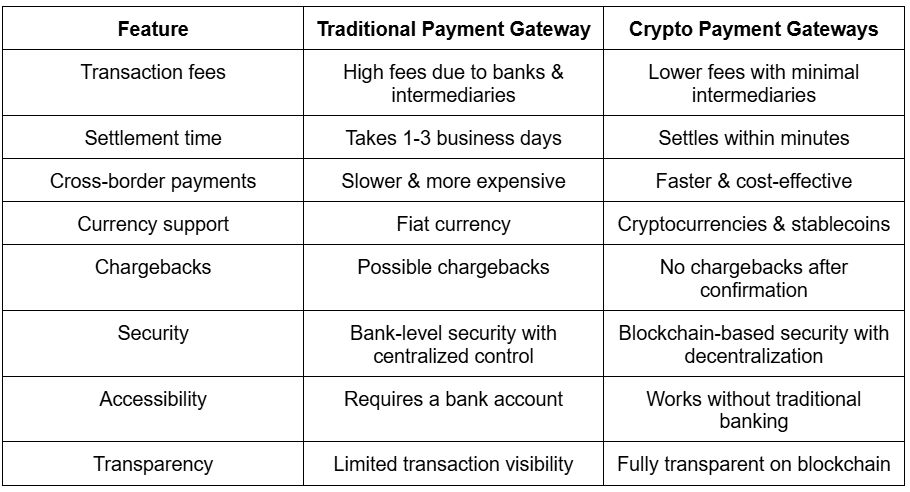
Thus, comparing both payment models helps businesses choose the right solutions based on transaction costs, settlement speed, customer reach, and future digital payment goals.
Core Features that Drive Crypto Payment Gateway Development Cost
Companies need to understand the technical features that affect the cost to build a crypto payment gateway. Your crypto payment gateway depends on its essential functions, which define the system capabilities and security requirements, and total implementation costs.
Wallet Integration & Multi-Crypto Support
Each cryptocurrency requires unique Blockchain integration and wallet connections, demanding separate coding, extensive testing protocols, and continuous maintenance that multiplies overall development time significantly.
Smart Contract Automation & Gas Optimization
Smart contracts automate payment processing without intermediaries, requiring specialized blockchain developers, while gas optimization reduces transaction fees through efficient coding, requiring advanced technical expertise.
Merchant Dashboard & Reporting Tools
User-friendly dashboard display features like analytics, dashboards, subscriptions, revenue, and cryptocurrency conversion rates, while custom reporting tools, subscription billing, and automated invoicing require substantial frontend development.
API for E-Commerce & POS Integrations
The integration affects the cost, as APIs connect your gateway with E-commerce platforms like Shopify, WooCommerce, and physical point-of-sale systems, requiring robust, secure endpoints for seamless third-party integration with extensive testing.
Hence, the implementation of these advanced features, including multi-wallet support, smart contracts, merchant dashboards, and API integrations, results in higher development costs, but it also improves system functionality, user experience, and future business expansion opportunities.
White-Label vs Custom vs Hybrid Crypto Payment Gateway Development
The comparison between white-label, custom, and hybrid crypto payment gateway development highlights cost efficiency, customization depth, ownership control, and time-to-market advantages. And by understanding these, one can choose which suits them the best.
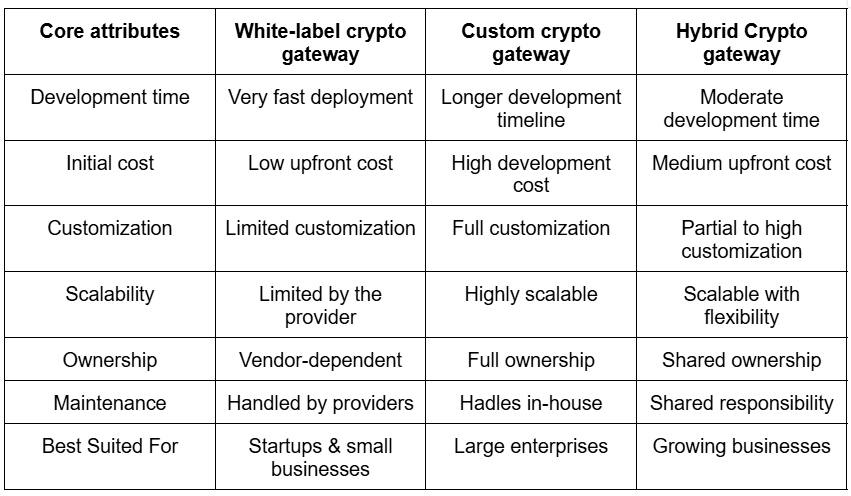
Selecting the right model defines your crypto payment gateway pricing, and it also helps businesses reduce cost, support growth, and deploy safe blockchain payment solutions aligned with long-term growth goals.
Key Factors That Affect Crypto Payment Gateway Development Cost
Now, let’s understand the key factors that affect the cost to create a crypto payment gateway and other business & technical elements.
Security and Compliance Considerations
The cost of crypto payment gateways increases largely because of security and compliance factors that require specialized tools, KYC and AML systems, data encryption, and regulatory requirements.
However, security measures are significantly improved when smart contract audits are performed, though it naturally leads to an increase in expenses. Because organizations must conform to both GDPR and PCI DSS regulations simultaneously, testing takes longer, legal assessments are more frequent, and as a result, all development and maintenance activities become costlier.
Supported Cryptocurrencies & Blockchain Networks
The cost of development stays minimal if the gateway supports only a single cryptocurrency, as less time is required for integration work by the developers. Having multiple wallet configurations and different price feed mechanisms, along with various blockchain operational procedures, increases the cost of a crypto payment gateway. In fact, integrating heavily used networks like Ethereum BSC and Solana is different because of the use of different protocols, smart contract systems, and transaction management methods, which cause additional testing requirements and more maintenance work in the future.
Feature Complexity & UI/UX Design
Simple crypto payment gateways typically have lower price tags as they come with fewer features and less complicated interfaces. It takes longer to develop special features such as an admin dashboard, a mobile application, recurring payments, and real-time analytics also require additional design resources. Custom user interfaces and a smooth user experience, deserving design research and testing activities, lead to higher production costs.
Development Team & Technology Stack
The development cost of a cryptocurrency payment gateway varies according to both the geographical location of its development team and the choice of its technological stack. Offshore teams for development are generally cheaper than onshore teams. It is important to separate the cost structures of backend developers from those of frontend and blockchain developers. The implementation of pre-built modules is beneficial for cost, cutting, and time saving, along with unique customization.
Scalability & Transaction Volume Requirements
High transaction volume gateways need more robust infrastructure systems inturn affecting the cost to build the gateway platform. Its price increases through the combination of cloud hosting services, load balancing solutions, and advanced server configurations. Organizations need to establish scalable systems, which enable them to handle traffic spikes, but this process demands strategic development, operational testing, and additional funding for infrastructure and monitoring system development.
This clarity allows crypto businesses or startups to make smarter choices when building a secure, flexible, and scalable crypto payment while keeping expenses under control.
Average Cost to Build a Crypto Payment Gateway
The average cost to build a crypto payment gateway depends on multiple factors such as feature complexity, development approach, and technical requirements. Basic payment gateways support one cryptocurrency, and essential payment processing functions need less funding and make them suitable for startups that want to test digital currency adoption. The mid-level solutions enable multiple cryptocurrency transactions, including Bitcoin and Ethereum, and stablecoins, with their merchant dashboard and reporting features, because they require advanced blockchain technology integration.
The enterprise-grade payment gateways require large financial investments because they include advanced compliance systems, KYC/AML solutions, and custom API development and unlimited system growth capabilities. The pricing of your development team depends on their geographic location because North American and European developers demand higher rates than Asian markets, which provide affordable development services. Hence, the total cost required to build a crypto payment gateway is also decided based on the maintenance costs for sustainable business growth.
Feature-Wise Cost to Create a Crypto Payment Gateway
Breaking down crypto payment gateway development costs by feature tiers helps businesses choose the right development package. Understanding basic, mid-level, and enterprise solutions ensures budget alignment with your specific requirements.
Basic Features
Essential Features form the core components of basic crypto payment gateways for users to process their transactions through one digital currency while making their first vital payments. This entry-level solution offers straightforward payment acceptance with minimal customization, typically supporting Bitcoin or Ethereum only. The gateway provides users with fundamental protection mechanisms through its SSL encryption and basic fraud detection systems. The basic package is perfect for small businesses and startups testing crypto payment adoption without heavy investment. The development process requires less time because the system needs only basic architectural components and essential connection points.
Mid-Level Features
Crypto payment gateways support multiple digital currencies, including Bitcoin, Ethereum, Litecoin, and USDT stablecoins. This tier includes comprehensive merchant dashboards featuring real-time transaction monitoring, revenue analytics, and automated reporting tools. Users can use automatic crypto-to-fiat conversion, payment button customization and basic API integrations for e-commerce platforms. It also includes two-factor authentication and advanced fraud detection methods. This solution suits growing businesses needing better control and visibility over cryptocurrency transactions.
Advanced/Enterprise Level Features
The Advanced/Enterprise package consists of three components: custom features, compliance solutions, and the capacity to handle extensive operations. The Enterprise-level crypto payment gateways provide complete custom solutions by combining advanced blockchain technology with support for all cryptocurrencies across different networks. The infrastructure achieves high scalability by processing thousands of simultaneous transactions through its load balancing and redundancy systems. The dedicated API development service provides you with complex integration solutions, white-label branding capabilities, and priority technical support. The combination of advanced smart contract automation, custom merchant tools, and enterprise-level security creates an optimal solution for large-scale business operations.
Your business size and your transaction volume, together with your customization requirements and your future needs for processing cryptocurrency payments, and your budget, determine which feature tier you should select.
Hidden & Recurring Costs that Impact Crypto Payment Gateway Development
The hidden costs that impact crypto payment gateway development result from active recurring costs and other indirect costs, which continue to affect operational budgets beyond their initial development stage.
Recurring Server and Cloud Costs
Cloud hosting and server infrastructure provide the necessary technology for crypto payment gateways with 24/7 availability and rapid processing capabilities. The monthly cloud expenses of the company grow as its transaction volume, storage requirements, backup needs, and scalability demands increase, which results in an ongoing operational cost.
Gas and Transaction Fees
Every crypto payment in the blockchain network process requires users to pay gas or transaction fees. Network demand determines fee fluctuations, which create direct effects on operational costs for high-volume gateways that manage multiple transactions across various blockchains.
Maintenance and Updates
The stability of crypto payment gateways depends on their regular maintenance and also to work on Blockchain updates. The ongoing costs of the project include bug fixing, performance enhancements, feature development, and support for new cryptocurrencies and protocol modifications.
Security Patches and Audits
Businesses need to conduct security updates and audits at regular intervals to safeguard both assets and customer information. The costs for testing vulnerabilities and auditing smart contracts, and implementing security patches, create ongoing expenses to help startups reduce their risk exposure and minimize system outages.
The process of identifying all types of costs needs to begin at an early stage because it enables businesses to establish sustainable operations for their crypto payment gateways without encountering financial or operational difficulties.
How to Reduce Crypto Payment Gateway Development Cost
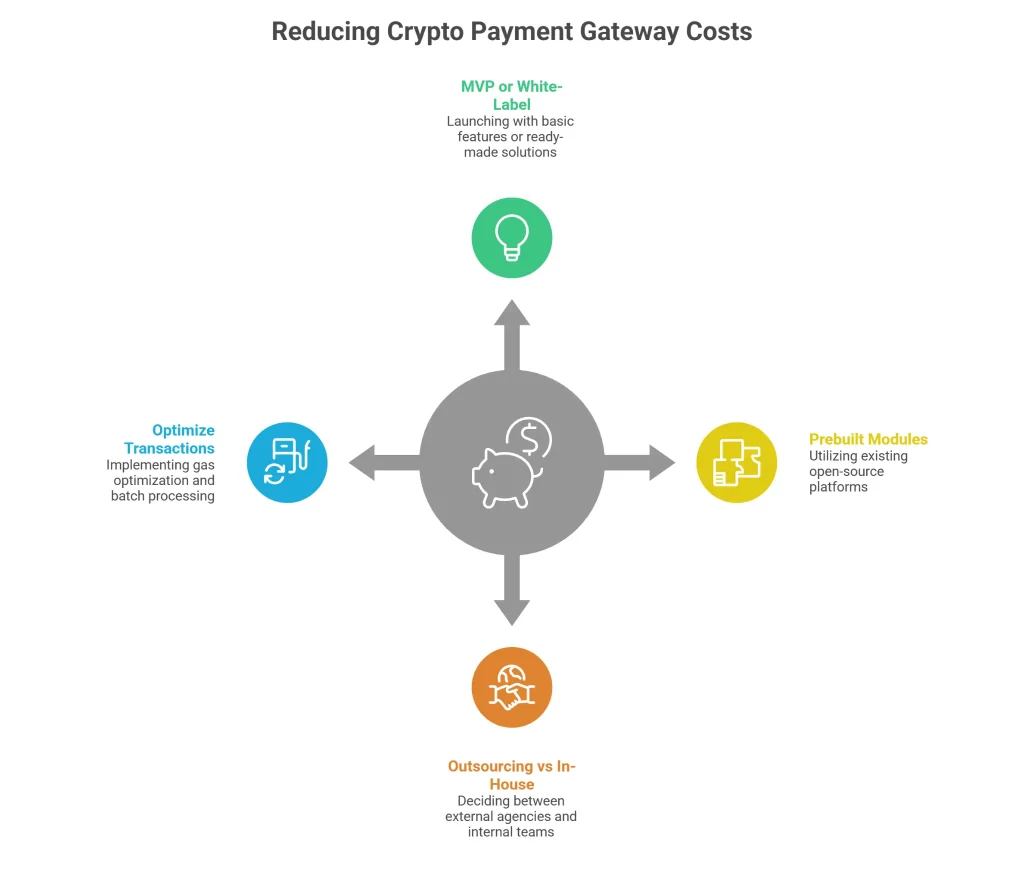
To reduce crypto payment gateway development cost, smart reduction strategies help businesses build functional crypto payment gateways without compromising quality. Implementing these proven methods minimizes expenses while maintaining security, scalability, and essential cryptocurrency payment features.
Start with MVP or White-Label First
The business should launch its essential product through a Minimum Viable Product, which includes basic payment functions to determine market interest before making significant investments in better product features. White-label solutions deliver ready-made cryptocurrency payment systems that businesses can personalize and brand as their own to achieve faster product development with lower upfront expenses.
Use Prebuilt Modules or Open-Source Frameworks
The team should use existing open-source platforms such as BTCPay Server and prebuilt payment modules to stop developing redundant features. The established frameworks deliver secure blockchain connections and wallet integration, and payment processing tools reduce development expenses while maintaining dependable cryptocurrency transaction processing and community backing.
Outsourcing vs In-House Trade-Offs
The business must assess its requirements for the upcoming years to decide between outsourcing work to blockchain development agencies and creating an internal development team. The company benefits from outsourcing because it cuts down on hiring expenses while delivering instant specialist knowledge, whereas in-house development allows more precise project management and continuous system updates for crypto payment gateway enhancements.
Optimize Blockchain Transactions
The business should implement gas optimization methods together with batch transaction processing to achieve lower operational expenses and better payment processing results. Smart contract optimization, cost-effective blockchain network selection, and a Layer 2 solution allow your crypto payment gateway to operate at reduced transaction costs.
Reducing crypto payment gateway development costs through MVP launches, open source tools, strategic outsourcing, and transaction optimization ensures budget-friendly development without sacrificing essential functionality.
Why Choose Cryptiecraft for Secure & Cost-Effective Crypto Payment Gateway Development
Cryptiecraft represents a new standard in crypto payment gateway development services, where uncompromising security meets genuine affordability. We engineer our solutions with institutional-level encryption, real non-custodial control, instant settlement capabilities, and merchant-first design principles that many providers still consider advanced features. As a top-tier crypto exchange software development company, we offer transparent pricing, rapid interaction, exceptional reliability, and a dedicated long-term partnership. We empower businesses to accept cryptocurrency confidently. Companies and startups select us because we consistently deliver what the market promises and frequently exceed it.
Frequently Asked Questions
Q1. How much does it cost to develop a crypto payment gateway?
Ans: The development expenses for a crypto payment gateway depend on its specific features, the blockchain systems it connects to, its required security measures, and its ability to handle future growth.
Q2. How long does it take to build a crypto payment gateway?
Ans: The timeline required to build a crypto payment gateway can take a few days to weeks, depending on the complexity of the project involved, multiple design stages, testing phases, and blockchain system connection work.
Q3. What factors most influence the cost of crypto payment gateway development?
Ans: The factors that influence the cost of crypto payment gateway development include compliance standards, the number of supported cryptocurrencies, the maximum transaction volume, the security system design, and the required system changes and maintenance activities after the system becomes operational.
Q4. What is the average cost range for basic, mid‑level, and enterprise crypto payment gateway solutions?
Ans: Basic crypto payment gateways cost between $1000 and $2500 because they handle essential functions, while mid-level solutions require $5000 to $15000 for their advanced features, and enterprise platforms need $30000 or more to meet their regulatory needs and growth requirements.
Q5. Which blockchain networks are most cost‑efficient to integrate for payment processing?
Ans: BSC, Polygon, and Solana are some of the Blockchain networks that provide a cost-effective way to integrate for payment processing, as these networks offer low transaction fees, fast processing times, and extensive developer support.
Q6. What is the difference in cost between custodial and non‑custodial crypto payment gateways?
Ans: The cost difference between custodial and non-custodial crypto payment gateways becomes lower than that of non-custodial design because custodial gateways need less initial investment, whereas non-custodial gateways require higher expenses because of the security impacts.
Q7. Does multi‑cryptocurrency support increase the crypto payment gateway development cost?
Ans: Yes, having multi-cryptocurrency support increases the development costs because it necessitates the implementation of additional blockchain systems and wallet management tools, the performance of testing procedures, and the creation of network compatibility updates.
Q8. Can you build a white-label crypto payment gateway for my business?
Ans: Yes, white-label crypto payment gateways can be delivered quickly, offering branded solutions, faster market entry, and lower development investment for businesses.
Q9. Can your company integrate blockchain networks like Ethereum, Solana, or BSC?
Ans: We can integrate Blockchain networks like Ethereum, Solana, or BSC and offer secure crypto payments, smart contract functionality, and scalable transaction processing.
Q10. Can your payment gateway handle high transaction volumes and scalable growth?
Ans: Yes, your payment gateway can handle multiple transactions simultaneously while growing because its design includes an expandable gateway to maintain performance, security, and transaction correctness throughout the expansion process.
Q11. Do you provide maintenance and updates after launch?
Ans: The company provides services for maintenance and software updates after the gateway has been released to customers, along with security updates, performance enhancements, and compatibility updates with evolving blockchain networks.
Q12. Can you integrate a crypto payment gateway with my existing website or e-commerce platform?
Ans: Yes, we can integrate it, and the process of connecting a cryptocurrency payment gateway to your current website and e-commerce system can be achieved through API and custom connector solutions, which enable businesses to maintain their ongoing operations.