






















The trading of digital assets has developed rapidly over the last decade. Both Centralized and decentralized platforms are important in the modern crypto ecosystem around the world. Although centralized exchanges offer high liquidity and easy-to-use interfaces, decentralized infrastructure is growing with the maturity of blockchain technology and the development of financial applications directly on the chain.
According to the CoinGecko market data, the volume of spot trading on decentralized exchanges reached $876.3 billion in Q2 2025. It is a growth of 25% on a quarterly basis, as on-chain trading activity continues to expand across multiple blockchain networks. The DEX-to-CEX trading ratio is at an all-time high as more users engage with DeFi protocols and self-custody wallets, according to the latest market report.
With the expansion of this ecosystem, startups and fintech developers are investing in decentralized exchange development to build safe and expandable trading platforms based on smart contracts. Nevertheless, the development of an effective decentralized exchange is not just a matter of launching a trading interface. It demands high liquidity architecture, secured smart contract systems, and optimized blockchain infrastructure.
This DEX Development guide discusses the entire process of creating a decentralized exchange, such as architecture design, liquidity strategies, security practices, and the cost of development.
What is Decentralized Exchange Development?
Decentralized exchange development is the process of building blockchain-based trading platforms where users swap digital assets directly through smart contracts, without depositing funds into a centralized custodian. A DEX handles pricing through automated market maker algorithms or order book logic, settling all transactions transparently on-chain with no intermediary controlling user funds.
A DEX development normally incorporates several basic components, including
- smart contract-based trading logic
- automated market maker algorithms
- liquidity pools that hold trading assets
- Web3 wallet integration for user access
- blockchain-based settlement and transaction records
Since every trade occurs through smart contracts, transactions are stored transparently on the blockchain.
For entrepreneurs and developers, DEX development is a blend of blockchain engineering, financial protocol design, and user interface development to build fully operational DeFi trading platforms.
Centralized vs Decentralized Exchange – A Quick Comparison
| Factor | Centralized Exchange (CEX) | Decentralized Exchange (DEX) |
| Custody | Exchange holds funds | User retains full custody |
| KYC / Compliance | Required | Optional at the protocol level |
| Liquidity Source | Order book + market makers | Liquidity pools + AMMs |
| Launch Speed | Moderate (regulatory) | Faster (smart contract deploy) |
| Revenue Model | Trading fees + listing fees | Protocol fees + token emissions |
How a Decentralized Exchange Platform Works
It is essential to understand the working mechanism of a decentralized exchange before planning to develop a DEX platform.
Smart Contract Trading
Every trade executed on a decentralized exchange is processed through smart contracts. These self-executable programs have predefined trading logic that will transfer assets automatically when specified conditions are satisfied. The smart contract interprets wallet balances, calculates pricing, and completes the trade directly on the chain.
Liquidity Pools
The foundation of DeFi exchange development is liquidity pools. Most decentralized exchanges rely on liquidity pools, instead of matching individual buyers and sellers. A liquidity pool refers to a smart contract containing a pair of tokens, such as ETH and USDC. The traders exchange assets against this pool, and the liquidity providers earn trading fees.
Automated Market Makers
Automated market maker models are used in the majority of decentralized exchanges. The prices of the assets are determined by an automated market maker using mathematical equations, depending on the reserves of tokens within liquidity pools. This removes the need for a traditional order book while ensuring continuous liquidity.
Wallet-Based Transactions
DEX platforms allow users to trade directly from their crypto wallets. Popular wallets used with decentralized exchanges include MetaMask and WalletConnect-compatible wallets. Wallet authentication replaces traditional account systems.
On Chain Settlement
All trades are completed on the blockchain network itself. This guarantees transparency as any transactions can be verified publicly.
Types of DEX
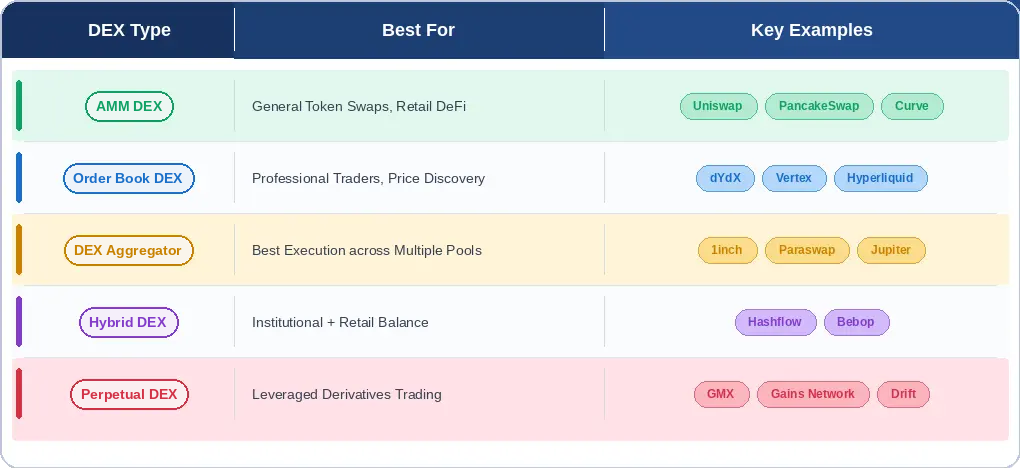
The type of DEX model that you adopt determines all the downstream technical and commercial decisions. Each architectures are addressed to different audiences, and they are associated with different engineering requirements. Choosing the right model is one of the most important decisions in Decentralized Exchange Development.
AMM DEX
The most commonly used architecture in DEX is automated market makers. Exchanges such as Uniswap and PancakeSwap operate based on liquidity pools, which have pricing equations. Its advantages include continuous liquidity, permissionless token listings, and simple trading mechanics. AMM Development is the most common entry point for new decentralized exchanges.
Order Book DEX
The order book exchanges are operating in the same way as the traditional financial market. Buy or sell orders are placed by the user, which are matched against other orders. The model provides accurate price discovery, but it needs a complex infrastructure. DEX architecture of order books is frequently used for derivatives and high-end professional trading systems.
DEX Aggregator
DEX aggregators send the trades to various decentralized exchanges to determine the most advantageous price. These platforms do not hold liquidity themselves. Instead, they examine several sources of liquidity and divide trades over pools to minimize slippage. The success of such projects as 1inch indicates the efficiency of the method.
Hybrid DEX
Hybrid decentralized exchanges are a type of exchange that integrates the capability of an order book with smart contract settlement. This model will enable faster trading interfaces without compromising the transparency of blockchain. Hybrid exchanges have gained popularity among institutional traders.
Perpetual DEX
Leveraged derivatives can be traded on perpetual DEX platforms. Such transactions require additional infrastructure, such as margin systems, funding rate mechanisms, and liquidation engines. The development of perpetual DEX is complicated compared to the AMM-based exchanges.
Key Technologies Used in DEX Development
The architecture defines whether your DEX is secure, scalable, and maintainable before you write frontend code. Each of the components below has design choices that increase in cost when reconsidered once deployed.
Smart Contract Layer
All trading logic on a DEX platform is regulated by smart contracts. They handle liquidity pools, determine the swap prices, and allocate the trading fees. It is necessary to ensure the smart contract development is secure since vulnerabilities have the potential to reveal user funds.
Blockchain Networks
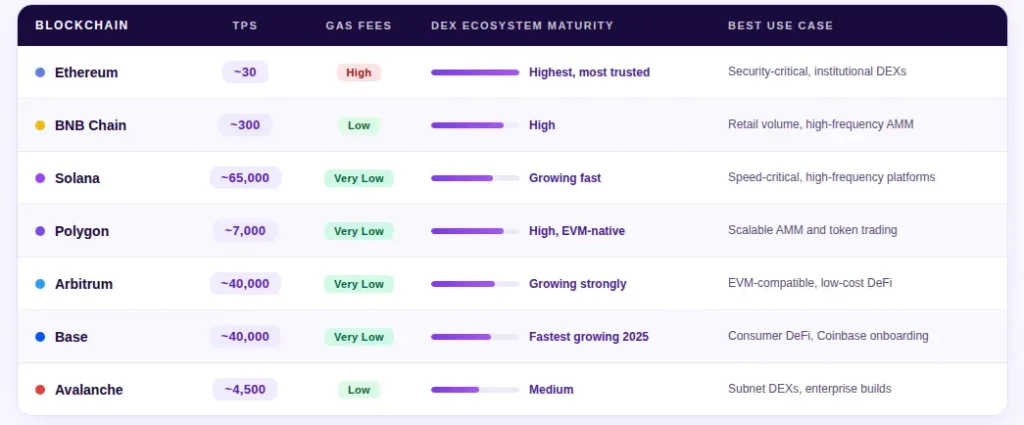
DEX platforms are supported by various blockchain networks, including Ethereum, BNB Chain, Solana, Polygon, and Arbitrum. Blockchain selection influences the cost and speed of transactions, as well as the liquidity of the ecosystem.
Web3 Wallet Integration
The integration of wallets allows users to integrate their crypto wallets with the trading interface. This enables trusted communication with smart contracts without centralized accounts.
Oracles
Smart contracts get real-world price information through oracles. Perpetual DEX systems are highly dependent on oracle networks to calculate funding rates and liquidations.
Indexing Infrastructure
The data on blockchains should be indexed for fast queries. Decentralized applications can use protocols such as The Graph to access trade data quickly.
AMM Pricing Mechanics
In the majority of decentralized exchanges, automated market makers set prices of tokens based on liquidity pool algorithms instead of traditional order books. The typical pricing formula applied in the development of DEX is the constant product formula.
x \cdot y = k
In this equation, x and y are token reserves, and k is kept constant. When a trade occurs, the ratio of tokens changes, automatically updating the prices and keeping the liquidity within the pool.
Key Features Every Competitive DEX Development Must Have
- Multi-wallet integration: MetaMask, WalletConnect 2.0, Phantom, Coinbase Wallet, and support for hardware wallets.
- Real-time price charts: Candlestick charts with volume information constructed using indexed subgraph data, not delayed API feeds.
- Slippage controls: Tolerance that can be adjusted by the user, and live price impact shown prior to each confirmation.
- LP position management: Proactive range monitoring, display of accrued fees, impermanent loss estimate, one-click rebalancing.
- Cross-chain swap routing: Built-in bridge functionality, so that users do not have to bridge manually before trading.
- Transaction history: Per-wallet swap history with on-chain explorer links to be fully transparent.
- Mobile-responsive interface: In 2025, mobile wallet users attracted 1.2 million new DEX participants.
- Fiat on-ramp: MoonPay or Transak will be integrated to ease the entry of people into crypto.
- Reference system: Fee-sharing referral mechanisms that transform satisfied users into acquisition channels.
Process to Develop a Decentralized Exchange Platform
Creating a decentralized exchange requires a several technical and strategic processes.
Define the Exchange Model
Developers have to decide the architecture of the platform, whether it is AMM, order book, or hybrid systems. All the models vary in terms of infrastructure requirements.
Choose the Blockchain Network
The choice of an appropriate blockchain is critical in terms of performance and access to liquidity. Ethereum is the most established DeFi protocol network. The second-layer networks have lower transaction costs.
Design Smart Contract Architecture
The interaction between liquidity pools, swap functions, and governance systems is defined by engineers. The vulnerabilities are minimized through careful architecture planning.
Develop DEX Smart Contracts
Trading logic is implemented by developers in programming languages like Solidity or Rust, depending on the blockchain network. Testing involves unit testing, fuzz testing, and simulation of extreme trading conditions.
Build the User Interface
The liquidity depth, price charts, and transaction status should be shown in the trading interface. User experience is the most significant factor in trader adoption.
Perform Security Audits
Smart contract audits are used to detect vulnerabilities, including reentrancy attacks or integer overflow bugs. The codebase is reviewed by professional security companies before deployment.
Launch Liquidity Programs
An emerging decentralized exchange needs adequate liquidity to attract traders. Early trading activity is frequently bootstrapped by liquidity mining programs and token incentives.
Choosing the Right Blockchain for Decentralized Exchange Development
Major Security Features of DEX Development
Security is not a stage that you can finish prior to launching. It is a discipline that flows across all design decisions since the initial architecture document through post-launch monitoring.
Reentrancy Prevention
Reentrancy attacks are based on the functions that utilize external calls prior to updating internal state and enable malicious contracts to recursively drain funds within a single transaction. The defense is the pattern of checks-effects-interactions, validating all conditions, updating all state variables, and then making external calls. OpenZeppelin implements this programmatically through the ReentrancyGuard modifier. Production DEX contracts are the type that requires the use of both the pattern and the modifier.
Flash Loan and Oracle Attack Defense
Flash loans enable opponents to borrow enormous amounts, manipulate pool ratios or governance balances within one transaction, and to repay it all before the block closes. The attack surface disappears with time-weighted average price oracles instead of spot prices in any calculation of values that an adversary may corrupt within a block. Introducing transaction-based limits on the size of the trade compared to the pool depth provides an additional layer of resistance against economic attacks that require large pool movements to execute.
MEV Protection
Sandwich attacks take advantage of DEX traders by front-running and back-running high-value transactions. By combining Flashbots Protect, or a private mempool service, Keeps a large number of trades out of the public mempool, where bots can mine the pending transaction queue for opportunities. Setting default slippage tolerance and showing clear price impact warnings prior to confirmation restricts the exploitable spread on any particular trade. On-chain MEV rebate mechanisms have now become feasible with Uniswap V4 hooks and redistribute captured MEV back to LPs instead of allowing it to flow entirely to external searchers.
Smart Contract Audit
Any intensive audit includes a manual code inspection, automated scanning with Slither and Mythril, economic attack modelling, and formal verification of key math functions. The complete report should be published publicly. Engage a second independent company to work on protocols dealing with over $5 million in user funds. Introduce a public bug bounty on Immunefi on the same day you go live on mainnet.
Liquidity Strategy of DEX Development
Liquidity is the product. An exchange that lacks deep and trustworthy pools delivers poor prices, frustrated traders, and a zero retention rate. The bootstrapping problem does not solve itself through engineering. It demands a proper commercial strategy that will operate simultaneously with the technical construction.
Protocol-Owned Liquidity
Protocol-owned liquidity is capital that is under the control of the protocol and implemented into its own pools. In contrast to externally-supplied liquidity of individual LPs, who may leave the market at any time, POL is a permanent depth floor. It absorbs volatility, provides a baseline trade execution in quiet periods, and generates a credibility signal to new liquidity providers considering whether to commit capital.
Liquidity Mining Design
Liquidity mining allocates protocol tokens to LPs in the form of a deposit reward. If done without a plan, it generates mercenary capital that exists whenever reward emissions are slow, leaving shallow pools and token sell pressure simultaneously.
Market Maker Partnerships
Professional market makers introduce in-depth, actively-managed liquidity and improved spreads. In the case of order book DEXs, this relationship is necessary. For AMM DEXs, it is becoming common practice for concentrations of liquidity positions to be managed actively by specialist companies instead of passive individual LPs. Such partnerships involve negotiation and, in many cases, token grants or fee-sharing arrangements, but the enhancement in trading quality delivered by them is measurable and has a direct impact on trader retention.
Tokenomics of Decentralized Exchange Development
Token design is one of the most leveraged decisions in DEX development. The wrong token model can burn your wallet, provide perverse rewards, and convert your most active early users into your largest sellers.
Governance Tokens
The majority of DEX protocols use governance tokens, which give holders voting rights to parameter changes like fee rates, new pool whitelisting, emissions schedules, and treasury allocations. The canonical examples are Uniswap’s UNI and Curve’s CRV. The problem lies in creating governance that’s actually participatory without being dominated by a small number of large holders. Snapshot-based off-chain voting is often economically preferable, although on-chain execution via Governor Bravo or OpenZeppelin Governor contracts is increasingly common for high-stakes decisions.
Vote Escrow Models (veTokenomics)
The vote escrow model developed by Curve in 2021, and since it has been the most popular tokenomic design of liquidity-centric DEXs. Tokens are locked by users (with up to 4 years in Curve’s case) to unlock veTokens, which get a higher governance weight and better distributions of fees. The reason why the mechanic works is that it aligns incentives, which means those people who have the greatest control over the direction of liquidity are also the most dedicated to the long-term health of the protocol. Both Velodrome on Optimism and Aerodrome on Base modified this model with significant enhancements to the efficiency of liquidity incentives.
Fee Distribution Architecture
In most DEXs, trading fees are distributed among liquidity providers, protocol treasury, and optionally token stakers. Uniswap V3 added a new concept of fee switch, where governance could reallocate a share of LP fees to the treasury, and it took three years and much discussion before a substantial vote could be approved. In case you are creating a DEX in 2026, the fee architecture choice must be made at the design phase, rather than post-launch. Retroactive changes must pass through governance votes, which are politically challenging and may undermine LP confidence.
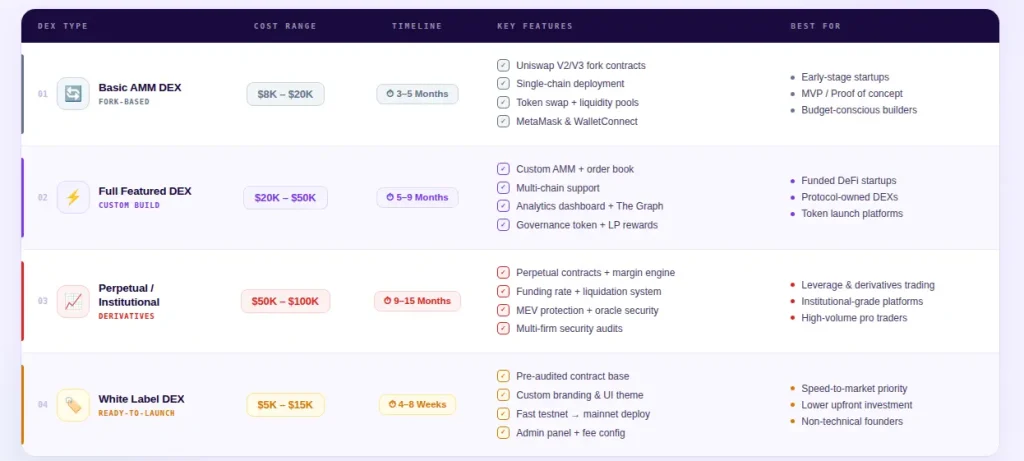
What does it cost to build a DEX in 2026?
Costs will vary based on the complexity of architecture, the number of supported chains, the position of the team and the extent of features.
A white-label decentralized exchange solution architecture deployed on standardized pre-audited contracts and a uniform frontend can be created within 4 to 8 weeks at a fraction of the cost of a full custom implementation to founders who emphasize minimizing time-to-market and initial cost.
Common Mistakes in DEX Development
Most of the DEX Development failures are not technical in nature. They are strategic decisions and should be made before the initial line of code, orelse that cause issues that are too expensive to rectify once it is launched.
- Skipping the audit to conserve time: Every Week of audit delay will cause your users to lie in the path of vulnerabilities. In 2023, the Euler Finance exploit caused the loss of more than $197 million in a single flash loan attack. A cost of audit will be a cheap compared to that consequence.
- Underestimation of the liquidity cold-start problem: A DEX without liquidity is not a product, but it is a smart contract with a UI. The majority of founders assume that traction precedes liquidity, but it rarely does. The liquidity strategy must be developed with the protocol, as opposed to after.
- Replicating Uniswap V2 without knowing its limitations: V2 is five years old. Its specialized liquidity structure (V3) and hooks framework of V4 are a consequence of many years of experience with that original structure. It will be a competitive disadvantage in 2026 to base the building on oudated AMM mechanics.
- Governance token that serves no purpose other than to vote: A token that is simply to vote is probable to sell. Distributing build fees, stake-to-earn mechanics, or access controls into the token model during pre-launch time, not as a V2 feature.
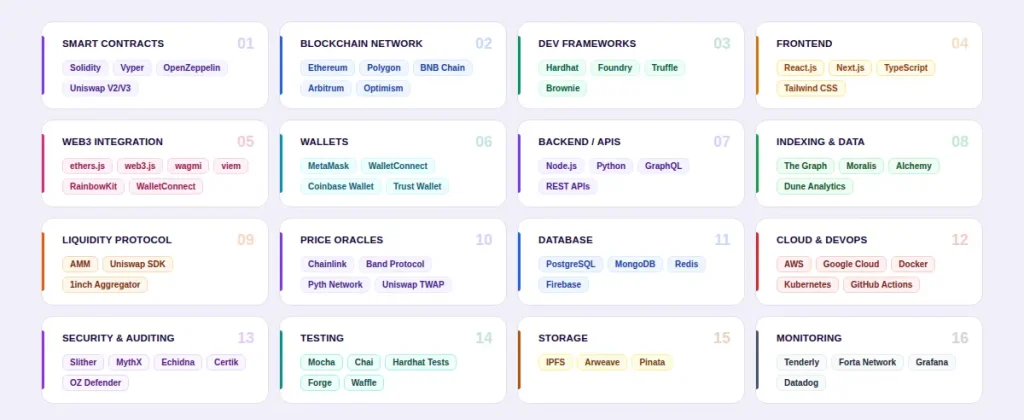
Tech Stack and Tools used to develop a DEX
Why Choose Cryptiecraft as Your Decentralized Exchange Development Company?
Creating a DEX platform requires more than just code; it requires a solid understanding of the protocols, battle-tested security, and a team that has deployed actual DeFi products. We, Cryptiecraft, a leading DEX Development Company, have more than 10 years of practical experience in blockchain development in Ethereum, Polygon, Solana, and more. All of our exchanges are designed to be fast, efficient in liquidity, and with integrity of smart contracts. We deal with the full stack, including AMM architecture, to custom liquidity pools and audit-ready contracts. Our customers prefer us because we simply do not create DEXs, but we assist them in launching products that the traders will trust.
Frequently Asked Questions
Q1. What is DEX Development?
Ans: The development of a decentralized exchange (DEX Development) is a procedure of developing a trading platform that will enable end-users to perform an actual trade of crypto assets using their wallets without the participation of a central authority. No intermediary keeps funds, as there is with a CEX. The development will consist of smart contract architecture, liquidity pool design, frontend trading UI, wallet integration, and security auditing to ensure that the platform is trustlessly on-chain.
Q2. How Much Does It Cost to Develop a DEX?
Ans: DEX Development cost will fall between $5,000 to $200,000+, depending on the complexity. The simplest AMM DEX with standard functionality is at the bottom of the list, and a more full-fledged platform including order books, cross-chain connectivity, analytics dashboards, and custom tokenomics can exceed that significantly. The cost of audit, the cost of maintenance, and the infrastructure are also taken into consideration.
Q3. How Long Will It Take to Build a DEX Platform?
Ans: A straightforward DEX Development takes roughly 3 to 6 months from architecture to mainnet launch. More complex builds with perpetual trading, multi-chain support, or custom liquidity mechanisms can take 8 to 12 months. Timeline depends heavily on scope, audit cycles, and how much custom smart contract work is involved.
Q4. What are the recommended blockchain networks for building a DEX?
Ans: The right chain for DEX Development depends on your audience and goals. Ethereum is the gold standard for trust and liquidity depth. Polygon and Arbitrum offer EVM compatibility with much lower gas fees. Solana is ideal for high-frequency, speed-critical trading. BNB Chain attracts high retail volume, while Base is growing fast for consumer-focused DeFi.
Q5. What are the top tools used in decentralized exchange development?
Ans: The core stack for DEX Development includes Solidity or Vyper for smart contracts, Hardhat or Foundry for development and testing, OpenZeppelin for audited contract libraries, ethers.js or wagmi for frontend Web3 integration, and The Graph for on-chain data indexing. Chainlink handles price feeds, MetaMask and WalletConnect manage wallet connections, and Slither or MythX cover security auditing before deployment.