













Key Takeaways
- Start with a niche – a focused marketplace (gaming, music, sports) outperforms a generalist platform at launch
- Blockchain matters – Polygon and Solana are more cost-efficient for users; Ethereum carries the most brand credibility
- Smart contracts are non-negotiable – they power minting, ownership, and automated royalty distribution
- White-label gets you to market in 4–8 weeks; custom development gives you full control but takes 4–9 months
- Development costs range from $20K to $30K+ depending on scope, blockchain, and customization level
The revolutionary digital advancements have changed the outlook of NFTs. With diverse things, such as art, unique collectibles, online identities, and historic moments, etc., in 2026. Building an NFT marketplace is a growing phenomenon, taking away the limelight. NFTs add value with built-in features, customizations, and innovative ideas.
Why Building an NFT Marketplace in 2026?
The NFT market has moved well past the speculative frenzy of 2021. What’s left, and what’s growing, is the infrastructure layer: the platforms, tools, and marketplaces that make digital ownership practical. According to DappRadar’s 2025 NFT Market Report, the global NFT market generated over $600 million in trading volume, with music, gaming, and sports collectibles leading the recovery from the 2022–2023 downturn.
The real opportunity isn’t another generalist marketplace competing with OpenSea. It’s the niche platforms, a licensed music NFT marketplace for independent artists, a carbon credit tokenization platform, a sports memorabilia exchange for a specific league, where the user base is defined, the use case is clear, and the competition is thin.
This guide walks through the full build process: the technical decisions, the feature set, the blockchain selection, the development approach, and the launch playbook. Whether you’re a founder exploring feasibility or a team already in the planning phase, here’s what building an NFT marketplace actually involves in 2026.
How to Build an NFT Marketplace? Step-by-Step Process
Developing an NFT marketplace requires proper planning with execution. Therefore, a step-by-step NFT process will help you to understand the market more extensively.
1. Define Your Niche
The single biggest strategic decision. A marketplace for “all NFTs” is competing with OpenSea, Blur, and LooksRare on Day 1, that’s a losing game for a new entrant. The marketplaces gaining traction in 2026 are vertical-specific: music NFTs for independent artists, sports memorabilia for specific leagues, gaming item marketplaces for specific game ecosystems, and real-world asset tokenization for specific asset classes. Define who your creators are, who your buyers are, and why they’d choose your platform over a generalist. If you can’t articulate that in two sentences, the niche isn’t sharp enough yet.
2. Choose a Development Approach: White-Label vs Custom
A white-label NFT marketplace solution (a pre-built platform you brand and customize) gets you to market in 4–8 weeks at a fraction of the custom development cost. It’s the right choice for validating your niche before committing to a full build. A custom-built NFT marketplace gives you complete architectural control , you design every feature, every smart contract, every user flow from scratch. That’s the right path if your niche demands features that white-label solutions can’t accommodate, or if you’re building for institutional/enterprise users who require bespoke infrastructure. Most first-time founders should start white-label, validate demand, then invest in custom development once the market need is confirmed.
3. Define Your Feature Set
Before any development work begins, produce a feature specification document. It doesn’t need to be exhaustive, it needs to be clear. What must exist at launch (wallet integration, minting, listing, search)? What comes in Phase 2 (fractional ownership, analytics, creator verification)? Prioritizing ruthlessly at this stage directly controls your development cost and timeline. Features that aren’t specified before development begins reliably add 30–50% to both.
4. Choose Your Blockchain and Tech Stack
Blockchain selection (covered in the section above) is your most consequential technical decision. Alongside it, your core tech stack typically includes: React or Next.js for the frontend; Node.js or Python for the backend API layer; IPFS or Arweave for decentralized NFT metadata and file storage; Solidity (Ethereum/Polygon) or Rust (Solana) for smart contracts; and Web3.js or Ethers.js for blockchain interaction in your frontend. If your development partner recommends a significantly different stack, ask specifically why, there are legitimate reasons, but “that’s what we know” is not one of them.
5. Design the UX/UI
NFT marketplace UX is harder than it looks. Your users span a huge range, from crypto-native collectors who know exactly what a gas fee is, to first-time digital art buyers who’ve never used a crypto wallet. The best marketplace designs serve both without condescending to either. Prioritize, clean NFT display grids that let the art speak, a frictionless minting flow (creators will abandon your platform if minting takes more than 3–4 steps), mobile responsiveness (a growing share of NFT activity happens on mobile), and clear transaction state feedback (users need to know when something is pending, confirmed, or failed). Use Figma for prototyping. Do usability testing with real users before committing to front-end development.
6. Develop the Smart Contracts
This is the most technically sensitive part of the build. Your smart contracts handle NFT minting (ERC-721 for unique items, ERC-1155 for editions), ownership transfers during sales, escrow logic for auctions, and royalty distribution on secondary sales. If you’re building on Ethereum or Polygon, OpenZeppelin’s audited contract library is the standard starting point, don’t reinvent from scratch unless your use case genuinely requires it. Once contracts are written, they must be audited by a third-party security firm before deployment. There are no do-overs with smart contract bugs, once deployed, a contract is immutable.
7. Build the Backend and Frontend
Backend development covers your API layer (handling user auth, search indexing, notification systems, and blockchain event listeners), your database (PostgreSQL for relational data, Redis for caching), and your file storage integration for NFT assets. Frontend development brings your UX designs to life as a working application, wallet connection flows, NFT browsing interfaces, creator dashboards, and transaction confirmations. These workstreams typically run in parallel with smart contract development once the feature spec is finalized.
8. Testing and Security Audit
Testing for an NFT marketplace has more layers than a standard web app. You need functional testing (does every feature work as intended?), smart contract testing on a testnet (Goerli for Ethereum, Devnet for Solana) before mainnet deployment, security penetration testing on your web infrastructure, and wallet integration testing across every supported wallet and browser combination. Gas estimation accuracy should also be tested, users abandoning transactions because of unexpected fees is a real conversion problem. The smart contract audit is non-negotiable. Budget $8K–$25K for this, depending on contract complexity.
9. Launch and Community Building
An NFT marketplace launch without a community is a tree falling in an empty forest. Start building your audience 3–4 months before launch, not after. The crypto community is Twitter/X and Discord-native, establish your presence there early. Creator acquisition is more important than buyer acquisition in the early stages: if you have compelling creators and their communities, buyers will follow. Consider a “founding creator” program where the first 20–50 creators on your platform get reduced fees, featured placement, and early access in exchange for promoting the platform to their audiences. This is how most successful NFT platforms bootstrapped their early liquidity.
10. Post-Launch Iteration and Support
The first version of your marketplace is a hypothesis, not a final product. Every user interaction tells you something about what’s working and what isn’t. Establish a feedback loop from day one: in-app feedback prompts, community Discord channels where users can report issues and request features, and weekly team reviews of usage metrics (minting volume, listing-to-sale conversion rate, user retention). Gas optimization, loading performance, and mobile UX are the three areas that consistently show improvement opportunities in the first 6 months post-launch.
NFT Marketplace Development Cost – What to Budget in 2026?
NFT marketplace development costs vary based on your chosen approach, blockchain, feature scope, design complexity, security requirements, and the expertise of your development team.
A white-label NFT marketplace can start from $20,000+, making it a practical option for businesses that want a faster and more budget-friendly launch. In contrast, custom NFT marketplace development requires a larger investment because each component is designed and built specifically for your platform’s goals, workflows, and scalability needs.
Typical cost factors include platform development, smart contract creation, UI/UX design, wallet integration, decentralized storage setup, testing, security audits, deployment, and post-launch support. As features become more advanced, the total budget and development timeline increase accordingly.
For most businesses, the smartest approach is to begin with an essential feature set, launch faster, and expand the platform later based on real user demand.
Key Features Every NFT Marketplace Needs
Not every marketplace needs every feature from day one, but there’s a clear separation between what’s essential at launch and what can be added in later iterations.
Multi-Wallet Support – MetaMask, Trust Wallet, WalletConnect, Phantom. Supporting multiple wallets dramatically widens your addressable user base.
NFT Minting Interface – No-code minting for creators. File upload, metadata input (name, description, royalty %), and one-click mint. Essential for non-technical creators.
Fixed Price & Auction Sale – Both sale mechanisms. Fixed price for high-demand items, timed auctions for rare or 1-of-1 assets.
Search, Filter & Explore – Category filters, price range, blockchain, recently listed, trending. Discovery UX is what keeps users on-platform.
Creator/Collector Profiles – Public profiles showing owned NFTs, created collections, and transaction history. Social proof and creator credibility.
Smart Contract Royalty – Automated royalty payments to creators on every secondary sale. ERC-2981 standard on Ethereum; native support on Solana.
Activity Notifications – Bid received, sale completed, new listing from followed creator. Drives return visits and reduces abandoned bids.
Gas Fee Estimation – Show users the estimated gas cost before they confirm a transaction. Reduces failed transactions and user frustration.
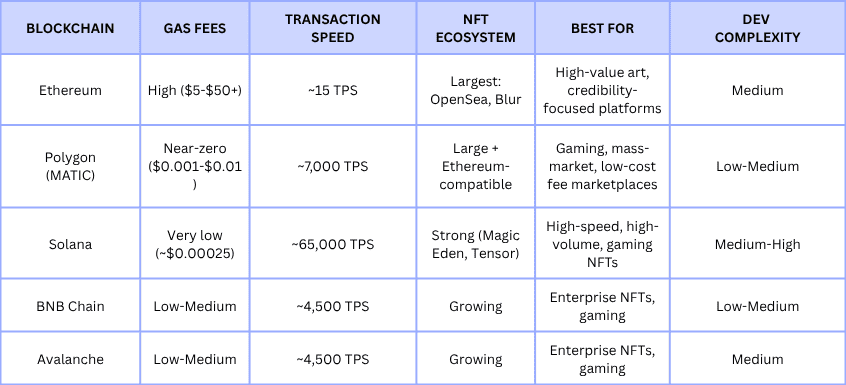
Which Blockchain Should You Build Your NFT Marketplace On?
This decision affects your development cost, your users’ transaction fees, your platform’s performance, and which wallets and tools you can integrate. There’s no single right answer, it depends on your niche, your target audience, and your budget. Here’s how the main options compare:
NFT Marketplace Revenue Models – How Platforms Make Money
OpenSea generated hundreds of millions in revenue at its peak almost entirely on a single revenue stream. Most new marketplaces won’t replicate that scale, but understanding the revenue mechanics helps you design a fee structure that’s competitive without being unsustainable.
Transaction Fees (Primary) – The platform takes 1–5% of every sale. OpenSea used 2.5%. Blur dropped to near-zero to gain market share then introduced BLUR token incentives to make up the difference. Transaction fees are your baseline revenue.
Minting Fees – Charge creators a small flat fee to mint NFTs, separate from gas costs. Common on platforms with high-quality curation, signals platform value to creators.
Listing Fees – A fee to list an NFT for sale. Less common now (most marketplaces have moved away from listing fees to reduce friction), but still used on highly curated platforms
Premium Features – Featured placement in search results, homepage spotlights, verified creator badges, analytics dashboards. SaaS-style upsells to creators with commercial ambitions.
Creator Partnerships – Revenue sharing or sponsorship deals with high-profile creators or brands launching on your platform. Common in sports, music, and gaming verticals.
DeFi Integration – NFT-collateralized lending, NFT staking, and fractionalization products generate revenue beyond trading. More complex, but a growing revenue stream for established platforms.
Why Build an NFT Marketplace with Cryptiecraft?
Since you have understood how to build an NFT marketplace. Cryptiecraft is here to make things simpler with our customizable solution in NFT Marketplace Development Services. With experienced developers, you can achieve your goal by building a platform packed with features. High-end security and scalability effectively drive more revenue. Leveraging your NFT platform in the market to drive more traders. Whether you need a ready-made platform or a custom-built marketplace, our expertise ensures a seamless launch.
Frequently Asked Questions (FAQ)
Q1. What are the key features of an NFT marketplace?
Ans: An NFT marketplace should include wallet integration, NFT minting, fixed-price and auction listings, search and filter tools, user profiles, royalty management, and secure transaction processing. These are the core features needed for creators and collectors to use the platform effectively.
Q2. Do I need coding skills to build an NFT marketplace?
Ans: No, you do not need to be a developer yourself to launch an NFT marketplace. Many founders work with an NFT marketplace development company or choose a white-label solution to handle the technical build.
Q3. How can I attract users to my NFT marketplace?
Ans: The best early strategy is to attract creators first, because strong creators bring their audiences with them. Community building, creator incentive programs, niche partnerships, and targeted promotions all help grow early platform activity.
Q4. Can I build an NFT marketplace without smart contracts?
Ans: No, smart contracts are essential for NFT marketplace functionality. They manage minting, ownership transfers, royalty distribution, and transaction execution on the blockchain.
Q5. Which blockchain is best for an NFT marketplace in 2026?
Ans: The best blockchain depends on your goals. Polygon is often chosen for affordability, Ethereum for credibility and premium ecosystems, and Solana for speed and low-cost high-volume use cases.
Q6. How much does it cost to build an NFT marketplace?
Ans:The cost depends on your development approach, blockchain choice, feature set, design complexity, and security requirements. White-label solutions usually cost less and launch faster, while custom development requires a larger investment for advanced control and scalability