

























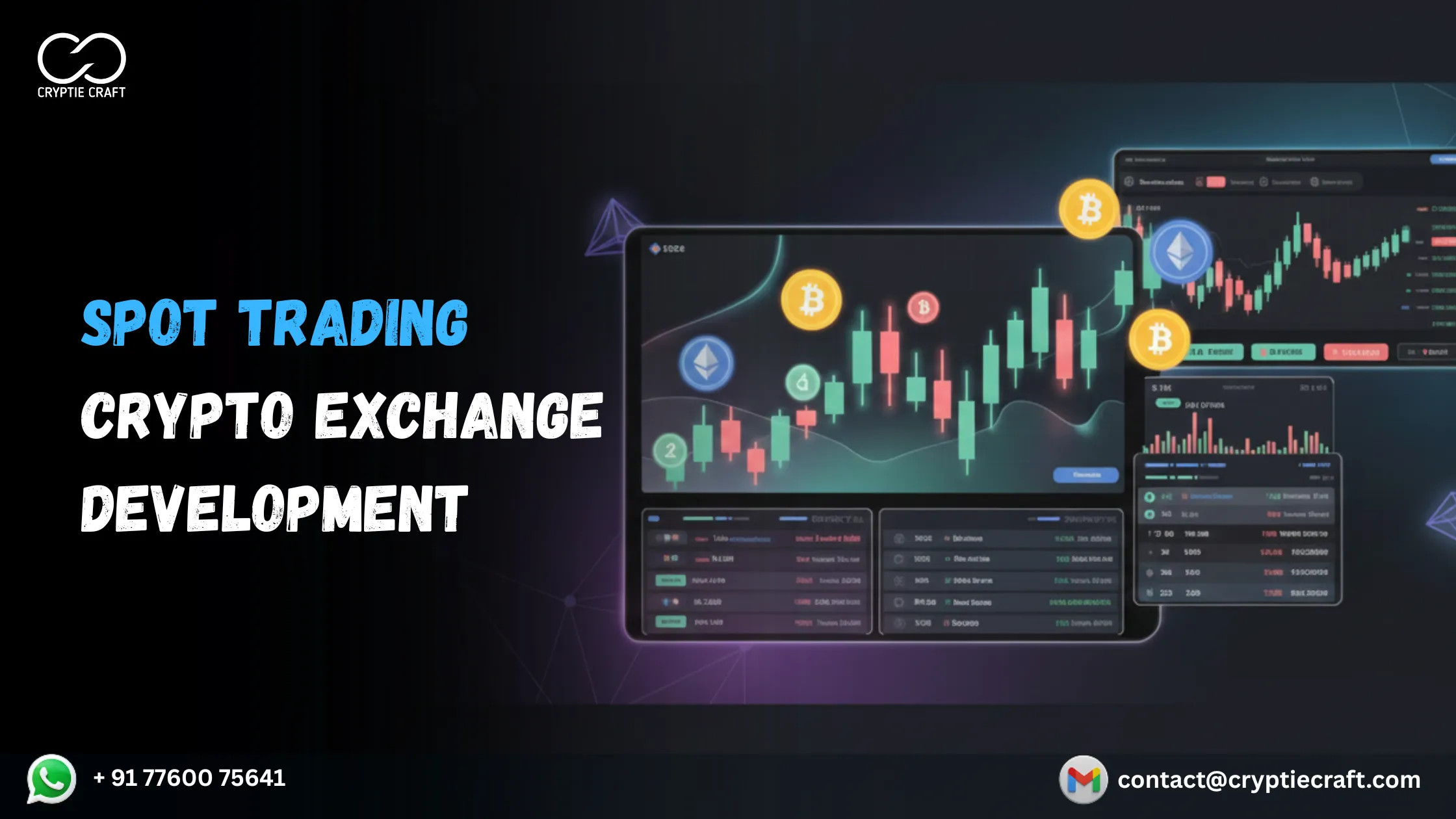
Yes. Spot trading crypto exchange development makes it possible for users to execute buy/sell transactions instantly, without expiry dates and without waiting for approvals, thanks to high-speed order execution, deep liquidity, and real-time crypto trading.
With faster trading modules and simplified mechanics, many new platforms now focus on launching spot trading platforms to meet growing user demand. Today, creating a spot trading exchange is a profitable investment opportunity, delivering strong revenue potential and global market reach.
Moreover, building a spot trading platform is often the most practical entry point into the crypto market. It offers lower technical complexity, predictable revenue streams, and access to a rapidly expanding user base.
What is Spot Trading Crypto Exchange Development?
Spot trading crypto exchange development is the process of building a platform that lets users buy and sell cryptocurrencies at real-time market prices with immediate settlement. Unlike derivatives or futures exchanges, spot trading involves direct asset ownership. When a user buys Bitcoin on a spot exchange, they receive actual Bitcoin in their wallet at the current market price.
The core technical components of a spot trading exchange are an order matching engine (which pairs buy and sell orders), a real-time order book, multi-currency wallet infrastructure, liquidity management systems, and KYC/AML compliance tools. A well-built spot exchange handles tens of thousands of orders per second without performance degradation, which is the engineering challenge that determines whether a platform succeeds with professional traders.
Different Order Types on a Spot Trading Exchange
The spot trading offers the traders multiple order options based on the goals, trade risk, and market conditions. Each order type gives users different levels of control over execution price.
Market Order
Executes instantly at the current best available price. No price guarantee. Preferred by traders who need to enter or exit a position quickly regardless of exact price.
Limit Order
Executes only when the market reaches a specified price. Gives full price certainty but no execution certainty. The most commonly used order type on spot exchanges.
Stop-Limit Order
Combines a trigger price (stop) and an execution price (limit). When the stop price is hit, a limit order is placed automatically. Used for both loss protection and profit locking.
OCO (One Cancels the Other) Order
Links a take-profit limit order and a stop-loss order. When one executes, the other is cancelled automatically. Advanced traders use OCO to define both their upside target and downside risk in a single action.
Trailing Stop Order
The stop price automatically follows the market price upward by a set percentage or amount. If price reverses by the trailing amount, the order triggers. Protects gains without requiring constant position monitoring.
Features of a Spot Trading Exchange Platform
The spot trading crypto exchange platform is designed with powerful features that enable the platform to perform sustainably. Some of the top-notch features that have to be included are,
- Order Book – Real-time display of all open buy and sell orders, organized by price level. A deep, well-visualized order book is a primary trust signal for professional traders evaluating a new platform.
- Matching Engine –The technical heart of your exchange. Pairs buy and sell orders at matching prices using price-time priority. Performance (orders per second without latency) is the single most critical technical specification. Industry benchmark: 100,000+ orders/second for a competitive platform.
- Trading Pairs – The asset combinations available for trading (BTC/USDT, ETH/BTC, etc.). More high-volume pairs attract more traders. Start with 20–30 pairs where you can provide genuine liquidity, then expand based on demand data.
- Liquidity Integration – External liquidity provider APIs populate your order book from day one, before organic volume develops. Without this, new exchanges suffer from wide spreads that drive traders away immediately.
- Multiple payment options – Fiat on/off-ramps (bank transfer, card), crypto deposits, and local payment methods for target markets. Payment method coverage directly drives user acquisition in markets where specific rails dominate.
- Customer Support – The 24/7 support system of the spot trading platform helps users with technical issues or trading issues. Users can reach out to the admin through chat, email, or ticket systems.
- KYC/AML Integration – Identity verification via Sumsub, Jumio, or Shufti Pro. AML transaction monitoring. Required by virtually every regulated jurisdiction and by payment processor partners.
- Real-time Market Data – Live price feeds, volume data, market depth charts, and 24h price change displays. Professional traders make decisions in seconds, data latency directly affects their willingness to trade on your platform.
- Advanced Charting Tools – TradingView-integrated charts with multiple timeframes, 50+ technical indicators, drawing tools, and candlestick display. Professional charting is non-negotiable for retaining experienced traders.
Spot Exchange vs Derivatives Exchange – Which Should You Build?
This is the most common pre-decision question for exchange founders. Here’s the honest comparison:
| Factor | Spot Exchange | Derivatives / Futures Exchange |
|---|---|---|
| Development Complexity | Medium | High (margin call, liquidation engine) |
| Development Cost | Starting From $10K | Starting From $15K |
| Regulatory Complexity | Medium (VASP registration) | High (CFTC oversight in US, MiFID in EU) |
| Target User Base | Beginners through professionals | Experienced traders, institutions |
| Revenue per User | Lower per trade, higher volume | Higher per trade (leverage fees), lower volume |
| Risk Management | No exchange liability on trades | Exchange absorbs liquidation risk |
| Time to Market | 4–12 weeks (white-label) | 8–24 weeks minimum |
| Best For | First exchanges, regional launches, mass market | Institutional focus, high-volume professional traders |
Practical guidance: Build spot first, validate your market, then add derivatives as a Phase 2 feature. The exchanges that try to launch with full derivatives capability on day one frequently delay their launch significantly and over-spend on features their initial user base doesn’t use.
Benefits of Building a Spot Trading Crypto Exchange
The spot trading exchange development offers multiple business benefits for upcoming startups and entrepreneurs. Some of the top business perks are listed below,
Broad User Base and Accessibility
Spot trading is a beginner-friendly feature that helps global users utilize the platform. Hence, creating a spot trading exchange enhances the global accessibility and the user base.
Higher ROI
The spot trading crypto exchange has its own revenue streams that include trading fees, listing fees, withdrawal charges, market-making spreads, and premium trading tools. Through this, entrepreneurs can earn a lump sum amount of profit.
Scalability & Flexibility
With the top-tier spot trading development services, the platform has premium, scalable features. As the market and user base grow, the platform can be extended with add-on trading features, security mechanisms, NFT integrations, etc.
Enhanced Liquidity & Market Trust
The spot trading exchange platforms act as fundamental liquidity hubs for digital assets. With the enhanced liquidity modules, the overall trade speed increases, which builds trust.
Low Risk
Compared to other exchanges like derivatives and futures, spot trading is a safer and more stable trading method. Users can own the actual assets by reducing the liquidity risk and regulatory complications.
Global Market Access
The spot trading platform connects with global users 24/7, which is borderless and decentralized. This helps the startups to tap into the global liquidity and attract international traders.
Immediate Settlement
Spot trades process instantly, which ensures users receive the purchased assets directly into their wallets. Instant settlement improves user satisfaction, reduces counterparty risks, and accelerates trading volumes on the platform.
How Spot Trading Crypto Exchange Works?
The Spot trading crypto exchange acts as a simple yet direct platform for cryptocurrency transactions. Based on the current market pricings, users can buy/sell digital assets without any delays.
User Sign-up
A new user can create a new crypto account on the platform by completing the KYC verification. Through this, the platform approves only the verified and authorized users who meet the regulatory compliance.
Wallet Setup
After creating a crypto exchange account, users can sign up for a crypto wallet for transactions. With the crypto wallet, users can deposit funds for trading.
Trade Engine View
By utilizing the crypto exchange, the users can get a view of the trading engine that displays the price, order books, and market depth. The real-time trade engine helps to pick the right trading pair for transactions.
Crypto Order Placement
Users can then utilize the platform to place two different types of spot orders, namely market orders and limit orders.
- Market Order – The spot trading module executes instantly at the best available price.
- Limit Order – This specialized trading module executes only when the trade price reaches the set value.
These two different trading modules offer flexibility based on the speed and desired entry price.
Order Execution
Once the trade engine pairs the buyer and seller orders, then the trade is executed smoothly. Also, the trade executes within seconds and ensures faster transactions.
Asset Ownership
The purchased crypto asset can then be viewed in the user’s crypto wallet. The user can get complete control over the asset to withdraw, resell, and transfer anytime.
Spot trading is widely preferred due to its simple trading flow, instant settlement, and real asset ownership. This makes it ideal for newcomers and experienced traders to execute seamless trading.
How Much Does it Cost to Build a Spot Trading Exchange?
There is no fixed price for building a spot trading crypto exchange, it depends entirely on your business needs and platform features.
- Basic Platform: A simple spot trading exchange with essential features like market and limit orders, wallet integration, and basic KYC/AML can start from a few thousand dollars.
- Advanced Platform: If you want custom designs, advanced order types (OCO, trailing stop), real-time charts, liquidity integration, and strong security, the cost will be higher, ranging from tens of thousands to over a hundred thousand dollars.
Want to know the exact cost for your idea? Our team can provide a personalized estimate based on your platform requirements, features, and business model.
→ Get Your Free Spot Trading Exchange Cost Estimate
Is Building a Spot Trading Exchange Profitable?
Yes, creating a spot trading crypto exchange will be a rewarding business model that possesses multiple revenue streams and long-term scalability. As crypto users trade cryptocurrencies in real-time, the admin can earn profits consistently with a wide set of exchange revenue streams. Various revenue streams from spot trading exchange development include trading fees, maker/taker charges, withdrawal fees, listing fees, API access fees, and premium feature fees.
Due to the beginner-friendly spot trading platform, it helps the startups to attract a wider user base than crypto derivatives and margin trading platforms. This helps enterprises to increase the overall platform traffic and liquidity. The spot trading crypto exchange development offers a sustainable business with consistent profit potential.
Planning a spot trading exchange with instant liquidity? Talk to our experts → Contact Us
How to Build a Spot Trading Crypto Exchange – 6 Steps
The spot trading platform development can be deployed with a simple 6-step process that ensures reliability. Let’s get the breakdown of the spot trading exchange development below,
Step 1: Define your Business Model
Picking the right business model before crypto exchange development will be a game-changer for your business. In that sense, creating a basic yet user-friendly spot trading crypto exchange platform will offer startups various business perks.
In this phase, the startups can identify the target audience, crypto exchange features, and revenue streams. The clarity offers a foundation for the platform’s architecture and growth map.
Step 2: Platform Architecture Designing
After the requirements are set, the spot trading exchange development can be moved to technical planning. Here, both the admin and user dashboards are designed with relevant features.
With the high-end tech stack utilization, the architecture can be designed with higher scalability and lower latency. This helps to ensure the upgrade of the features without downtime.
Step 3: Trade Engine Designing
In this phase, the development team creates an intuitive, responsive, and clean trading interface where users can place spot trading orders. Also, the power-packed trading engine ensures that the orders are processed instantly.
The user-friendly user interface is efficiently designed to trade seamlessly with various features.
Step 4: Feature Integrations
With the spot trading exchange platform, third-party APIs, crypto wallets, and payment gateways are integrated. Also, the wallets are packed with security features like 2FA, data encryption, anti-DDoS, KYC/AML verification, smart contract audits, and server-level firewalls.
The compliance module plays a major role in ensuring that the operations align with the local crypto regulations.
Step 5: Testing
As the exchange platform is ready to be launched, it is essential to conduct rigorous testing that includes unit testing, security audits, stress testing, bug fixing, and beta testing. This ensures the platform’s performance and sustainability.
Step 6: Launch a Spot Trading Exchange
After the successful testing process, the spot trading exchange platform can be launched in the crypto market for public usage. Occasional upgrades and feature integrations can be integrated to increase the platform’s performance and stability.
This is how the spot trading crypto exchange Platform process is executed. Startups can launch their crypto business without any technical delays. As we have acknowledged the development process, now is the right time to know about the future of the spot trading business model.
Future of Spot Trading in Crypto Exchange
Global spot trading volume has already exceeded $2 trillion and continues to grow as institutional adoption expands and new geographic markets come online. The next wave of spot exchange development is being shaped by four trends: multi-chain support (users expect to trade assets across Ethereum, Solana, BNB Chain, and other networks from a single platform), AI-powered market surveillance (real-time fraud detection and market manipulation identification), mobile-first design (60%+ of trading already happens on mobile, and this share is increasing in emerging markets), and compliance-by-default architecture (exchanges that make regulatory compliance a product feature rather than an afterthought consistently outperform those that don’t).
For founders evaluating the market entry timing: the window to build a well-positioned spot exchange is still open. Exchange consolidation is happening, but regional markets (Southeast Asia, Africa, Latin America) remain genuinely underserved by platforms with localized payment methods, local language support, and jurisdiction-appropriate compliance infrastructure
Why Cryptiecraft is the Smart Choice for Spot Trading Exchange Development?
Cryptiecraft is a leading centralized exchange development company that stays ahead in the competitive crypto market and has delivered multiple crypto projects. As a leading provider of crypto exchange development solutions, we have helped many startups by offering top-tier spot trading services without any technical issues.
Our team helps you in customizing the platform based on the high-tech features, security-compliant modules, and user-friendly infrastructure. We help you integrate all the necessary APIs, trading modules, and advanced functionalities needed for your crypto exchange platform.
Ready to explore what your platform could look like? Get a free demo from our business team and begin your journey toward launching a spot trading exchange.