

























The crypto industry continues to evolve at a rapid pace, and so does the technology that powers modern digital asset trading platforms. With global regulations tightening, blockchain adoption expanding, and security threats becoming more sophisticated, choosing the right technology stack for crypto exchange development in 2026 is more crucial than ever.
Partnering with a reliable cryptocurrency exchange development company can make all the difference in getting these foundational decisions right from day one. Whether you’re a startup founder, blockchain entrepreneur, or enterprise planning to enter the crypto trading sector, your tech stack will determine your exchange’s performance, scalability, security, development cost, and long-term sustainability.
In this guide, we’ll break down everything you need to know about selecting the ideal technology stack in 2026 from backend frameworks and blockchains to middleware, APIs, database systems, mobile technologies, and future-ready enhancements.
Crypto Exchange Tech Stack Overview
crypto exchange relies on a powerful and well-structured technology stack to deliver fast, secure, and scalable trading experiences. The tech stack is divided into multiple layers, each responsible for essential functions from user interfaces to trading engines and database management. When the right combination of technologies is used, the exchange can maintain smooth performance during heavy trade volumes, enable real-time order execution, and uphold strong security practices to protect user assets at all times.
Why Tech Stack Decisions in Crypto Exchange Development Are High-Stakes?
The crypto industry moves fast enough that most development decisions can be revisited. Tech stack is different. Replacing a matching engine architecture mid-operation, migrating a production database with live user funds at stake, or refactoring the entire blockchain integration layer, these are not routine maintenance tasks. They’re high-risk, high-cost rearchitecting projects that most exchanges can’t afford to do while staying operational.
The exchanges that get this right from day one build scalable, performant platforms. The ones that don’t face technical debt that compounds until it either forces a costly rebuild or constrains product development indefinitely. This guide covers what those decisions are, what the options look like, and how to reason through them for a production exchange in 2026.
1. Scalability
Your tech stack determines whether you can handle 1,000 concurrent users or 1,000,000. Microservices architecture with Kubernetes orchestration scales horizontally, you add compute as needed. Monolithic architecture scales vertically, until it can’t. Build for scale from the start, even if you’re small now.
2. Performance and Speed
Milliseconds determine whether professional traders use your platform. The matching engine must process orders in sub-millisecond time. WebSocket connections must deliver real-time price updates without perceptible delay. Every technology choice in your stack either contributes to or detracts from this performance requirement.
3. Security
Security failures in exchanges cost real user funds. The tech stack determines what security primitives are available: HSM integration for key management, multi-sig wallet implementation, AES-256 encryption at rest. Getting this wrong isn’t a bug to fix later, it’s a liability that follows the platform permanently.
4. User Experience
The UX quality ceiling is determined by your frontend stack. React.js with TradingView chart integration can deliver institutional-grade trading interfaces. Weaker frontend choices limit what’s achievable regardless of backend performance. Professional traders leave platforms with poor charting and order entry UX, permanently.
5. Exchange Architecture
The overall architecture of your crypto exchange , whether monolithic or microservices-based, relies on the chosen technologies. A suitable tech stack supports modular development, seamless API integration, secure wallet management, liquidity modules, and real-time trading engines. Proper architectural choices also allow easier updates, faster feature releases, and long-term maintainability, reducing technical debt and development costs.
10 Key Technologies of a Promising Crypto Exchange Platform
Building a high-performing crypto exchange requires the right combination of technologies working together to ensure speed, security, scalability, and reliability. Below is a detailed overview of the 10 core technologies that power a modern and successful crypto trading platform.
1. Programming Languages
Different languages serve different roles in the exchange stack. C++ and Rust for ultra-low-latency matching engines where nanoseconds matter. Golang for high-performance backend services (matching engine for most teams, order routing, trade settlement). Python for ML-driven risk management, fraud detection, and KYC verification workflows. TypeScript (Node.js) for the API layer and real-time services. Solidity for EVM smart contracts. The correct answer is rarely “one language”, it’s understanding which language’s strengths align with which component’s requirements.
2. Blockchain and Smart Contracts
Blockchain layer choices depend on which networks your exchange needs to support. EVM-compatible chains (Ethereum, Polygon, BNB Chain, Arbitrum, Avalanche) use Solidity for smart contracts, the most mature ecosystem with the most available developers. Solana uses Rust for on-chain programs, it offers significantly higher throughput but requires a smaller developer pool. Move-based chains (Aptos, Sui) are newer with faster finality but limited ecosystem maturity.
For a new exchange: support Ethereum (credibility), Polygon or Arbitrum (low gas for retail users), and BNB Chain (Asian market exposure) as a baseline. Add additional chains based on your target user base.
3. Matching Engine and Trading Infrastructure
The matching engine is the most performance-critical component of any exchange, the core that pairs buy and sell orders in real time. It processes thousands of trades per second and must do so with sub-millisecond latency. Golang is the dominant choice for production exchange matching engines in 2026 for specific reasons: compiled language performance, native goroutines for concurrent order processing, and significantly shorter development cycles than C++.
Rust offers comparable performance with stronger memory safety guarantees but requires a more specialized development team. C++ remains in use at legacy institutional exchanges where the performance margin justifies the development overhead. For new builds, Golang is the pragmatic choice; Rust is defensible if your team has the expertise. Golang for most new exchange builds, Rust if extreme performance + memory safety is critical, C++ only for teams with existing C++ expertise.
4. Backend Frameworks
Production exchanges don’t use a single backend language, they use different languages for different services. The API layer (handling user requests, authentication, account management) is typically Node.js with TypeScript: fast development, excellent ecosystem, strong async performance for I/O-bound operations.
The matching engine is Golang. KYC/AML processing and risk management systems are often Python: excellent ML library ecosystem (TensorFlow, scikit-learn) for anomaly detection models, and faster iteration on compliance logic that changes frequently with regulatory requirements. Java Spring Boot appears in enterprises with existing Java teams or regulatory requirements for JVM-based deployments.
5. Database Management
Databases store critical data such as user accounts, trade history, KYC records, and wallet transactions. High-performance databases like PostgreSQL, MongoDB, Redis, and Cassandra ensure fast read/write speeds and data security. Redis is particularly useful for caching order books and real-time updates to enhance system performance.
6. API Integration
REST APIs handle standard operations: account management, order placement, trade history, wallet operations. WebSocket APIs handle everything real-time: live order book updates, price feeds, and trade notifications. GraphQL is used by some exchanges for flexible data querying, particularly useful when serving both mobile and desktop clients with different data requirements. FIX Protocol (Financial Information exchange) is the institutional standard, if your exchange targets algorithmic traders or prime brokerages, FIX connectivity is often a non-negotiable requirement.
7. Cloud Infrastructure & DevOps
Kubernetes with Docker is effectively the standard for exchange infrastructure: container orchestration enables automatic scaling when trading volume spikes, zero-downtime deployments, and faster disaster recovery. AWS is the most commonly used cloud provider for exchanges given its geographic availability, managed services ecosystem, and compliance certifications. GCP is a strong alternative with better BigQuery support for trade analytics.
Nginx handles load balancing and serves as a reverse proxy. CI/CD pipelines (GitHub Actions, GitLab CI, or Jenkins) enable frequent, safe deployments without manual intervention, critical for maintaining security patch cadence.
8. Frontend Frameworks
React.js with Next.js is the dominant frontend choice for exchange interfaces in 2026, strong TypeScript support, large developer ecosystem, excellent performance optimization, and server-side rendering for fast initial page loads. Trading View’s lightweight charts library is effectively the industry standard for exchange charting, professional traders expect its indicator set and interface patterns. WebSocket connections are required (not optional) for real-time order book updates and live price feeds; HTTP polling creates unacceptable latency for professional trading.
Mobile: Flutter or React Native for cross-platform development when team resources don’t justify separate iOS and Android codebases.
9. Liquidity Management
Liquidity infrastructure is often treated as a business decision, but it has significant technical requirements. Integrating with external liquidity providers (Binance, OKX, or institutional prime brokers via API) requires building robust API connection infrastructure with failover handling, your exchange’s order book depth disappears if the liquidity feed goes down. For DEX components, AMM pool integration or management requires smart contract integration for pool state reading and trade routing.
10. Security Measures
Hardware Security Modules (HSMs) are the gold standard for private key management, physical devices that prevent key extraction even if the surrounding software is compromised. Gnosis Safe is the most widely deployed multi-sig wallet infrastructure for institutional custody. Cloudflare handles DDoS protection at the network edge. HashiCorp Vault manages secrets and API keys across your service infrastructure. Smart contract audits by CertiK or Hacken are mandatory before any exchange with on-chain components goes live with real user funds.
Tech Stack for Cryptocurrency Exchange Development
Building a high-performance cryptocurrency exchange requires a carefully chosen tech stack that ensures speed, security, scalability, and a seamless user experience. From the frontend to blockchain integration and backend infrastructure, each component plays a crucial role in your platform
Here’s a modern stack suitable for high-performance exchanges:
Frontend
- React.js + Next.js
- Tailwind CSS
- WebSockets / Socket.IO
Backend
- Node.js + TypeScript
- Golang for matching engine
- Python for KYC/AML & risk management
Database
- PostgreSQL
- Redis (cache)
- MongoDB (logs/session data)
Blockchain Layer
- Solidity, Rust, Move
- Multi-chain node providers
Infrastructure
- Kubernetes
- Docker
- AWS/GCP
- Nginx
- CI/CD pipelines
Mobile
- Flutter / React Native
Security
- HSM integration
- SHA-256 hashing
- DDoS protection
- WAF
- Multi-signature wallets
How to Decide Which Technology to Use?
This is the question the previous sections build toward. Here’s the decision framework for the most important technology choices:
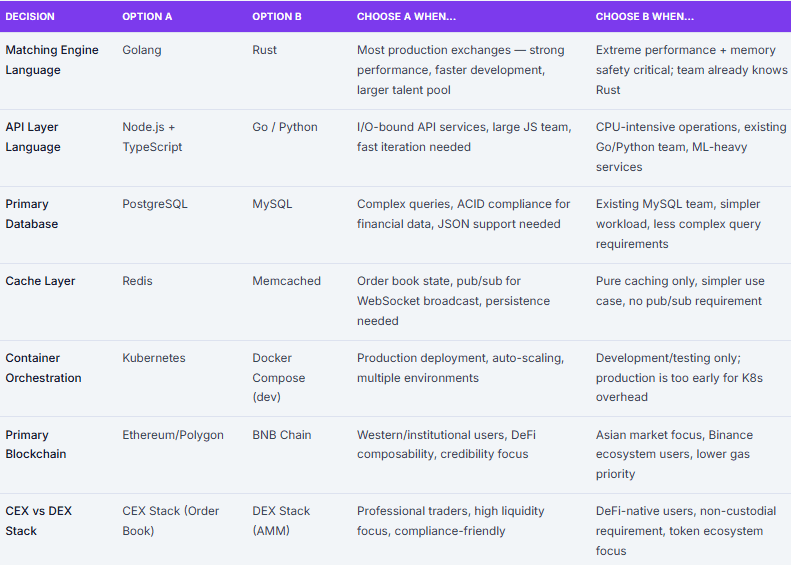
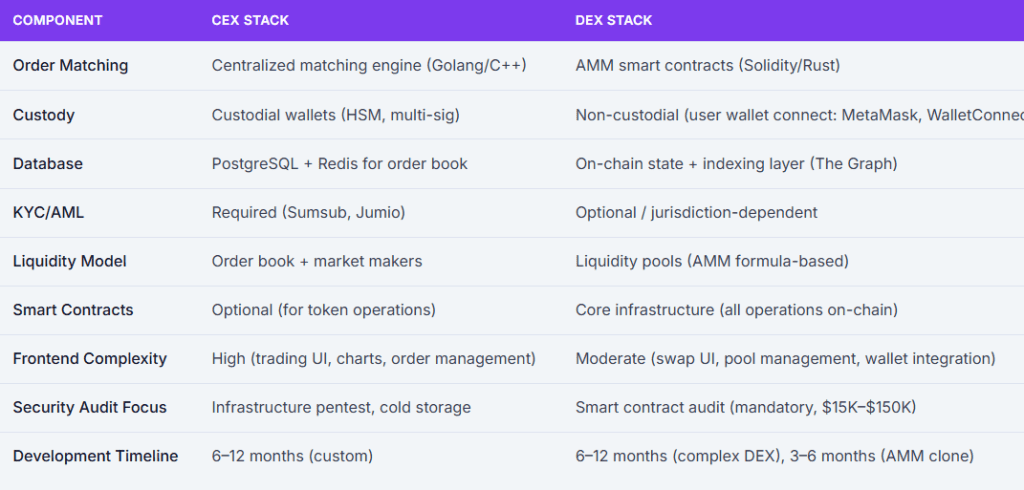
CEX vs DEX — How the Tech Stack Differs
A centralized exchange (CEX) and a decentralized exchange (DEX) share some infrastructure components but differ fundamentally in their core architecture. Here’s where they diverge
Conclusion
Choosing the right technology stack for your crypto exchange shapes everything, performance, security, scalability, and long-term growth. With proven technologies like microservices, Golang, Node.js, MPC wallets, and AI-driven risk management, building a world-class exchange is more achievable than ever.
The right stack doesn’t just run your platform, it powers your vision. Choose wisely, and you’re setting your crypto exchange up for success from day one. We’ve helped founders and enterprises build crypto exchanges from the ground up. If you’re ready to take the next step, let’s talk. Reach out to our team and let’s figure out the best path forward for your project , together.