




















In 2017, Ethereum’s initial coin offering raised $18M and changed how the world thought about startup fundraising. In 2021, Polkastarter helped launch dozens of IDOs that generated millions in the first hour of trading. According to the CMC Article, in 2023, BlackRock’s tokenized money market fund, built on institutional-grade security token infrastructure, crossed $500M in AUM. Three moments, three models, three entirely different approaches to raising capital on blockchain.
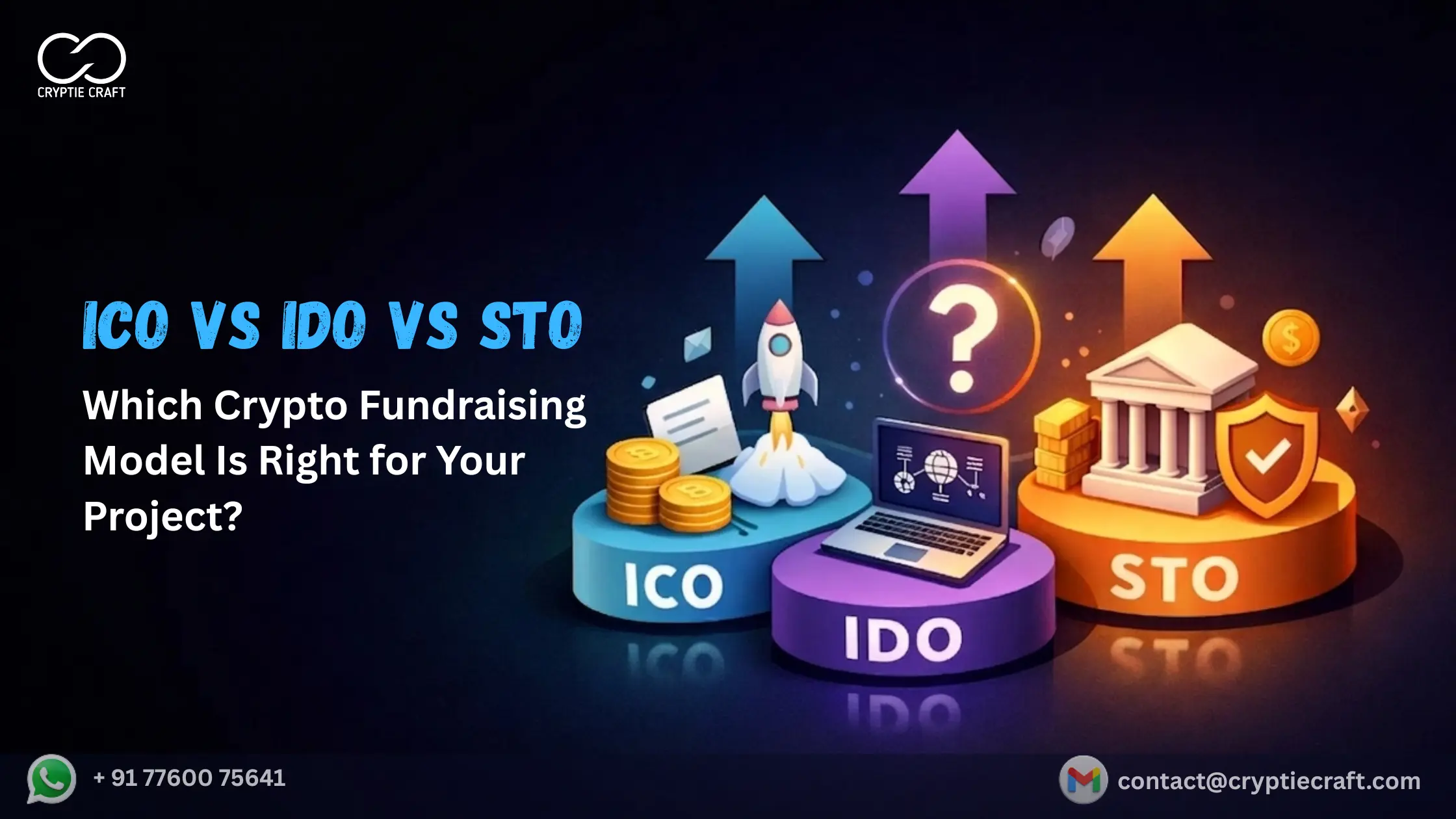
Fundraising on the blockchain has evolved beyond the traditional approach today. In fact, founders are keenly weighing the pros and cons of ICO vs IDO vs STO combinations. Every fundraising mechanism has its distinct merits and substantial obligations. Picking the wrong one can damage one’s credibility and halt the pace of growth. On the other hand, a good decision will increase investors’ trust and strengthen market confidence.
This blog will clarify all the doubts you have and give a clear explanation of ICO vs STO vs IDO. Highly complicated crypto fundraising models are broken down into clear and useful steps here. We emphasize clarity, strategy, and the creation of real value in business.
Evolution of Token-Based Fundraising in Blockchain
Token-based fundraising started with token sales on simple digital blockchains. At the beginning, projects isolated ICOs for raising global capital rapidly. These offerings got rid of the traditional intermediaries in fundraising processes. The sector experienced such a rapid expansion that it attracted innovators, startups, and global investors.
Conversely, the lack of regulations led to an increase in risks and a decrease in investor protection. The industry changed by bringing more structured fundraising models. IDOs raised their heads by employing decentralized exchanges for open token distribution. Then STOs came, adding regulatory compliance and asset-backed security. With each evolution, the level of trust, transparency, and market maturity rose. Nowadays, blockchain fundraising is about striking a balance between innovation, security, and compliance worldwide.
What is an ICO (Initial Coin Offering)?
An Initial Coin Offering (ICO) is a way to raise funds through the creation of new crypto tokens by blockchain startups and projects, which are then sold to investors. Investors acquire new tokens either by exchanging other well-known cryptocurrencies, such as Bitcoin or Ethereum, or occasionally, by using fiat money.
Tokens are usually linked to the utility function, i.e., they are like passes that enable token holders to use future services, features, or decentralized applications on the platform in the project’s ecosystem. In contrast, the tokens offered in an ICO usually lack the elements of equity ownership and dividend rights that traditional securities embed.
How ICO Fundraising Works
The ICO fundraising process is a highly organized one wherein the projects based on blockchain collect funds from all over the world by creating and selling their tokens.
1. Whitepaper Creation
The projects make available to the public comprehensive whitepapers that explain their vision, technology, tokenomics, roadmap, team qualifications, and use cases transparently.
2. Token Development
The team responsible for development creates smart contracts that stipulate the volume, manner of distribution, quality, and platform specifications of the token.
3. Marketing Campaign
The projects make people aware of their existence through a combination of social media, online communities, celebrity endorsements, and marketing through high-quality content.
4. Pre-Sale Phase
The first investors are assured of the lowest price for the tokens sold in the private sales, which is a source of initial capital and a market validation for the project.
5. Public Token Sale
The main ICO is open to the public, which means that investors from all over the world can buy tokens with Bitcoin, Ethereum, or traditional currencies.
6. Exchange Listing
The tokens will be traded on cryptocurrency exchanges after the ICO, thus providing liquidity and creating the environment for secondary market trading.
Knowing the steps aids the projects in the implementation of ICO campaigns, candidates for investors in the evaluation of the opportunities, and the already committed funds in their release.
Benefits of ICO Fundraising for Blockchain Projects
The ICO funding process gives blockchain startups many new, different, and sometimes better ways of raising funds, such as global capital availability, community building, and faster funding without the barriers of conventional methods.
1. Global Investor Access
ICOs allow projects to get in touch with investors all over the world at once, thereby getting rid of geographical restrictions and the limitations of traditional funding entirely.
2. No Equity Dilution
The founder keeps the entire ownership and control while raising a lot of money through the sale of tokens instead of shares.
3. Faster Fundraising Process
ICO campaigns can get started in just a few weeks, while traditional venture capital negotiations and due diligence can take months.
4. Early Community Building
The sale of tokens brings the participation of the investors who are going to be the users, advocates, and promoters of the project by and large.
5. Lower Fundraising Costs
ICOs free the fundraising process from costly intermediaries such as investment banks, brokers, and underwriters, thus making a significant reduction in overall fundraising costs.
6. Market Validation
The successful sales of tokens confirm the existence of real market demand and investor trust even before the complete product development and launch.
All these factors make ICOs an excellent choice for raising funds and engaging the community at the same time for creative blockchain projects.
Risks and Challenges of ICOs
ICOs have endured a high-risk profile during their entire life cycle, despite being among the most popular methods for raising funds in the cryptocurrency market at the very beginning. The absence of a law to regulate the use of this mechanism heightens the risk of fraud as well as the lack of protection for investors. Unrealistic expectations and inadequate planning are some of the reasons why many projects end up disappointing.
The massive fluctuations in the value of tokens can lead to an instant loss of capital for investors. Vulnerabilities in the smart contracts are the points where hackers can easily get access to the funds. Lack of transparency results in credibility issues and the loss of trust in the long run. Unclear legal requirements bring about a situation where each jurisdiction’s proverbial legal maze has to be negotiated.
Often, ICOs do not have sufficient Know Your Customer (KYC) and other compliance measures. The risks of ICO Development are higher than those of the other fundraising models, i.e., IDO and STO. Inadequate support after the launch is detrimental to the token’s utility and its adoption.
What is an IDO (Initial DEX Offering)?
An IDO is identified as an Initial DEX Offering in terms of blockchain financing. It gives the opportunity for projects to present their tokens right on decentralized exchanges. IDOs do away with intermediaries and allow non-restricted token distribution. Investors make use of wallets for participating without having the approval of centralized exchanges.
Liquidity pools make the immediate trading of the token after launch possible. Smart contracts take care of the process of fundraising and the allocation of tokens automatically. IDOs have made the process more transparent than with traditional ICO models. They have made faster launches available in the existing crypto fundraising models with less time. Lower entry barriers draw a large number of both retail and institutional investors from all over the world. IDOs are the perfect choice for fundraising for projects that are looking for decentralized, liquid, and community-driven support.
How IDO Fundraising Works on Decentralized Exchanges?
IDO fundraising is conducted through decentralized platforms, and it can be easily secured with the help of the community and automated protocols, thus enabling the process of token launching to be more transparent and immediate in terms of liquidity.
1. Platform Selection
The project is selecting the right decentralized exchange, like Uniswap, PancakeSwap, or Polkastarter, for their launch.
2. Smart Contract Deployment
The project developers are executing the smart contracts after auditing, which detail the parameters, mechanics, and rules for the token sale and its distribution.
3. Liquidity Pool Creation
The project will add liquidity to the market by combining the new tokens with the major cryptocurrencies.
4. Whitelist Registration
The individuals interested in buying the tokens will get registered, and will also have to go through the KYC process in order to be able to purchase tokens.
5. Token Sale Launch
The IDO event starts, and the whitelisted persons get the chance to exchange their cryptocurrencies for tokens.
6. Immediate Trading
Tokens are offered for trading right after the launch, which creates an opportunity for immediate liquidity and price to be discovered.
IDO fundraising is a method of decentralization through which the global investor’s access to the token launches gets instant and transparent.
Benefits of IDO Fundraising
IDO’s are superiors and the most beneficial properties are the same things that make them stand apart from classic methods of funding like ICOs, among others, and those are: instant liquidity, improved transparency, lower costs, and fairer token distribution.
1. Immediate Liquidity Access
Tokens can be traded right after they are launched on decentralized exchanges with no waiting time.
2. Enhanced Transparency
Working with a blockchain allows anyone to check sales, distributions, and movements since everything is done on-chain.
3. Lower Launch Costs
IDOs avoid the major costs of exchange listing and intermediaries, which are mainly associated with ICOs.
4. Fairer Token Distribution
With the use of decentralized platforms, large investors cannot manipulate the market to their advantage and retail investors are guaranteed access.
5. Faster Time to Market
Projects releasing tokens take only days instead of months as in the IDO’s as compared to the ICOs.
6. Reduced Centralization Risks
With the decentralized infrastructure, there are no single points of failure, and censorship or control is less likely.
IDOs are the new way of raising crypto funds, decentralization, transparency, and good accessibility; hence, token launches are done with much more efficiency, and they are democratic.
Risks and Limitations of Initial DEX Offerings
IDOs are still regarded as risky investments, despite their unparalleled approach to fundraising. The occurrences of smart contract vulnerabilities may result in exploits and lead to the loss of funds. Rug pulls are a scenario in which developers leave a project after acquiring funds. High gas fees on major blockchains are a factor that makes it hard for investors to afford participation.
Often, bot activity is responsible for taking up the entire quota of tokens during sales and thus preventing regular retail participants from being able to buy tokens. The insufficient due diligence measures adopted expose the venture to fraud and a project of lower quality. Price instability right after the launch can result in enormous losses for investors. Legal uncertainties in regulations are a big risk factor for projects as well as participants. Manipulation of liquidity pools has an influence on the prices of tokens because of artificial supply restrictions. Decentralized platforms provide next to no protection for the investors as compared to regulated ones. Technical difficulty is one of the factors that creates barriers for less knowledgeable cryptocurrency users all over the world.
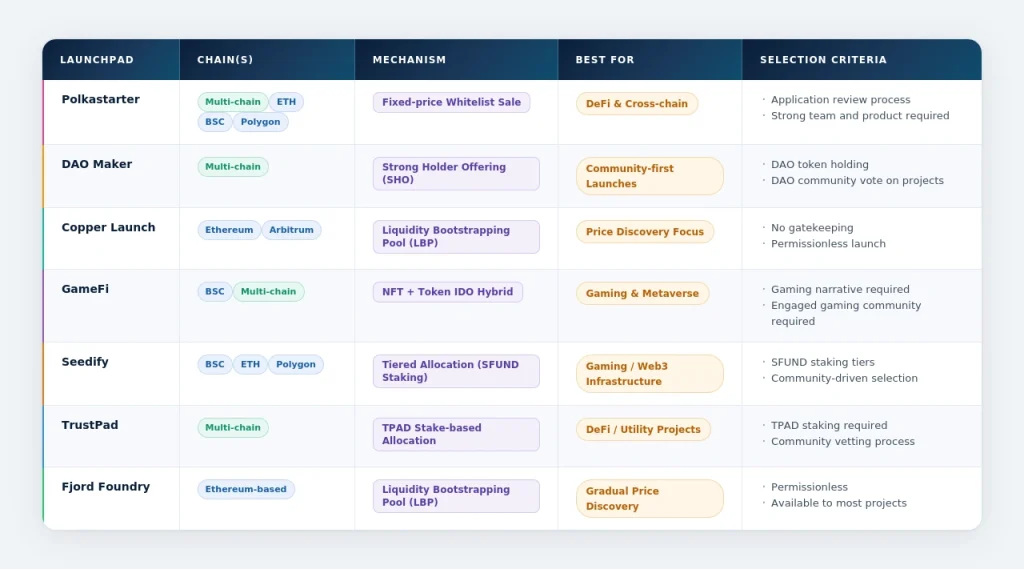
Top IDO Launchpads
What is a STO (Security Token Offering)?
A Security Token Offering (STO) is an officially controlled fundraising technique through which blockchain projects make the issuance of digital tokens that are considered securities under the securities law. The tokens indicate copyrights, sharing of profits, or backing by real-world assets. STOs follow all the way through with securities regulations, such as SEC guidelines and laws. Investors are granted legal protection through well-defined financial regulatory frameworks and supervision. Apart from ICOs, the STOs go through a thorough legal compliance and accreditation process. The tokens may depict equity, debt, derivatives, or they could be backed by physical assets that are represented through tokenization. Most of the time, only qualified or accredited investors can get involved in this kind of investment in different places.
The process of STO Development includes very meticulous legal audits along with registration necessities and compliance actions. This approach connects the previous financial system with the new blockchain innovation and tech. The benefits of the STOs for investors are the three factors such as transparency, liquidity potential, and regulatory legitimacy.
How STO Fundraising Works
The process of STO fundraising is highly regulated and consists of a series of steps that combine the use of blockchain technology with compliance with securities laws to secure both the investors and the projects.
1. Legal Structure Setup
The projects create legal entities and then classify the security tokens according to the regulations of the particular jurisdiction.
2. Regulatory Registration
The companies get compliance approval by filing the necessary documents with the securities regulators, such as the SEC.
3. Token Architecture Design
The development teams construct regulatory-compliant smart contracts that incorporate the restrictions of the regulations and the limitations on transfers automatically.
4. Investor Accreditation
The platforms verify the investors’ qualifications by conducting KYC, AML checks, and accreditation status verification.
5. Regulated Token Sale
The approved investors buy the security tokens through compliant platforms, which follow all the legal requirements.
6. Secondary Market Trading
The tokens are traded on regulated security token exchanges where compliance monitoring is done on an ongoing basis.
STO fundraising provides legal protection, regulatory compliance, and investor security through established frameworks, thus being the most regulated cryptocurrency model.
Benefits of STO Fundraising for Enterprises
STOs give companies a legal framework, protection for investors, tokenization of assets, and trust in the institutions for raising funds through legitimate ways.
1. Legal Protection and Regulatory Compliance
STOs are limited to the securities law, which has already been set up already and this significantly diminishes the legal risks that companies face.
2. Higher Investor Trust
The control by the government and the compliance measures in place attract the institutional investors who are looking for opportunities that are not only legitimate but also profitable.
3. Possibilities of Asset Tokenization
Companies can now easily turn their physical assets, such as real estate, stocks, or commodities, into digital tokens.
4. Models of Fractional Ownership
Security tokens give the possibility of fractional ownership of assets, which brings the investment to the doorsteps of the investors.
5. Access to Global Capital
STOs go all the way to the world’s accredited investors while still being able to maintain the highest standards of regulatory compliance.
6. Liquidity Potential Widened
The secondary trading markets of security tokens are offering an easier way to get the money back than traditional assets.
The enterprise that is going to raise capital in a compliant way has no better method than through STO fundraising, which merges blockchain innovation with regulatory legitimacy.
Challenges and Limitations of STOs
STO Development is faced with major obstacles, even though it provides the advantages of regulatory compliance. The high costs of legal consultancy and compliance are the main financial barriers to the market, which are very heavy right from the start. Token issuances are usually postponed for several months due to long registration procedures. The variety of regulatory issues that exist in different countries makes international token offerings more difficult and less attractive.
There are restrictions on investors’ participation, and only accredited or qualified investors can become part of the market. The liquidity in the secondary market is still low when compared with that of regular cryptocurrency exchanges. Security tokens inherently possess transfer limitations that greatly reduce trading movement. The legal supervision and the reporting requirements of the continuous compliance taking place are costs that cannot be avoided.
The market for the technical infrastructure of security token exchanges is still very new and underdeveloped. There is constantly a legal risk created by the regulatory uncertainty in the emerging markets. The small number of investors that can participate in a security token offering reduces the possible amount to be raised in comparison with ICOs.
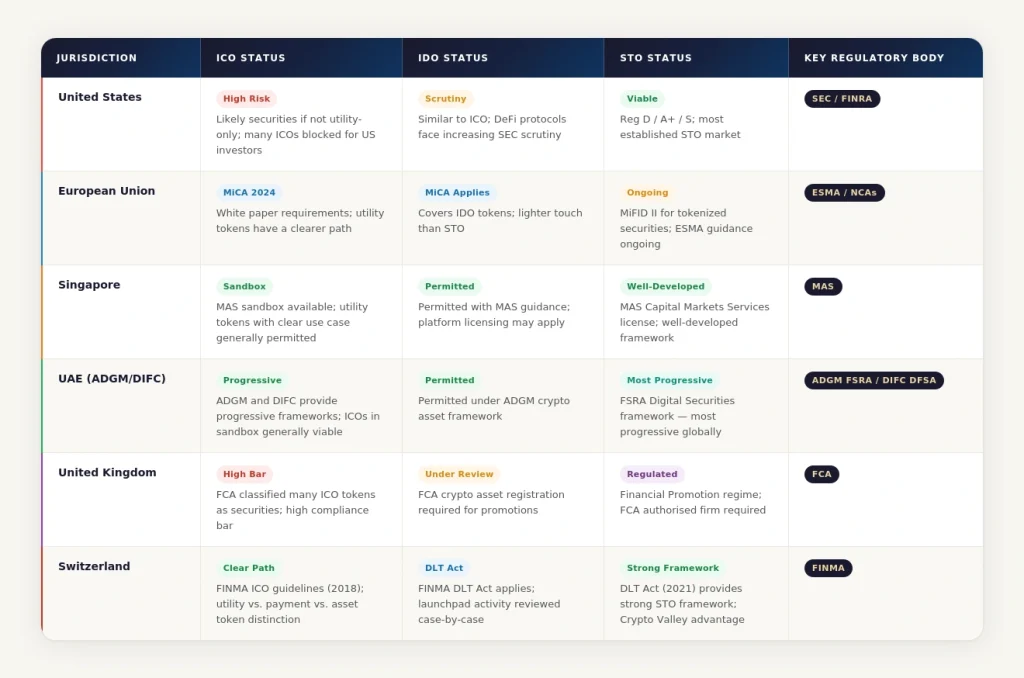
Regulatory Framework by Jurisdiction for ICO vs IDO vs STO Development
ICO vs IDO vs STO: Key Differences Explained
ICO (Initial Coin Offering)
ICOs are a global phenomenon introducing utility tokens via either central or decentralized platforms. Most ICOs are marked by a minimal level of regulatory supervision and a lack of regulatory scrutiny over their entire lifespan and activities. The terms and conditions governing the token sale are solely determined by the Project. Investors are subjected to high risk owing to the scant legal protections they are afforded. Start-ups with limited budgets benefit from the lower cost of ICOs that render them accessible. All token holders are subject to the delay in liquidity caused by the listings that take place after the sale has ended.
IDO (Initial DEX Offering)
IDOs are the first to sell tokens on a decentralized exchange and additionally, offer instant liquidity. The whole process is handled by smart contracts that automatically carry out the sales and thus completely cutting out intermediaries and centralized control. Also, the on-chain transactions are so transparent that anyone can check all the token movements. The retail investors are going to be much wider since they will be able to participate from the very first day because of the lower barriers. Instant trading occurs straight away after the IDO is successfully concluded. Participants still have to deal with high gas fees and bot activity as major problems.
STO (Security Token Offering)
STOs are issuing security tokens that are regulated and represent ownership or rights that are backed by assets. Full compliance with securities law is meant to not only protect the issuers but also the accredited investors. While high legal fees are involved, the increased credibility and trust are the main advantages of such a situation. The participation of investors is restricted to those qualified under the most regulatory jurisdictions globally. The secondary market for security tokens is limited to regulated exchanges where trading of such assets takes place. The legal costs of monitoring compliance and reporting to regulatory authorities are ongoing.
Thus, understanding ICO vs IDO vs STO differences helps choose the best fundraising model for crypto projects based on compliance needs.
Comparison Table: ICO vs IDO vs STO Development
This extensive comparison underscores the main distinctions between different crypto fundraising models and thus facilitates the proper assessment of ICO vs STO vs IDO options.
| Factor | ICO | IDO | STO |
| Cost | $20K–$400K+ | $12K–$150K | $85K–$600K+ |
| Speed to launch | 2-4 months | 2-6 weeks | 6-12 months |
| Technical complexity | Moderate | Low to moderate | High |
| Regulation & compliance | Minimal/None | Minimal | Extensive/Full |
| Security & investor protection | Low | Moderate | High |
| Liquidity & market access | Post listing only | Immediate | Limited secondary markets |
| Risk level | High | Moderate to high | Low to moderate |
| Use case suitability | Utility tokens, dApps | Community-driven projects | Asset-based, equity tokens |
| Legal & KYC requirements | Optional/Voluntary | Platform dependent | Mandatory/ Strict |
| Scalability & global reach | Global access | Global access | Restricted to jurisdictions |
Grasping these differences explained between ICO vs IDO vs STO makes it easier to choose the right fundraising model, leading to the successful outcome of your crypto project.
How to Choose the Right Fundraising Model for Your Project
Determining the most appropriate fundraising model for a crypto project involves a thorough examination of objectives, compliance, capabilities, target audience, and resources.
Set Your Fundraising Goals and Target Capital
Get exact capital needs, timeline expectations, and whether growth through the dilution of shareholding is an acceptable risk.
Pinpoint Your Ideal Investor Audience
Clarify whether your target is retail investors, institutional players, or accredited high-net-worth individuals in that order.
Prepare for Regulation and Compliance
Evaluate the feasibility of your project in terms of the legal requirements, licensing, and obligations during the project period.
Analyze Technical Complexity and the Time to Market
Take into account the development period, smart contract audits, platform integrations, and the overall availability of technical resources.
Factor in Liquidity and Post-Launch Requirements
Analyze the need for liquidity right away, the exchange listings, the tacit market, and the long-term token utility requirements.
The decision between ICO vs STO vs IDO entails grasping the crypto fundraising models, the compliance requirements, and the best approach to fundraising.
Factors to Consider Before Selecting a Token Sale Model
Recognizing the decisive elements helps in picking the best crypto fundraising model that fits perfectly with the characteristics and limitations of your project.
Project Type and Real-Life Application
The first step is to consider whether your project concerns utilities, backed by assets, and rights representation, or just pure speculation.
Token Utility and Economic Design
It is necessary to create to the fullest the token utility, its supply mechanics, when and how it will be distributed, when it will be vested, and what long-term value will be offered.
Legal Jurisdiction and Compliance Obligations
Spot the rules that must be obeyed in the places where you operate and in the target markets that require your compliance with the legal framework.
Budget and Overall Fundraising Costs
Sum up all expenses that go along with the process and that include legal fees, marketing, development, audits, and listing costs.
Security Protocols
Nurture wide-ranging smart contract audits, penetration testing, multi-signature wallets, and strong security measures.
Considering these factors leads to the conclusion of ICO vs STO vs IDO that fits best, thus ensuring the perfect fundraising model for the success of a crypto project.
Our End-to-End Blockchain Fundraising Expertise
We provide all fundraising services that are not only comprehensive but also help projects in every step of successful token launching.
Fundraising Strategy and Model Selection
We look into the needs of the project and suggest the best fundraising models that are compatible with shareholder expectations, budgets, and target groups.
Tokenomics Design
Our specialists create durable tokenomics that include supply, distribution, usage, and reward structures.
Smart Contract Development
We create confidential and audited smart contracts on various blockchains, giving preference to functionality, safety, and compliance.
Regulatory and Compliance Support
The legal department helps with securities regulations, licensing requirements, KYC/AML implementations, and jurisdiction-specific compliance.
Exchange and Launchpad Integration
We list on different platforms like centralized exchanges, DEXs, and launchpads to enhance visibility and liquidity.
Fundraising Launch and Execution
We take complete control of the campaign, including marketing, community building, investor relations, and technical support.
Your project will be launched successfully through ICO Development and STO Development solutions because of our expertise in all crypto fundraising models.
The Future of Crypto Fundraising Models
One major direction that new and advanced methods of crypto fundraising are taking is through the use of combined, hybrid token sale strategies. Rule definitions are the main factor that brings in more institutional capital, and on top of that, they also give a worldwide boost to investors’ trust. The new frameworks for fundraising are mixing up the elements of ICO, IDO, and STO for more efficient launching of projects.
DAOs are more influential than traditional investors when it comes to the decision of where to allocate the capital. Tokenization of real-world assets opens up the fundraising world to the markets of physical assets. With the help of AI and analytics, the process of matching investors and optimizing launch strategies becomes even more precise.
Besides that, IDOs are still leading the way in community-driven token sales, which are characterized by instant liquidity. Security and compliance have turned into essential factors for serious fundraisers instead of being a matter of choice. So, single-step models are going to be replaced by a flexible, modular fundraising approach. While innovation and trust together, the future of crypto fundraising will be decided upon the right resources.
Why Choose Us for Fundraising Platform Development?
Cryptiecraft provides well-rounded blockchain fundraising services that are supported by expertise and achievements. Our group is composed of ICO Development, IDO launching, and STO Development specialists. The differences between ICO vs IDO vs STO have been clarified in-depth. Cryptiecraft, as a leading fundraising platform development company, assists in choosing which fundraising model fits best for a specific crypto project. Our comprehensive services include strategy, tokenomics, compliance, and technical execution. We will lead projects through all types of crypto fundraising with certainty.
Frequently Asked Questions
Q1. What are ICOs, IDOs, and STOs, and how are they different from one another?
Ans: Publicly sold utility tokens are the primary feature of ICOs. The launch of IDO takes place on DEXs. On the other hand, an STO is an issuance of securities that are properly regulated and governed by law. All these different modes are traditionally planned according to the strategy of the project’s goals.
Q2. Which one is preferable among ICO, IDO, and STO?
Ans: There is no one-size-fits-all approach for every project. ICOs are for open communities, IDOs are for quick liquidity. The STO route is a moderate option for regulated enterprises that want to gain institutional credibility.
Q3. What is the most secure crypto fundraising model?
Ans: The most secure fundraising model is regarded to be the STO. It entails adherence to the regulations and hence grants protection to the investors legally. Consequently, the elimination of fraud and compliance risks for corporations becomes substantial.
Q4. Which fundraising model is best suited for startups?
Ans: Generally, the IDOs are most suitable for startups. The reason is that they provide a fast launch along with early liquidity. Besides, the process is not bound to be a heavy regulatory one at the very beginning. Plus, the exposure is the one driven by the community.
Q5. Which fundraising model is best for enterprises?
Ans: STOs are the models of choice for enterprises and large organizations. Their characteristics are compliance, transparency, and investor protection. These points make them appealing to institutions and regulators. Across global markets.
Q6. In which aspect do ICO, IDO, and STO differ concerning costs?
Ans: The overall costs of ICOs are usually lower than that of STOs. IDOs take away listing fees by opting for decentralized exchanges. The high costs associated with STOs are largely due to compliance and legal requirements.
Q7. Which fundraising model offers better liquidity and quicker token listing?
Ans: The immediate DEX listings provided by IDOs give them the advantage of quicker liquidity. The tokens are trading right away after the launch. This is unlike ICOs or STOs, which have to face delayed exchange access most of the time.
Q8. Which fundraising model is likely to appeal to institutional investors?
Ans: STOs are the ones that attract institutional investors who are in search of regulated digital assets. They are in line with the current financial regulations and with the compliance-driven investment strategies of global financial institutions.
Q9. What is the cheapest crypto fundraising method?
Ans: ICO is typically the cheapest method of fundraising. It demands the least amount of infrastructure. While also being the least compliant among IDOs and STOs. Besides, the latter two have high operational requirements involved.
Q10. What is the duration of an ICO, IDO, and STO launch?
Ans: IDOs are the fastest to launch because of the uncomplicated decentralized processes. ICOs have longer periods for marketing preparations. STOs have a longer wait time because of the required regulatory approvals. Before the public fundraising can start, the approvals have to be secured.