

























In a world where the crypto market never slows down, timing is really important.
And, if you’ve ever wondered, “How long does it take to build a crypto exchange?”, then you are at the right place.
Today, many businesses want to launch their own cryptocurrency exchange platform. We could see users expecting smooth and safe trading. This makes the development time very important. Some exchanges take months to build because they are created from scratch. Others launch in just a few weeks by using ready-made solutions or clone scripts. However, each of these methods will yield the same outcomes, but requires a different amount of time and effort.
In this blog, we’ll explain what actually affects your launch timeline and why some businesses go live quickly while others take longer.
Let’s find out how much time it really takes to build a crypto exchange. Before jumping in let’s begin with a reminder on,
Cryptocurrency Exchange Overview
A crypto exchange is an online trading platform where users can buy, sell, or trade directly. These crypto trading platforms connect both traders and the crypto markets effortlessly. They offer real-time prices, wallets, and intuitive trading tools to help users manage their digital assets safely. The Crypto exchanges vary based on how they operate and the level of control the users have. Broadly, they can be classified as,
- Centralized Exchanges – These exchanges are controlled by a company or authority. Be it trading, security, or storage, everything is managed by a centralized authority.
- Decentralized Exchanges – These platforms run on blockchain smart contracts without any authority. The trades and transactions are done here directly in a decentralized manner without any intervention.
- Hybrid Exchanges – These exchanges combine the best of both CEX and DEX. It offers the speed and user-friendly features of centralized exchanges while giving more control and transparency like decentralized platforms.
How to Build a Crypto Exchange: Step-by-Step Process
A crypto exchange development requires strong planning, regulation, and a technical background. Here is a quick, clean glance at how to create a crypto exchange platform effortlessly.
- Project Planning – This is the base stage where you will identify the type of exchange you want to build and understand your target market, user base, and business goals. Competitor analysis and determine the unique value proposition.
- Legal Requirements – Upon preparing a base plan, it is also important to be compliant with essential laws and geographical restrictions. Understand the legal requirements, obtain essential licenses and registrations depending on your niche regions.
- UI/UX Designing – Now, you can move on to the design phase. Focus on creating an intuitive user experience for traders. Plan and design the platform’s dashboard, trading screen, charts, and wallet interface accordingly.
- Security Incorporation – The crypto exchange development comes with essential security implementations. Security protocols like Multi-layer authentication, DDOS protection, anti-phishing, and anti-fraud detectors are added here.
- Quality Assurance – Before launching the platform, ensure that the platform undergoes quality assurance checks and testing. The team of testers would need to test the platform based on several business circumstances and real-world use cases.
- Platform Launch – Here, the platform will be deployed to the planned production servers. Essential APIs and wallets are fully activated here. Based on the business requirements, marketing, listing partnerships, and user onboarding campaigns can also be launched here.
How Long Does it Take to Build a Crypto Exchange?
On average, building a crypto exchange would take around 6 to 8 business weeks, depending on your business approach. This timeline might be reduced depending on the core elements from the trading engine to the admin dashboard. While a fully custom-built exchange may take months, a clone or white-label model drastically speeds up the development without compromising the quality or performance. Here is an estimated quick breakdown of the development timeline that a crypto exchange development might follow,
Project Planning – 1 Week
The development journey begins with project planning. Here, the core requirements, tech stack, features, compliance needs, and development model are finalized. This phase can take time because every exchange has unique goals; aligning them is important.
UI/UX Design Customization – 1 Week
Even if you’re using a white-label or clone script, the platform needs an optimized UI/UX to match your branding, user flow, and target audience. Personalizing the exchange to your business goals might take up time.
Feature Integration & Module Customization – 2 Weeks
This stage is about integrating essential modules. Customization makes this phase time-consuming because each of the crypto exchanges may have its own requirements. Incorporating additional trading modules, advanced order types, and features might extend the project deadlines.
Security Implementation & Wallet Setup – 1 Week
Security is a non-negotiable factor in crypto exchange development. In this, integrating protocols like 2FA, anti-phishing, SSL encryption, DDOS mitigation, and wallet configurations is done. This time duration is really important, because a single mistake can lead to serious breaches.
Liquidity Integration & API Setup – 3 to 5 business days
Liquidity is important for any successful exchange. This step includes integrating with liquidity providers, external exchanges, or market makers. Bringing in additional asset pairs, getting responses from third-party APIs might slow up.
Testing & Performance Optimization – 1 to 1.5 weeks
Once the core functions are in place, the QA teams test the platform across all scenarios and real-world cases. Testing and fixing up in case of any bugs or vulnerabilities might take up the time.
Final Deployment & Launch – 3 to 4 days
The final stage involves deploying the exchange on the main servers. Configuring the domain, firewall setup, launching the app, cloud server verification, and monitoring initial uptime takes time.
Estimated Time Taken For Crypto Exchange Development Approach
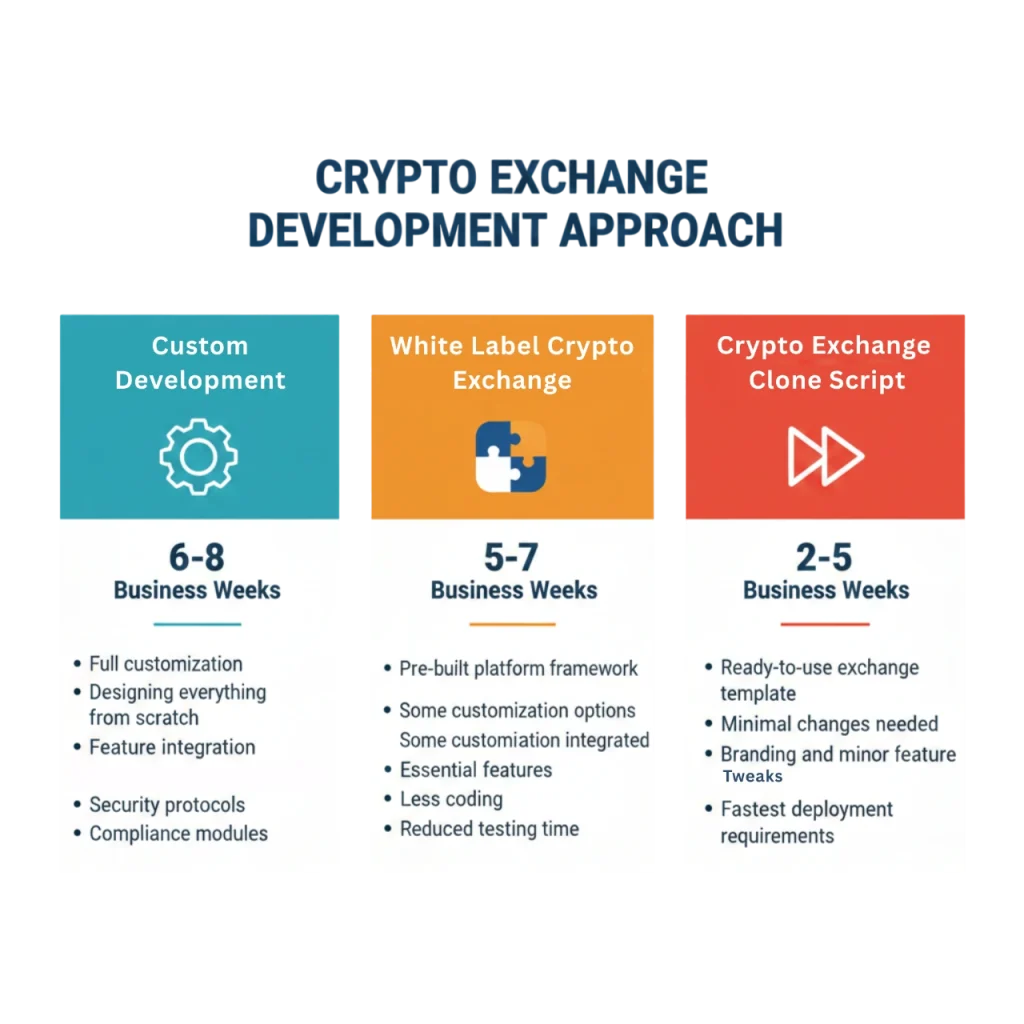
The time taken to launch a crypto exchange varies mainly due to the level of customization and the extensive support involved. Custom development takes the longest timeframe because every component, from UI/UX to trading engine, everything needs to be built and tested from scratch. While the White-label solutions save time by offering a pre-developed platform where businesses can customize modules without building the base structure. This reduces the development time to a few months. On the contrary, the crypto exchange clone scripts are the fastest route since they are ready-made replicas of proven exchanges. They require only minor branding and feature changes, allowing a functional platform to go live in just a few weeks.
What Are the Factors Impacting the Development Timeline?
Building a crypto exchange involves several technical, financial, and regulatory components, each of which directly affects how fast the platform can go live. Below are the major factors that determine your overall development timeline.
Feature Customization
The more features you add, the longer the development time would be. Basic exchanges with essential modules can be developed quickly. The advanced customizations, such as multi-chain support, AMM, and analytics, would require extra time. Tailoring the UI/UX, admin controls, or third-party integrations might also extend the project duration.
Regulatory Compliance
Compliance is important and can significantly influence timelines. Different regions require various types of licenses and might follow various frameworks. The process of setting up, executing, and validating these may take weeks or months, depending on the locality.
Crypto Exchange Type
The crypto exchange development timeline might change based on the type of exchange and trading module you develop. Each of these has its own level of complexity in the development process. The more advanced the trading type, the more time is required to build, integrate, and test the backend systems.
| Trading Type | Time Duration Taken | How Does it Impact the Development Timeline |
| P2P Trading | 6-8 Business Weeks | Moderate timeline. Requires escrow logic, chat systems, dispute management, and KYC validation. |
| OTC Trading | 5 – 7 Business Weeks | Takes up extra time for manual trade handling, verification processes, and high-limit security layers. |
| Spot Trading | 3-4 Business Weeks | Fastest to develop. Requires a basic matching engine and simple order execution tools. |
| Futures Trading | 4-5 Business Weeks | Slower to develop due to complex risk engines, funding rates, and liquidation logic. |
Security Measures
Security protocols are the most important part of the crypto exchange development. Incorporations like multi-layer authentication, DDoS mitigation, anti-phishing protection, and continuous security audits require careful design and testing. The more your security requirements, the longer the development time.
Technology Stack
The choice of technology stack can either fasten or slow down development. Using a modern tech stack helps in speeding up the process. The outdated or overly complex stacks may require additional time. Factors like database selection, third-party APIs, and programming language choices directly influence the overall timeline.
Product Testing
A crypto exchange must undergo extensive testing before launch. This includes functional, API, performance, stress testing, and security audits. Each bug or vulnerability discovered requires fixing. The more advanced your platform’s features are, the more time is needed. This ensures everything works smoothly under real-world conditions.
Budgeting Constraints
Your financial state affects the pace of development. Projects often slow down when businesses are still finalizing budgets or waiting for funding approval. Some projects might stop midway due to financial constraints. A clear, well-planned budget beforehand will ensure you an uninterrupted progress.
How to Reduce The Crypto Exchange Development Time?
Building a fully-functional crypto exchange from scratch can be a time-consuming process. They often take time due to the complexities like security protocols, liquidity management, and trading engine integration. Here are some of the most effective ways to speed up your development process.
Custom Development From Scratch
Even when building a crypto exchange from scratch, try launching the platform with only the essential features first. This approach lets you go live faster while ensuring the exchange remains stable and secure. Once the basic trading engine, wallet, KYC, and order-book functions are successfully deployed, you can add additional modules. This cuts down initial development time, lowers complexity, and allows for smoother upgrades based on real user feedback.
White-Label Crypto Exchange
A white label crypto exchange software is a ready-made software solution platform that comes with all the essential features. By using a white label solution, you skip the time-consuming development from scratch and focus directly on branding and regulatory setup. These platforms are built to offer security, scalability, and user experience, making them an ideal choice for businesses to enter the crypto market faster.
Crypto Exchange Clone Scripts
Another effective way to reduce development time is through a crypto exchange clone script. These clone scripts replicate the functionality of successful exchanges, offering ready-to-deploy clone solutions. This allows you to customize the features to match your business needs. This approach is faster and cost-effective, since the backend logic and trading mechanisms here are pre-tested and ready to deploy.
Both white-label platforms and clone scripts drastically minimize development time and effort. If you’re curious about the cost to develop a crypto exchange, then these pre-built solutions are the best bet you could make.
Future Trends That Could Reduce Development Time
The future of crypto exchanges is quite promising and fruitful. Here is a list of future predictions and possibilities that might streamline the process of developing a crypto exchange platform.
AI assistants
With the help of AI-integrated services and code-generation tools, some of the repetitive development tasks can be automated. This helps in fixing smart contracts, detecting bugs, and speeding up the overall development cycles.
Plug & Play Modules
Instead of building everything from scratch, the developers might go for ready-made modules for KYC, trading engines, and risk analytics tools. This approach will help in minimizing development time and effort dramatically.
Regulatory Frameworks
As the global crypto regulations become clearer and streamlined, the developers will spend less time navigating compliance complexities. This predictability and legal support would reduce the delays and shorten approval timelines.
How Cryptiecraft Helps You Launch a Fully Functional Crypto Exchange Quickly
Cryptiecraft is the leading Cryptocurrency Exchange Development Company. They simplify the entire crypto exchange development journey with their exemplary crypto exchange development services. Besides, they are also known for offering ready-made, infrastructure designed specially for fast deployment. Our team also offers you a complete end-to-end development approach, taking care of everything from requirement planning to platform deployment.
We have a team of professionals and experts who will solely work on your development goals. With a proven development framework and 80% reusable architecture, we offer continuous, uninterrupted technical support, helping you stay ahead of the market competition.
Frequently Asked Questions
1. How long does it take to build a crypto exchange from scratch?
The estimated time to build a crypto exchange from scratch typically takes around 4 to 9 months. Based on your platform size, feature complexity, regulatory approvals, and development resources this might change.
2. Can I launch a crypto exchange faster?
Yes. You can launch a crypto exchange faster using a white label crypto exchange solution or a customized clone software. These ready-made frameworks come with pre-built functionalities, allowing you to enter the market quickly.
3. What affects the time duration of crypto exchange development?
Several key factors influence the crypto exchange development time, including,
- Customizable Feature Integration
- Licensing & Regulatory Requirements
- Security Requirements
- Used technology stack
- Planned Budget & Resources
4. What Are the Development Stages Involved in Building a Crypto Exchange?
A professional crypto exchange development includes,
- Project Planning
- Legal/Regulatory Requirements
- UI/UX
- Feature Incorporation
- Security Protocol integration
- Quality Assurance
- Platform Launch