





























Key Takeaways:
- Matching engine = the most performance-critical component of any exchange, determines speed, fairness, and trading experience
- Binance processes 1.4 million orders per second; a new exchange needs 50,000–100,000/sec minimum to be competitive for professional traders
- Three matching algorithms: Price-Time Priority (most common), Pro-Rata, Hybrid
- Primary languages: Golang (most production engines), Rust (performance-critical), C++ (legacy institutional)
- Build vs buy: custom engine = $20K–$30K+ and 4–12 months; white-label = weeks and fraction of cost
Binance’s order matching engine reportedly processes up to 1.4 million orders per second. Nasdaq’s matching engine handles around 300,000 messages per second. In contrast, dYdX’s on-chain engine processes roughly 10 trades per second, highlighting the massive performance gap between centralized and decentralized architectures.
Ever wondered how thousands of traders hit buy and sell at the exact same second—yet everything executes seamlessly without chaos?
Well, the reality is far from simple.
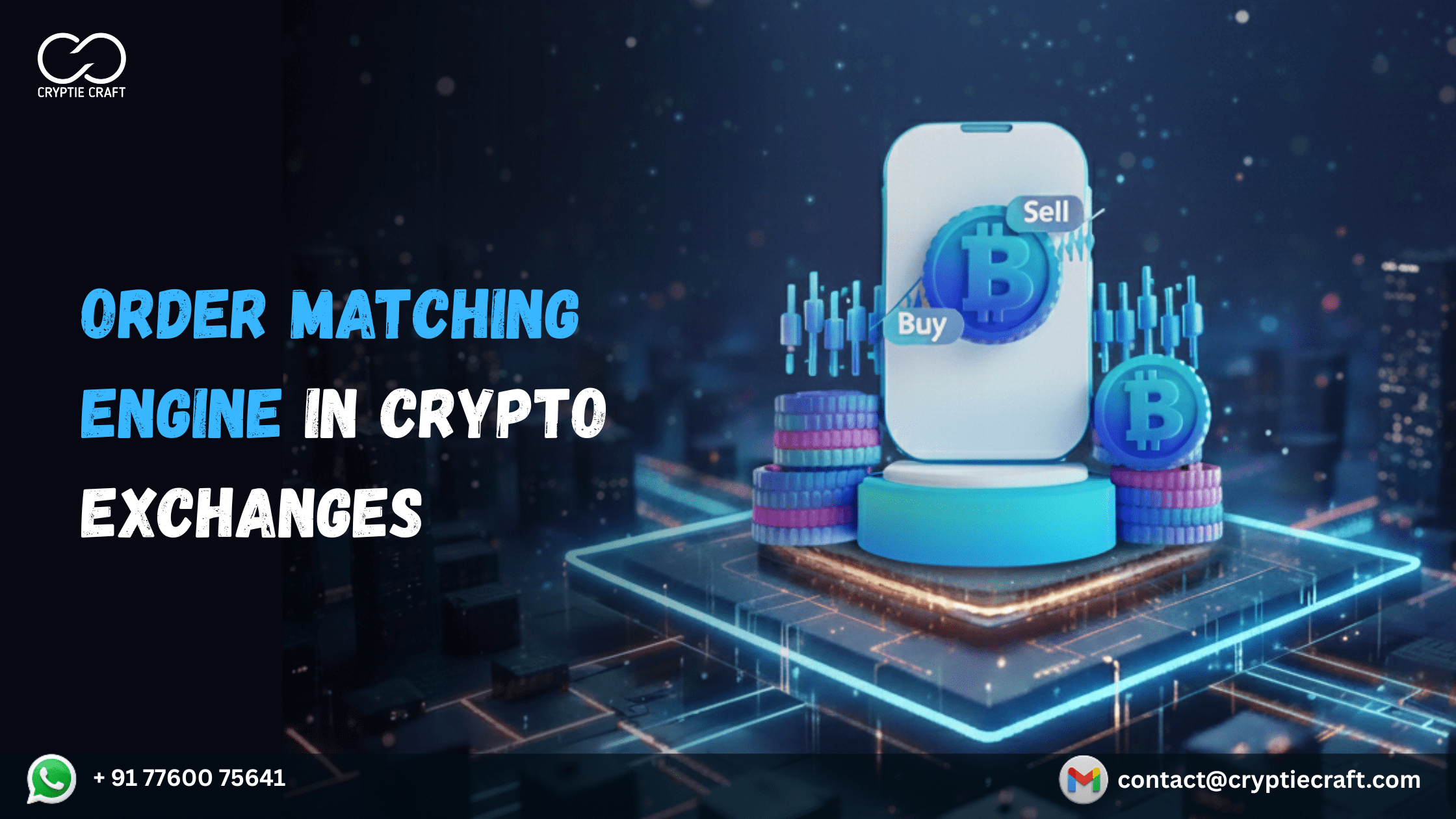
Behind the simple buy/sell button, the trader click is a whole world of the matching engine. This order matching engine in a Crypto exchange would quietly do all these risky jobs. They prioritize orders, match prices, and keep the entire exchange platform from collapsing.
In this blog, we’ll break down how matching engines actually work, how they’re structured, and the backend architecture that keeps a crypto exchange fast, stable, and reliable. By the end, you’ll have a clear understanding of what happens behind the scenes every time a trade is executed.
How an Order Matching Engine Works ?
An order matching engine is the core component of a cryptocurrency exchange that receives buy and sell orders, validates them, organizes them in a real-time order book, and pairs compatible orders for trade execution using a defined matching algorithm. It operates in microseconds, processing thousands to millions of orders per second while maintaining price-time fairness across all participants.
Order Submission Process
When a user places an order, the exchange captures the full order details: asset pair, direction (buy/sell), quantity, price, order type, and timestamp. The timestamp is critical, it’s used to establish time priority in price-time matching algorithms. Orders arrive via REST API (for standard placements) or WebSocket (for real-time high-frequency submissions).
Order Validation and Risk Checks
Before reaching the order book, every order goes through validation: sufficient user balance, valid order parameters, price within acceptable bounds, and account status checks. This layer also runs risk checks, flagging suspicious patterns, oversized positions relative to available liquidity, or orders that could manipulate the market. Invalid or risky orders are rejected here, before consuming matching engine resources.
Order Book Creation
Valid orders enter the order book, a real-time sorted data structure that maintains all outstanding buy and sell orders. Buy orders are sorted with the highest bid at the top; sell orders with the lowest ask at the top. The spread (gap between best bid and best ask) is visible to all traders and reflects current market depth. This structure must be updated atomically, partial updates create race conditions that cause matching errors.
Trade Matching & Execution
The matching algorithm continuously scans for compatible order pairs, a buy order at or above the price of a sell order. When a match is found, the trade executes immediately. Market orders fill against the best available price. Limit orders may fill partially if insufficient liquidity exists at the specified price. The matching algorithm determines the order of execution when multiple orders compete at the same price level.
Post-Trade Processing
After execution, the engine updates account balances (credit buyer, debit seller), stores the trade record in the transaction history database, calculates and deducts trading fees, and broadcasts the trade update to all WebSocket subscribers. Partial fills generate multiple trade records if a single order is matched against several counterparties. This settlement must be atomic, the entire update either completes or rolls back.
Types of Orders Supported by Matching Engines
A matching engine supports a wide range of order types. Each of these is planned for different trading scenario. Below is a list of the most common order types used in crypto exchanges.
i. Market Orders
Execute immediately at the best available price. No price guarantee. The matching engine fills against the order book in sequence from best available price until the order is fully filled or book is depleted.
Ideal for: Traders who want fast execution.
ii. Limit Orders
Execute only at a specified price or better. If no compatible order exists, the limit order waits in the order book until matched or cancelled. The foundation of order book depth.
Ideal for: Traders who prefer price profitability.
iii. Stop Orders
Remain dormant until a trigger price is reached, then convert to market or limit orders. Used for automated loss protection and strategic entries without constant monitoring.
Ideal for: Traders looking for automated risk management and strategic entries.
iv. Trailing Stop Orders
The trigger price automatically adjusts as the market moves favorably, trailing by a set percentage or fixed amount. If the market reverses by the trailing distance, the stop triggers.
v. Fill-Or-Kill and Immediate-Or-Cancel
Must be completely filled immediately or cancelled entirely. No partial fills. Used by institutional traders who need guaranteed full execution or nothing, avoiding partial position accumulation
Ideal for: Traders seeking strict execution conditions.
vi. Futures and Perpetual Orders
Futures contracts execute at a predetermined price for future delivery. Perpetuals have no expiry, using continuous funding rates. Both require additional matching engine logic beyond spot trading: funding rate calculations, mark prices, and liquidation triggers. Exchanges targeting derivatives markets require specialized crypto perpetual exchange development expertise to implement these mechanics correctly.
Ideal for: Traders looking for long-term strategies.
vii. Immediate-Or-Cancel (IOC)
Executes whatever portion is immediately available and cancels the remainder. Allows partial fills unlike FOK. Useful when traders want some execution at current liquidity levels without waiting for the rest.
Ideal for: Derivatives
Order Matching Algorithms Explained
The matching algorithm determines which orders get filled first when multiple orders exist at the same price level. The choice of algorithm directly affects fairness perception, trading strategies that work on the platform, and professional trader behavior.
i. Price-Time Priority Model:
The best price executes first. At equal prices, the earliest-submitted order wins. Creates a natural incentive to submit orders quickly and at competitive prices. The most widely used algorithm is because of its simplicity and fairness properties, and it is early participant without complexity.
ii. Pro-Rata Matching Model:
At the same price level, execution is proportionally allocated by order size rather than time priority. A 100-unit order at $50 gets 10x the execution allocation of a 10-unit order at the same price. Favors large liquidity providers over early movers. Common in markets where large institutional orders need guaranteed partial fills.
iii. Hybrid Matching Algorithms
Combines price-time priority with pro-rata allocation, typically price priority first, then pro-rata among tied price orders. Balances fairness for early submitters with proportional allocation for large liquidity providers. More complex to implement but provides better market quality in high-liquidity environments.
Order Book Architecture
To understand how trades are actually organized and executed, we need to look at the order book architecture.
i. Centralized Limit Order Book Structure:
This is the core framework of most trading platforms. This maintains a list of all buy and sell orders arranged based on the different price levels. The highest bids on one side, the lowest asks on the other, creating a clear pathway. The matching engine reads from this structure continuously to execute trades whenever compatible prices meet.
ii. Order Cancellations and Modifications Management
Traders usually update their orders, and the matching engine must respond instantly. When a user cancels or modifies an order, the system removes or updates it in the order book without disrupting ongoing matching operations. This keeps the order book accurate, stable, and trustworthy.
Security and Risk Control Mechanisms
An order matching engine must operate in a strictly controlled environment where every trade is protected from manipulation, system failures, and malicious attacks. For a comprehensive breakdown of all the layers involved, see our dedicated crypto exchange security guide. At the engine level, modern exchanges implement the following core protections:
- Uses time-stamped ordering and fair sequencing rules to detect abnormal order patterns and suspicious price movements.
- This matching engine can validate order details and price boundaries to prevent the risks of malformed or inconsistent trades.
- Matching engine replicas are kept as a backup for instant switch-over. These also have real-time syncing to prevent data loss or trade mismatches.
Compliance Structure of the Matching Engines in Exchanges
Monitoring and compliance systems are significant for maintaining transparency in a trading platform. These tools help exchanges track real-time activities, maintain historical records, and stay prepared for regulatory audits. Here is a list of some of those,
Real-time trade monitoring
They alert the system to unusual trading patterns or sudden volatility. They help you maintain a healthy trading environment, tracking market activity and liquidity changes.
Audit Trails
They record every action, submission, cancellation, modification, and even the matches. They ensure full traceability for dispute resolution, ensuring a fair trading ecosystem.
Compliance Ready
They support essential KYC/AML integration and follow up with risk-based monitoring. They would automate report generation for regulators and internal teams.
Challenges in Building a Matching Engine
Developing an order matching engine for a crypto exchange might seem like an easy task, but it also comes with its own limitations and complexities. Here is a quick list of challenges and some mitigation strategies that building a matching engine might bring to the table.
i. Scalability Issues
The Challenge:
A matching engine needs to process thousands of orders per second without slowing down. As the number of users rises during market volatility, the engine can experience congestion. This might lead to delayed order execution and a poor trading experience.
The Fix:
To handle heavy loads, exchanges need to adopt proper scaling functionalities. Also, having a balanced smart contract logic might help smooth functioning even during peak hours.
ii. Network Latency
The Challenge:
In trading, even a millisecond delay can change the price at which an order gets filled. High latency between the user, server, and internal modules leads to slippage, unfair prices, and a loss of user trust.
The Fix:
Optimizing latency rates might help in minimizing trade delays and executing them correctly at lightning speed.
iii. Data Consistency Issues
The Challenge:
The order book needs to be updated many times a day. If even one update goes out of sync, then it huge issue. One might face errors, mismatched order states, or duplicate trades, creating accounting issues, imbalanced user balances, or distorting market depth.
The Fix:
Incorporate the matching engines with event sourcing functions to maintain a clean, traceable action. This ensures that the order book remains accurate at all times.
iv. Security Vulnerabilities
The Challenge:
Matching engines are high-value targets. Attackers may attempt to inject fake orders to bring vulnerabilities or overload the system with malicious traffic. Any breach can freeze trading or manipulate prices.
The Fix:
Security is enforced using strict API rate limits, role-based access control, WAF protection, and real-time anomaly detection to stay resilient against attacks.
Build vs. Buy: Making the Right Decision
For founders earlier in the process, our how to build a cryptocurrency exchange guide covers the full product and infrastructure roadmap. For those specifically evaluating the matching engine decision: a custom engine gives you full architectural control, while a white-label solution compresses your time to market from months to weeks.
| Factor | Custom Build | White-Label / Partner |
| Timeline | 4–12 months | Weeks |
| Upfront Cost | $20K–$30K+ | Fraction of custom cost |
| Performance Control | Full control | Pre-configured limits |
| Maintenance | Your team | Vendor-managed |
| Best For | Tier-1 ambitions, unique algorithm needs | Speed-to-market, validated architecture |
For a full breakdown of all development expenditures across the stack, see our cost to build a crypto exchange , which covers infrastructure, licensing, compliance, and team costs end-to-end.
Future of Order Matching Engines
Given the rise in cryptos, we all can agree that the cryptos aren’t slowing down. They might only expand their possibilities in the future rather than being limited. Here are some of the possibilities that the matching engines might bring in the near future.
AI-Powered Order Flow Prediction
Machine learning models predict order flow patterns to pre-allocate matching engine resources before volume spikes arrive. AI-based anomaly detection for market manipulation patterns (spoofing, layering) at the microsecond level, faster than rule-based detection systems.
Cross-Chain Matching
Matching engines that process orders across multiple blockchain networks simultaneously, creating unified BTC/ETH liquidity across Ethereum, Solana, and BNB Chain without requiring users to bridge assets. The technical challenge: maintaining atomic execution guarantees across chains with different finality times.
CEX/DEX Convergence
Centralized engines maintaining their performance advantage while DeFi perpetuals (dYdX, Hyperliquid) narrow the gap through L2 and app-chain architectures. The next 3–5 years will see hybrid models where centralized matching engines settle to decentralized ledgers, combining the performance of CEX with the custody model of DEX.
Intelligent Market-Making Integration
Deep integration between matching engines and automated market-making systems that manage liquidity, balance inventories in real time, and keep spreads tight during volatility, creating healthier markets with lower slippage and more consistent trading experiences across all market conditions.
Performance and Scalability Capabilities of the Matching Engine
i. Latency Optimization Techniques
An order matching engine in a crypto exchange is built to reduce every possible millisecond of delay. Techniques like in-memory processing, optimized network paths, and low-latency messaging queues help engines to respond and process trades instantly.
ii. High-Frequency Trade Handling
A scalable matching engine must handle a massive number of orders, especially from high-frequency traders. This engine uses efficient matching algorithms, parallel processing, and batching mechanisms to keep performance stable.
iii. Horizontal and Vertical Scaling
To support growing user bases and increasing market loads, the engine can scale in two ways. Vertical scaling adds more power to existing machines, while horizontal scaling spreads the load across multiple engine nodes.
iv. Throughput Optimization Strategies
High throughput means the engine can process a huge number of orders at the same time. Techniques like multi-threaded execution, efficient memory management will help in improving overall order-processing capacity.
Why is Cryptiecraft the Ideal Partner for Building a High-Performance Order Matching Engine?
Cryptiecraft is a well-established crypto exchange development company. The years of hands-on experience and expert developer team support make this company stand out. With a deep understanding of market behavior, trading logic, and security requirements, Cryptiecraft will help you build platforms that are fast, scalable, and reliable. If you’re looking to build a top-tier crypto exchange, then Cryptiecraft is the most suited development partner that can make it happen.
Frequently Asked Questions
Q1. What is an order matching engine in a crypto exchange?
Ans: An order matching engine is the core component of a cryptocurrency exchange that receives buy and sell orders, validates them, organizes them in a real-time order book, and pairs compatible orders for execution using a defined matching algorithm. It operates in microseconds, processing thousands to millions of orders per second. The matching engine determines the price, time, and fairness of every trade on the platform.
Q2. What programming language is used for crypto exchange matching engines?
Ans: Golang (Go) is the most common language for production crypto exchange matching engines in 2026 , it offers strong performance, native concurrency through goroutines, a large developer pool, and manageable development complexity. Rust is used for exchanges that need zero garbage-collection pauses and maximum memory safety at the cost of higher development complexity. C++ remains in legacy institutional systems. Most new production engines are built in Golang; Rust is the choice for teams that specifically need sub-microsecond latency guarantees.
Q3. How many orders per second should a crypto exchange matching engine handle?
Ans: For a new CEX targeting professional traders, 50,000–100,000 orders per second is the competitive floor. For retail-focused exchanges: 10,000–50,000 orders/sec is generally sufficient. Binance’s matching engine processes approximately 1.4 million orders per second. A new exchange doesn’t need to match Binance’s throughput, but it needs enough capacity to handle traffic spikes during major market events (typically 10–20x normal volume).
Q4. What is the difference between price-time priority and pro-rata matching?
Ans: Price-time priority (FIFO) fills the best-priced order first; at equal prices, the earliest-submitted order wins. It’s the most common algorithm and rewards fast, competitive order placement. Pro-rata matching fills orders at the same price proportionally by size is a 1,000-unit order gets 10x the execution of a 100-unit order. Pro-rata is used in markets where large institutional orders need guaranteed proportional fills regardless of submission time. Most crypto exchanges use price-time priority; some derivatives markets use pro-rata for large order books.
Q5. How is a CEX matching engine different from a DEX matching engine?
Ans: A CEX matching engine is centralized software running on the exchange’s servers, processing millions of orders per second with sub-millisecond latency. A DEX matching engine uses smart contracts on a blockchain, processing orders on-chain, which limits throughput to the blockchain’s transaction speed (10–1,000 transactions per second depending on the chain). On-chain matching requires deep smart contract development expertise to ensure atomic settlement guarantees and resistance to front-running. Some DEXs (dYdX) use hybrid approaches: off-chain order matching with on-chain settlement, achieving CEX-level matching speed while maintaining non-custodial settlement. The fundamental CEX vs DEX trade-off is performance vs trustlessness.