Binance Clone Script
 KuCoin Clone Script
 Bybit Clone Script
 Kraken Clone Script
 OKX Clone Script
 ERC-20 Token Development
 TRC-20 Token Development
 BEP-20 Token Development
 Crypto Token Development
 ICO Development
 STO Development
 Binance NFT Clone
 OpenSea Clone Script
 Rarible NFT Clone
 NFT Marketplace Development
 MetaMask Clone Script
 Trust Wallet Clone Script
 Crypto Wallet Development
 DeFi Wallet Development
 Uniswap Clone Script
 PancakeSwap Clone
 SushiSwap Clone
 Crypto Payment Gateway
 Binance Pay Clone
 Crypto MLM Software
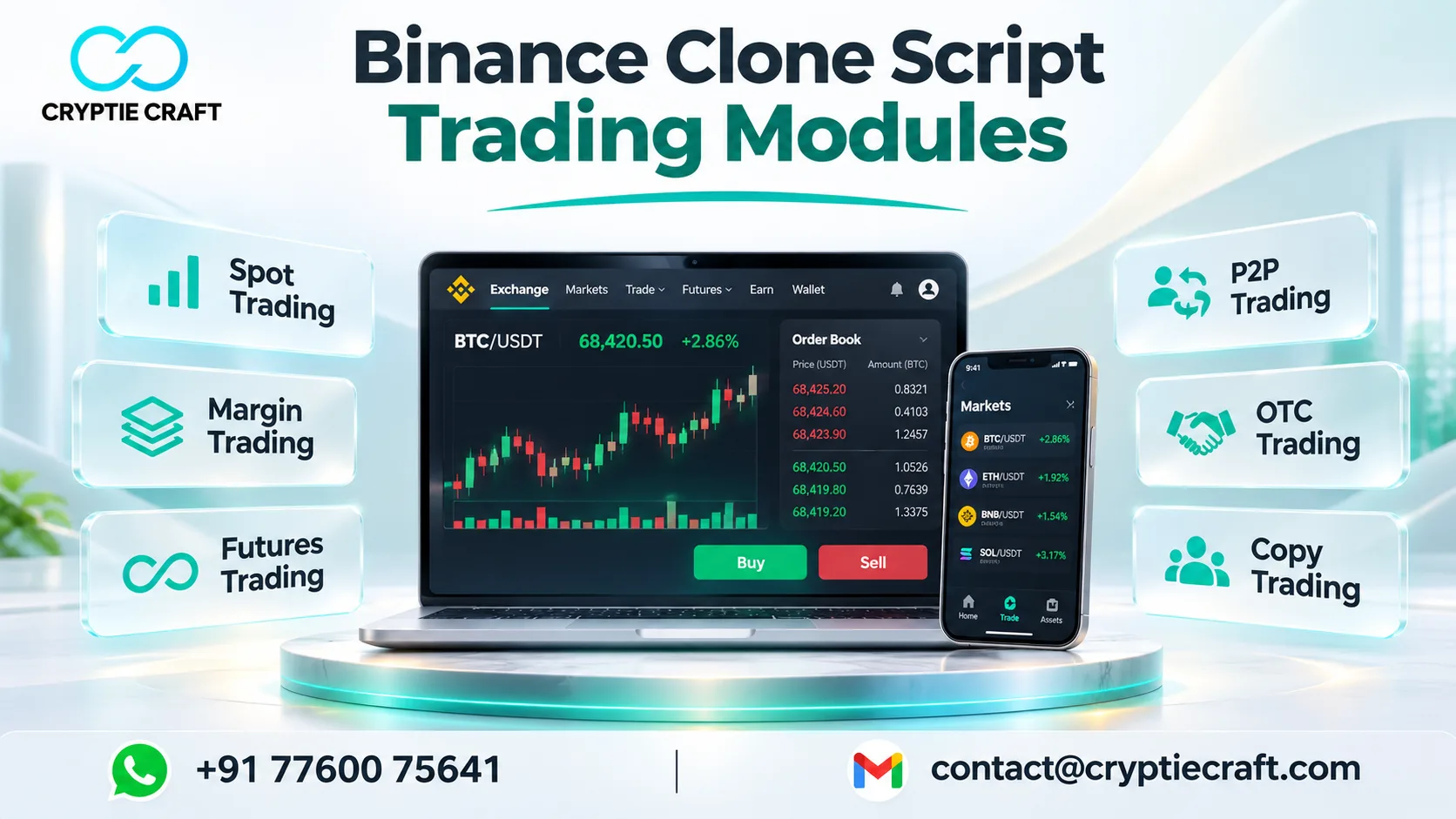
A Binance Clone Script can support multiple trading methods within one cryptocurrency exchange, but each trading feature operates differently. Spot trading handles direct asset purchases, margin trading involves borrowed funds, and futures trading manages contract positions.
These differences affect how orders are executed, funds are allocated, and trading risks are controlled.
Binance Clone Script trading modules manage these activities through dedicated functions connected to the platform’s trading infrastructure. Each module has its own requirements, allowing different trading methods to operate within a single exchange.
Understanding these modules helps determine which trading features are suitable for a platform and what is required to implement them.
What Are Trading Modules in a Binance Clone Script?
Binance Clone Script trading modules are dedicated software components that manage specific trading activities. Each module follows its own rules for order placement, trade execution, fund management, and transaction settlement.
These modules interact with the matching engine, wallet system, and liquidity sources. While some handle direct cryptocurrency transactions, others require additional controls for borrowed funds, open positions, or payments between users.
This structure allows multiple trading features to operate within one platform while maintaining the functions required by each trading method.
Core Trading Modules in a Binance Clone Script
A Binance Clone Script can support six major trading modules, each designed for a different trading method. Their functionality depends on the platform’s configuration, integrations, and trading rules.
1. Spot Trading Module
The spot trading module allows users to buy and sell cryptocurrencies using their available funds. Traders can place market orders to execute against available offers or limit orders at a specified price.
The module includes trading pairs, live price charts, order books, and transaction history.
Market orders execute against available liquidity and may receive different prices across multiple fills. Limit orders execute only at their specified price or better, and any unfilled quantity may remain open until executed or cancelled.
2. Margin Trading Module
The margin trading module allows users to borrow funds against collateral to increase their trading exposure.
For example, a trader with $100 in eligible collateral may control a position worth $300 using 3x leverage, subject to borrowing limits, margin requirements, and applicable fees.
The module tracks borrowed amounts, interest charges, collateral value, and margin levels. It also monitors whether the account meets maintenance requirements.
If the margin level falls below the permitted threshold, the system may initiate liquidation according to its configured rules.
3. Futures Trading Module
The futures trading module allows users to trade contracts linked to cryptocurrency prices without directly purchasing the underlying assets.
Traders can open long positions when expecting prices to rise or short positions when expecting prices to fall.
The module manages contract specifications, leverage, open positions, unrealized profit or loss, and liquidation conditions.
Perpetual futures may include periodic funding payments between long and short positions, while dated futures have defined expiration and settlement terms.
Both contract types require accurate margin calculations and position monitoring.
4. P2P Trading Module
Users can buy and sell cryptocurrencies directly from other users through the payment methods supported by the P2P module.
A seller creates an advertisement specifying the price, payment method, and transaction limits. When a buyer accepts the offer, the seller’s cryptocurrency is held in escrow.
After the seller verifies receipt of payment, the cryptocurrency is released to the buyer.
The module also supports payment deadlines, transaction records, user verification, and dispute resolution to manage payment-related issues.
5. OTC Trading Module
The OTC trading module supports cryptocurrency transactions negotiated outside the public order book. It is commonly used for larger trades where a single market order could significantly affect the execution price.
Traders can request a quote, review the offered price, and confirm the transaction within a specified period.
The module manages quote validity, trade confirmation, settlement status, and transaction records.
The execution process depends on whether the platform uses direct negotiation, an OTC desk, or an external liquidity provider.
6. Copy Trading Module
The copy trading module allows users to follow selected traders and automatically replicate eligible trading activity according to configured settings.
Users can review a lead trader’s performance, allocate funds, and define limits for copied positions.
When the lead trader opens or closes a position, the module attempts to execute a corresponding trade in the follower’s account.
It tracks copied positions, profit or loss, and available balances. Differences in execution prices, account funds, or order restrictions can cause follower results to vary from those of the lead trader.
How Trading Modules Connect with Exchange Infrastructure
Trading modules rely on shared systems, but their technical requirements differ. Understanding how each module uses order matching, liquidity, balances, collateral, and risk controls helps explain how these features operate within one exchange.
Order Matching
The order matching process executes compatible buy and sell orders in spot and margin trading based on their prices, quantities, and order priority.
Spot trading uses the order book to match orders against available liquidity. Margin trading may use the same matching engine, but the module must first verify the trader’s available buying power, including permitted borrowed funds.
A limit order remains open when no compatible order is available, unless its order conditions require cancellation.
The matching process forms part of the wider Binance Clone trading workflow, which covers how orders move through the platform.
Liquidity Integration
Liquidity integration determines the available prices and quantities that trading modules can access during execution.
Spot and margin trading rely on liquidity in their supported asset markets. Futures trading requires liquidity in the relevant contract markets, while copy trading depends on available market depth when replicating orders.
For example, a large market order may execute across several price levels if sufficient quantity is unavailable at the best quoted price.
This results in slippage, meaning the average execution price is different from the expected price.
The impact depends on market depth, order size, and execution conditions.
Wallet Management
Wallet management tracks available, reserved, and allocated funds across trading modules.
Spot trading reserves the required balance for open orders. Margin trading accounts for borrowed funds and collateral, while futures trading tracks margin committed to active positions.
P2P trading holds the seller’s cryptocurrency in escrow until the transaction is completed or resolved.
Copy trading checks the follower’s available funds before attempting a replicated order.
These balance controls prevent funds already committed to one activity from being incorrectly reused in another.
Collateral Management
Collateral management supports leveraged trading by monitoring the funds required to maintain margin and futures positions.
Margin trading uses eligible collateral to secure borrowed funds. The module calculates account margin levels based on collateral value, outstanding liabilities, and applicable risk requirements.
Futures trading uses initial margin to open positions and maintenance margin to keep them active.
The required margin can change with position size, market prices, and contract rules.
If an account fails to meet its maintenance requirements, the module applies the configured liquidation process.
Risk Controls
Risk controls enforce the limits applicable to each trading method.
Spot trading may apply order quantity restrictions and price protection rules. Margin trading monitors borrowing limits, while futures trading applies leverage limits, position restrictions, and liquidation checks.
Copy trading can restrict the amount allocated to each copied position. P2P trading may enforce transaction limits, payment deadlines, and escrow release conditions.
Certain leveraged products may also require customer eligibility checks depending on the operating market.
These controls help trading modules operate according to their configured rules and account restrictions.
How to Choose the Right Trading Modules for Your Exchange
The right trading modules depend on your target users, technical requirements, and expansion plans. Each feature should serve a clear purpose without adding unnecessary complexity.
Target Traders
Spot trading suits users buying and selling cryptocurrencies directly, while margin and futures trading serve traders seeking leveraged exposure.
P2P supports direct user transactions, OTC accommodates negotiated trades, and copy trading allows users to follow selected traders.
Understanding the intended audience helps identify which modules should be prioritized.
Development Complexity
Trading module development involves different levels of technical implementation and testing.
Spot trading requires reliable order handling and settlement records. Margin trading introduces borrowing calculations and interest tracking, while futures trading requires continuous position valuation and testing of liquidation behavior during rapid price changes.
P2P development must account for payment disputes and escrow exceptions. Copy trading requires synchronization between lead traders and followers, including handling failed or partially executed orders.
These requirements influence the cost of Binance Clone development through additional integrations, testing, and maintenance.
Module Expansion
Trading modules can be introduced gradually based on platform requirements.
For example, an exchange may launch with spot trading and add margin trading once its borrowing functionality and risk controls have been tested.
Planning for future trading module integration helps maintain compatibility with existing balances, transaction records, and account permissions.
Why Choose Cryptiecraft for Binance Clone Script Trading Module Development?
Every trading module has specific technical requirements. Spot trading depends on accurate order execution, margin and futures trading require reliable collateral monitoring, while P2P and copy trading follow different transaction processes.
At Cryptiecraft, we develop trading modules based on how each feature needs to operate within the exchange. Our Binance Clone Script can be configured with spot, margin, futures, P2P, OTC, and copy trading capabilities, supported by the required liquidity integrations, wallet management, and trading controls.
Whether you’re starting with spot trading or planning to introduce advanced modules, our team can help define the functionality, integrations, and customization your platform requires.
Have specific trading modules in mind? Talk to Cryptiecraft about your Binance Clone Script requirements.

Frequently Asked Questions
Q1. Can spot trading and futures trading operate simultaneously in a Binance Clone Script?
Ans: Yes. Both modules can operate simultaneously when the platform maintains accurate trading balances, order records, and risk calculations for each supported market.
Q2. Why does a trading module show insufficient balance when funds are available?
Ans: Funds may be reserved for open orders, allocated as collateral, or held in another trading account, making them unavailable for new orders.
Q3. What happens when a Binance Clone Script trading order is partially filled?
Ans: The module records the executed quantity and leaves the remaining amount open, unless the order type requires cancellation of any unfilled quantity.
Q4. Why might a copy trading module fail to replicate a trade?
Ans: Copy trading may fail when followers lack sufficient margin, exceed order limits, select unsupported trading pairs, or encounter execution price restrictions.
Q5. Can a Binance Clone Script support isolated margin trading?
Ans: Yes. An isolated margin module can assign collateral to individual positions or trading pairs, limiting exposure according to the configured margin rules.
Q6. Can different trading modules support different order types?
Ans: Yes. Spot and margin modules may support market and limit orders, while futures modules can include conditional orders based on contract trading requirements.