Binance Clone Script
  KuCoin Clone Script
  Bybit Clone Script
  Kraken Clone Script
  OKX Clone Script
  ERC-20 Token Development
  TRC-20 Token Development
  BEP-20 Token Development
  Crypto Token Development
  ICO Development
  STO Development
  Binance NFT Clone
  OpenSea Clone Script
  Rarible NFT Clone
  NFT Marketplace Development
  MetaMask Clone Script
  Trust Wallet Clone Script
  Crypto Wallet Development
  DeFi Wallet Development
  Uniswap Clone Script
  PancakeSwap Clone
  SushiSwap Clone
  Crypto Payment Gateway
  Binance Pay Clone
  Crypto MLM Software
Imagine turning untouched assets, such as old buildings or private funds, into simple digital tokens that anyone can trade. Tokenization of real-world assets (RWAs) is exactly what it does. It is a transition from the old finance to blockchain, which is faster and more transparent. This change eliminates intermediaries, allowing anyone to invest small amounts.
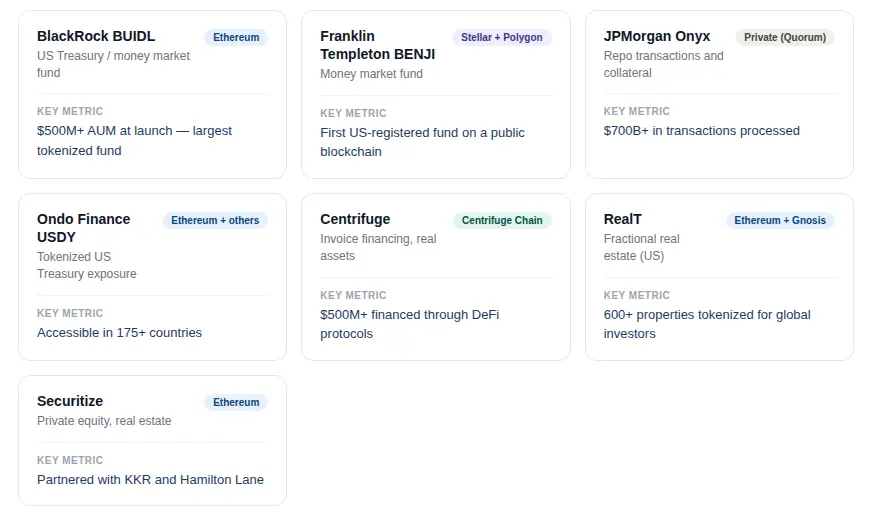
According to a CNBC report, in 2024, BlackRock introduced an Ethereum-based tokenized money market fund. Franklin Templeton subsequently proceeded with an on-chain money market instrument. The Onyx platform of JPMorgan has settled more than $700 billion in tokenized repo transactions. They are not pilots, but they are production deployments by institutions whose assets are managed in the trillions.
According to the latest market report by Binance, the total market cap of real-world assets tokenized on public blockchains has surpassed $30 billion by late 2025, indicating a substantial number of users engaging with these platforms to purchase valuable assets.
In this blog, we will outline the main process of the RWA tokenization platform Development with the latest features and how to join this fast-paced industry.
What is RWA Tokenization Platform Development?
RWA Tokenization Platform Development is the construction of a full-fledged digital infrastructure that allows businesses to tokenize physical or financial assets on blockchains and operate their full life cycle, including issuance and trading.
In contrast to simple token creation, it involves developing a full-scale platform that incorporates smart contracts, compliance frameworks, investor management, and integrations necessary to work in a scalable and regulated asset ecosystem.
Our RWA Tokenization Platform Development Services
We provide end-to-end RWA tokenization platform development solutions to assist you in developing, launching, and scaling secure, compliant, and high-performance asset tokenization platforms.
Custom RWA Tokenization Platform Development
We create fully-customized RWA tokenization platforms that align with your asset type and business objectives. Our solutions are scalable, flexible, and long-term growth.
White-Label RWA Tokenization Solutions
Our white-label RWA platforms are ready to deploy, making us a better fit to help you start. Our solutions can be completely customized to suit your market and brand requirements.
Smart Contract Development & Auditing
We create secure and automated smart contracts to ensure smooth tokenization of assets. We have a reliable auditing process that is transparent and risk-free.
Compliance & Legal Structuring (KYC/AML Integration)
We incorporate effective KYC/AML to make your platform compliant with international standards. At Cryptiecraft, we assist you in navigating regulations and provide a seamless onboarding experience.
Multi-Chain RWA Platform Development
We develop multi-chain platforms on Ethereum, Polygon, BNB Chain, and others. Our solution provides scalability, interoperability, and performance optimization.
Secondary Market & Liquidity Integration
We facilitate smooth trading through secondary market integrations and liquidity provisions. In Cryptiecraft, we make sure that your platform facilitates real-time transactions and the flexibility of investors.
How the Real-World Asset Tokenization Platform Works
Asset Identification & Evaluation
The professional teams look at the asset, review the documents evidencing the ownership of the asset, check the legal status, and verify the feasibility of the tokenization by thorough due diligence and market analysis.
Legal Structuring & Compliance Setup
Through the use of ownership structures, regulatory frameworks, and compliance protocols, legal experts ensure the legitimacy of the tokens in different jurisdictions and under different regulations.
Asset Digitization & Token Creation
The technical teams write the smart contracts that outline the token features, the rights of the owners, the way the tokens will be distributed, and the rules of the governance of the tokenized asset.
Blockchain Registration
The assets are then recorded on the selected blockchain networks; thus, the ownership records become immutable with unique token identifiers, as well as metadata for verification happens in the Blockchain registration.
Token Distribution & Listing
The tokens are offered to investors in private sales or in public offerings. After that, they are listed on the exchanges that comply with the respective regulations and thus can be traded in the secondary market.
Ongoing Asset & Token Management
The continuous supervision ensures tracking of the asset’s performance, distribution of dividends, compliance reporting, and communication with the investors by means of automated systems based on the blockchain.
It is imperative to grasp this workflow to be able to implement it successfully.
Types of Assets Suitable for RWA Tokenization Platform
The following are the key types of real-world assets that can be tokenized using our RWA tokenization platform.
- Real Estate (Residential & Commercial)
- Commodities (Gold, Silver, Oil, etc.)
- Private Equity & Venture Funds
- Bonds & Debt Instruments
- Art, Collectibles & Luxury Assets
- Carbon Credits & ESG Assets
- Intellectual Property & Royalties
- Infrastructure Assets
- Agricultural Assets (Farmland, Crops)
- Revenue-Generating Businesses
Key Benefits of a Real-World Asset Tokenization Platform
Real-world asset tokenization platforms deliver transformative advantages for investors, asset owners, and financial institutions by revolutionizing traditional investment models through blockchain technology, creating unprecedented opportunities for market participation and efficiency.
Enhanced Liquidity
Tokenization unlocks liquidity in traditionally illiquid assets, enabling faster transactions and broader market participation through digital exchanges worldwide.
Fractional Ownership
Blockchain enables the division of an asset into smaller units, thus investors can purchase affordable fractions of high-value properties or commodities.
Global Investor Access
Digital tokens remove location-based restrictions, giving investors from anywhere in the world access to diverse asset classes via decentralized blockchain networks instantly.
Improved Transparency
The use of blockchain creates an unchangeable ledger that records ownership, transaction histories, and even real-time asset tracking, which is viewable by all stakeholders involved.
Faster Settlement & Reduced Costs
Smart contracts handle settlement activities automatically; hence, no intermediation, together with transaction costs, paperwork, and processing timeframes.
Regulatory Traceability
With blockchain, there are full audit trails, which enable the monitoring of regulatory compliance, transaction tracking, and transparent reporting for government authorities.
Such attractive advantages are what make tokenization the fastest method to modernize asset ownership and investment. Knowing the benefits naturally leads one to consider the technical implementation process.
Following that, we will delve into the vital platform components that make these tokenization operations possible and efficient.
Essential Features of Our RWA Tokenization Platform Development
Our all-in-one tokenization platform incorporates advanced features that not only simplify asset digitization but also guarantee compliance with regulations and provide smooth user experiences for all stakeholders.
Multi-Asset Tokenization Engine
The RWA token development is capable of tokenizing any asset class that includes real estate, commodities, securities, art, and intellectual property.
Smart Contract-Based Token Issuance
The automated smart contracts help in creating secure tokens and their subsequent management, along with programmable rules and customizable governance for assets.
Investor & Asset Management Dashboard
User-friendly dashboards offer portfolio monitoring in real-time, transaction logs, asset performance metrics, and a wide range of reporting tools for stakeholders & administrators.
Fractional Ownership & Trading Module
The integrated marketplace allows for effortless fractional trading, peer-to-peer transfers, and liquidity provision through automated matching engines for quick transactions.
Multi-Blockchain Support
Our RWA token development is compatible with Ethereum, Polygon, Avalanche, and other networks, guaranteeing that it remains adaptable and runs at an optimum speed for different kinds of use.
Compliance-Ready Architecture
The built-in KYC/AML verification, regulatory reporting tools, and compliance frameworks for different jurisdictions ensure that operations are lawful and investors are protected.
These powerful features constitute the core of a viable tokenization platform. Nevertheless, the excitement of features should not overshadow the importance of security measures that are equally indispensable in safeguarding assets and the interests of investors holistically.
Security Features of Our RWA Tokenization Platform Development
Security is the most important aspect of asset tokenization. We implement a top-tier security architecture for the enterprise, which includes blockchain cryptography, sophisticated threat detection, and institutional custody solutions that safeguard tokenized assets worth billions.
Smart Contract Auditing & Testing
The comprehensive security audits by third parties, penetration tests, and vulnerability assessments uncover code flaws, ensuring that smart contracts can be deployed and operated without any problem.
Multi-Layer Data Encryption
The sensitive data of the investors, transaction info, and asset data are protected by the military-style AES-256 encryption protocols at the different layers of storage, transmission, and processing.
Role-Based Access Control (RBAC)
The sophisticated systems of permission management at a granular level make sure that only authorized personnel have access to critical functions, thus preventing unauthorized activities and insider threats through hierarchical controls.
Secure Wallet & Custody Management
The enterprise multi-signature wallets, hardware security modules, and institutional-grade cold storage solutions all together provide the bank-level protection for the custody of tokenized assets.
KYC/AML Compliance Integration
The money laundering, fraud, etc., are prevented, and the regulatory compliance is ensured by using the automated identity verification workflows, sanctions screening databases, and continuous transaction monitoring.
DDoS & Fraud Detection Systems
Our real-time anomaly detection algorithms, distributed infrastructure redundancy, and AI-powered threat intelligence give protection against cyberattacks, fraud attempts, and other malicious activities.
Once strong security measures are put in place, the next step would be to decide on the best blockchain network. Which blockchain ecosystems would you like to examine to see if they are suitable for tokenization needs?
Cost and Timeline to Develop an RWA Token Platform
The average RWA Tokenization Platform Development Cost falls between $30,000 to $1,00,000+, and the development timeline can take 2 to 9 months based on the type of asset, regulatory compliance, complexity of smart contract, and functionality of the platform. Advanced RWA Tokenization Platform integrations can extend the timeline and increase the overall budget.
Choosing the Right Blockchain for RWA Platform Development
Tokenization success hinges heavily on choosing an appropriate blockchain. Study top chains side-by-side, figure out your scalability needs, and get a grip on next-gen protocols if you want to create RWA platforms that last.
Comparison: Ethereum, Polygon, Avalanche
Ethereum always guarantees the highest level of security and liquidity, while Polygon uses its cost-effective scaling to attract new customers, and Avalanche is adapting to the tokenization needs of the banks with its rapid finality.
| Blockchain | TPS | Avg Tx Cost | RWA Token Standard | Compliance Features | Best for RWA |
| Ethereum L1 | ~15 | $5 – $20 | ERC-3643, ERC-1400 | Mature audit ecosystem | Institutional, high-value |
| Polygon PoS | ~7,000 | < $0.01 | ERC-3643, ERC-20 | EVM compatible | Retail RWA, scalable |
| Avalanche | ~4,500 | $0.01 – $0.1 | ERC-20 (C-Chain) | Subnet compliance config | Enterprise, private nets |
| Ethereum L2s | ~4,000 | $0.01 – $0.1 | ERC-3643, ERC-1400 | Inherits Ethereum security | Balanced cost + security |
| Hyperledger | 3,000+ | Minimal | Custom | Permissioned by design | Private enterprise RWA |
| Algorand | ~6,000 | < $0.001 | ASA standard | CBDC partnerships | Government, CBDC-adjacent |
Interoperability & Cross-Chain Considerations
The use of cross-chain bridges along with the multi-chain architecture allows for great flexibility in terms of asset movement, larger liquidity pools, and a wide range of investors coming from different blockchain ecosystems.
Scalable & Compliant Infrastructure Selection
Opt for enterprise-grade blockchains that provide high throughput for transactions, low-latency operations, and integrated security and compliance features, thus supporting growth based on sustainability.
Emerging Standards & Token Protocols
The ERC-3643, ERC-1400, and the new security token standards work together for regulatory compliance, programmable transfer restrictions, and global interoperability among the different tokenization platforms.
Choosing a suitable blockchain base is merely the first step. Explore next the innovative use cases of real-world tokenization that are reshaping various industries such as real estate and DeFi.
Use Cases of Real-World Asset Token Platform
Real-world asset tokenization is changing the way various industries operate, it is opening access to everyone, increasing the ease of buying and selling, and creating new investment opportunities across both traditional and emerging asset classes globally.
Real Estate Tokenization
Real estate investments that grant ownership of portions of real estate, such as luxury estates, commercial buildings, and residential complexes, are tokenized, thus promoting the democratization of access to premium real estate investments around the world.
Commodity & Precious Metals Tokenization
The commodity & precious metal tokenization involves gold reserves, silver bullion, oil barrels, and agricultural commodities can be represented by tradable tokens digitized and backed by verified physical assets in secure custody
Financial Instruments & Debt Tokenization
Bonds from corporations, invoice financing, syndicated loans, and structured debt products can be turned into liquid securities based on blockchain and sold to global institutional investors through this type of real-world asset tokenization.
Art & Collectibles Tokenization
The blockchain technology will allow everyday investors to have a stake in museum-quality artwork, rare vintage collectibles, and luxury watches by fractionalizing them, thus permitting their ownership of prestigious cultural assets.
Supply Chain Asset Tokenization
Tokenizing the inventory of companies, goods kept in warehouses, and logistics assets helps them to access capital, better track goods, and significantly improve operational efficiency is another important use case in the blockchain asset tokenization world.
Tokenization in DeFi Ecosystems
Bringing real-world assets into the decentralized finance protocols, where they will be able to do collateralized lending, yield farming, liquidity mining, and the creation of new financial products as a result.
These groundbreaking use cases illustrate the power of RWA tokenization. However, there are substantial obstacles to its implementation. We will take a look at the main challenges that developers need to address.
Real-World Examples of RWA Tokenization Platform Development
Major institutions such as BlackRock, JPMorgan, and Franklin Templeton are already scaling up the implementation of tokenized assets, which indicates that the Real-World Asset tokenization has left the theory phase and entered production. These practical deployments prove the idea that blockchain-based management of assets is transforming traditional finance in a variety of asset classes worldwide.
Challenges in RWA Tokenization Platform Development
Although tokenization completely deals with regulations, laws, and technical aspects requires carefully laid out plans, skilled advice, and strong infrastructure solutions.
Asset Ownership & Legal Rights Clarity
Clarifying the ownership transfer mechanisms and legal frameworks that will be enforceable in the future is an important aspect since it will secure the rights of the holders of the tokens over physical assets.
Jurisdiction-Specific Regulations
The hurdles posed by diverse regulatory landscapes across different countries can only be overcome by a combination of legal expertise, compliance strategies tailored for local conditions, and regulatory monitoring as part of the ongoing daily operation.
Securities Law Compliance
A great number of assets that have been tokenized are classified as securities and, therefore, are subject to registration, disclosure obligations, and compliance with the regulations that protect investors in the respective jurisdictions worldwide.
KYC/AML & Investor Verification
The implementation of the identity verification processes that are strong but at the same time protect users’ privacy and make it hard for any fraudulent activities to happen is a big challenge that needs technology and compliance expertise.
Custody & Asset Safekeeping Requirements
Inviting investor confidence is done effectively by providing secure physical custody of the underlying assets through trusted custodians, comprehensive insurance coverage, and regular audits.
Ongoing Reporting & Audit Readiness
The requirements of continuous compliance reporting, financial disclosures, and audit preparation will require the systems tracking asset performance, transactions, and regulatory obligations to be integrated and very comprehensive.
Success depends on grasping these difficulties. Luckily, our tried and tested development approach tackles every barrier in a step-by-step manner, thus providing the deployment of a tokenized platform that is not only compliant and secure but also scalable, from the very beginning of the idea to its launch.
Global Regulatory Landscape for RWA Platform Development
Regulatory frameworks of tokenized assets differ across various countries, including the SEC and FinCEN in the US, MiCA in Europe, VARA in the UAE, and MAS in Singapore. These jurisdiction-specific compliance requirements must be understood and navigated to develop a legally viable and globally scalable Real-World Asset tokenization platform.
| Jurisdiction | Framework | Key Requirements | Status in 2026 |
| United States | SEC Reg D / S / CF & Howey Test | Accredited investor limits; registration or exemption filing | Evolving |
| European Union | MiCA + MiFID II | Asset-referenced token registration; whitepaper requirements | Fully implemented |
| United Kingdom | FCA Sandbox + FSMA | Regulated activity authorization; prospectus rules | Active sandbox |
| Singapore | MAS Capital Markets Services | CMS license for tokenized securities; investor accreditation | Progressive |
| UAE / ADGM | FSRA Digital Assets Framework | Digital asset license required; compliance reporting | Crypto-friendly |
| Switzerland | FINMA DLT Law | DLT trading facility license; prospectus for public offering | Clear framework |
Step-by-Step RWA Tokenization Platform Development Process
We use a tried and tested development method to systematically move a concept through various phasesincluding legal analysis, technical development, security auditing, and ongoing supportuntil it results in a compliant tokenization platform.
Asset Selection & Legal Feasibility Analysis
We carry out rigorous due diligence to assess the asset’s worth and do so by reviewing and evaluating key aspects like ownership papers, government regulations, and using legal assessments to determine the proper course of action for tokenization.
Regulatory Compliance & KYC/AML Setup
Our team creates lawful frameworks that are compliant with regulations, and introduces customer verification processes, and sets up systems for reporting to the government that will ensure compliance with the entire jurisdiction.
Smart Contract Design & Token Creation
We develop smart contracts that are tailored to each asset, and that set the rules for the tokens’ economic activities, their distribution process, governance, and even the compliance that is automatically done.
Platform Development & Blockchain Integration
Our team of developers creates secure user interfaces, back office, wallet connections, and links with the blockchain to ensure that the users’ experience and operations are both efficient and smooth.
Security Testing & Smart Contract Audits
Before the official public launch, we ensure the security of the platform through extensive penetration tests, third-party smart contract audits, and vulnerability assessments in the asset tokenization application/platform.
Deployment, Monitoring & Ongoing Support
By permanently monitoring the platforms, we increase their performance and provide legal updates, customer support, and feature enhancements through iterations, thereby assuring their continued success.
Such a well-defined process not only lowers the chances of possible risks but also greatly shortens the time-to-market.
Why Choose Us for RWA Tokenization Platform Development?
Cryptiecraft is a prominent RWA tokenization development company that specializes in creating first-rate solutions for pegging real-world assets that can be utilized in an enterprise environment. Our offerings are wide-ranging and cover everything from legal structuring and regulatory compliance to the development of personalized smart contracts and support after the launch. Our full partnership approach, which merges technical know-how with extensive regulatory knowledge in multiple countries, is what we view as our primary distinguishing trait. We are involved in the areas of tokenizing real estate, commodities, and financial instruments, as well as for providing transparent communication, competitive prices, and having strategic custodian partnerships, thus turning your tokenization idea into a reality with compliant and market-ready platforms.
Frequently Asked Questions
Q1. What is RWA tokenization?
Ans: RWA tokenization is the process of changing ownership of tangible or traditional assets to blockchain-based tokens, hence enabling digital ownership, fractional investment, and transparent transactions with decentralized technology, resulting in better liquidity.
Q2. Are tokenized real-world assets legally recognized?
Ans: Tokenized real-world assets are considered legally recognized if they are structured under compliant legal frameworks, asset-backed agreements, and jurisdictional regulations for securities, ownership rights, and investor protections.
Q3. What types of assets can be tokenized using an RWA platform?
Ans: RWA tokenization platforms can tokenize a variety of assets, including real estate, commodities, precious metals, bonds, invoices, art, collectibles, carbon credits, and any other legally verifiable income-generating assets.
Q4. Which blockchain is best for RWA tokenization?
Ans: Ethereum, Polygon, and Avalanche are the blockchains of choice because of the strong security, scalability, and smart contract support they offer, along with the maturity of their ecosystems and compliance-friendly token standards for RWA tokenization implementations.
Q5. Is RWA tokenization safe for investors?
Ans: RWA tokenization is safe for investors when the platforms incorporate audited smart contracts, give secure custody solutions, ensure regulatory compliance, provide asset backing transparency, and have robust KYC/AML investor verification mechanisms in place.
Q6. How long does it take to develop an RWA tokenization platform?
Ans: The time required to develop a RWA tokenization platform generally takes 2 to 9 months. The duration depends on the complexity of compliance, the blockchain selected, the class of assets, the features required, and the extent of the security audit.
Q7. Can RWA tokens be traded on secondary markets?
Ans: RWA tokens are allowed to be traded on compliant secondary markets, assuring the investors liquidity, price discovery, and exits while at the same time enforcing the regulatory transfer restrictions and eligibility rules.
Q8. What are the biggest challenges in RWA tokenization?
Ans: RWA tokenization faces hurdles such as being legally recognized as the owner of an asset, regulatory compliance across different jurisdictions, custody management, investor verification, and further ensuring accuracy in asset valuation, and having a comprehensive reporting and auditing process.
Q9. Who should build an RWA tokenization platform?
Ans: The creators of RWA tokenization platforms should be the crypto token development companies that have extensive experience in blockchain technology, especially in the fields of smart contracts, regulatory compliance, security audits, asset tokenization, and enterprise-grade platform architecture.
Q10. What would be the cost to develop a RWA tokenization platform?
Ans: The cost of developing the RWA tokenization platform usually depends on the particular features, compliance requirements, blockchain selection, and the post-launch support needs. It typically ranges from $30,000 to $100,000 and above.