Binance Clone Script
  KuCoin Clone Script
  Bybit Clone Script
  Kraken Clone Script
  OKX Clone Script
  ERC-20 Token Development
  TRC-20 Token Development
  BEP-20 Token Development
  Crypto Token Development
  ICO Development
  STO Development
  Binance NFT Clone
  OpenSea Clone Script
  Rarible NFT Clone
  NFT Marketplace Development
  MetaMask Clone Script
  Trust Wallet Clone Script
  Crypto Wallet Development
  DeFi Wallet Development
  Uniswap Clone Script
  PancakeSwap Clone
  SushiSwap Clone
  Crypto Payment Gateway
  Binance Pay Clone
  Crypto MLM Software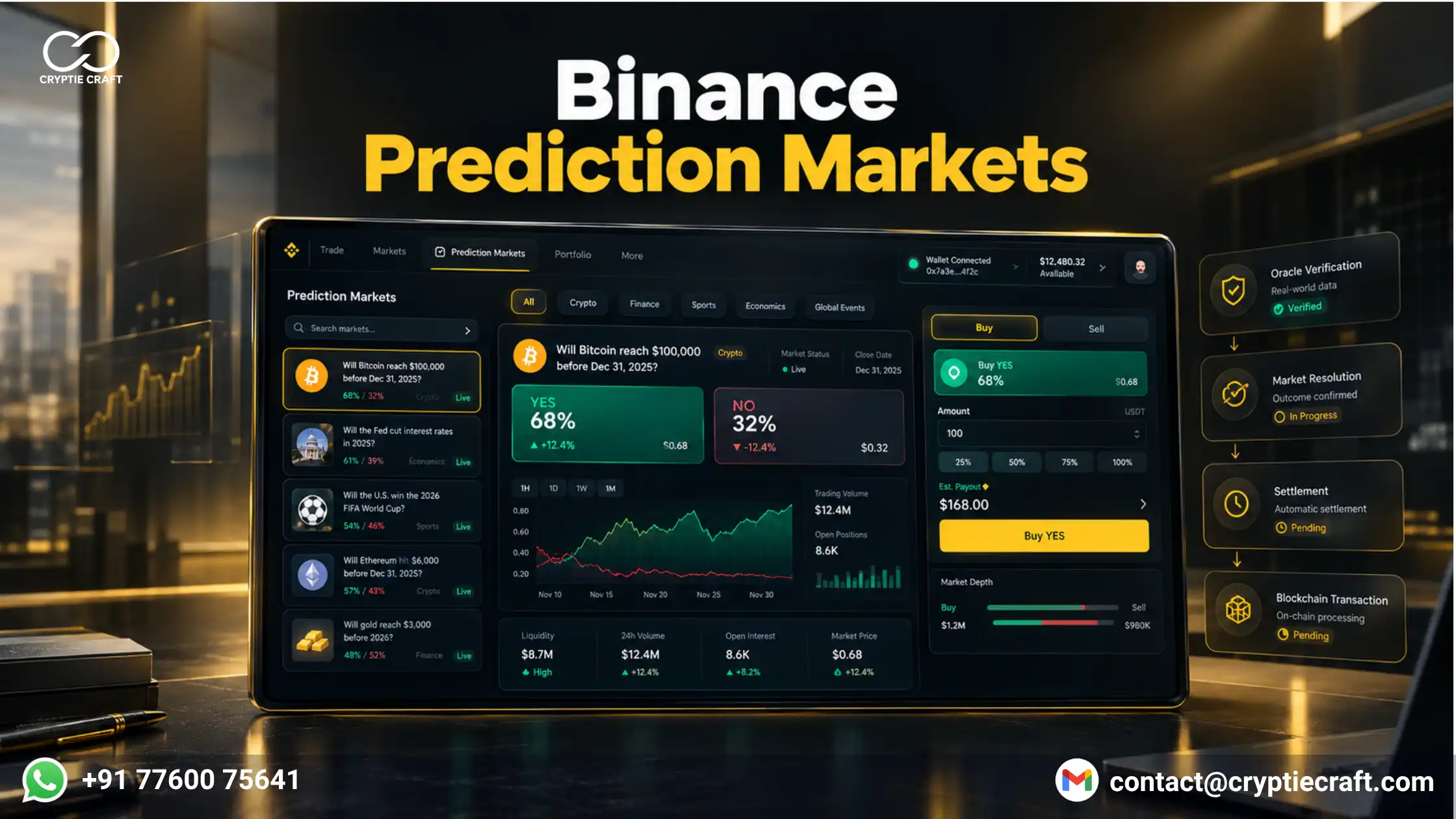
Crypto exchanges are expanding beyond traditional spot and futures trading. Binance Prediction Markets is one of the latest examples, giving eligible users access to event-based markets where they can take YES or NO positions on future outcomes through Binance Wallet.
What makes this shift important is the way prediction markets change the trading experience. The focus moves from “Where will the price go?” to “Will this event happen?” That creates a different market structure built around probability, liquidity, resolution rules, settlement, and trusted data sources.
For exchange businesses, this raises a practical question: could prediction markets become the next major trading module?
This guide explains how the model works, the technology behind it, the risks involved, and where prediction-market functionality can fit within a modern Binance-style exchange.
What Are Binance Prediction Markets?
Binance Prediction Markets are event-based markets where users trade on whether a future outcome will happen. Instead of buying an asset, participants take a YES or NO position linked to a defined event. Each outcome is represented by a tradable share.
The share price reflects the market’s implied probability. For example, a YES share trading at $0.70 indicates that participants are collectively pricing that outcome at roughly a 70% probability in a sufficiently liquid market. Binance currently provides eligible users access to third-party prediction markets through Binance Wallet, with Predict.fun serving as the primary provider on BNB Smart Chain.
How Do Binance Prediction Markets Work?
Binance Prediction Markets follow a clear user journey from choosing an event to final settlement.
- Market Selection: Users browse available prediction markets, review the event question, check the expiry date, then examine the current probability before deciding whether to participate.
- Position Entry: Users choose YES or NO based on the outcome they expect. Binance Wallet currently supports market orders plus limit orders for eligible users.
- Price Movement: Share prices change as trading activity shifts. A rising YES price generally means the market is assigning a higher probability to that outcome.
- Event Resolution: Once the event concludes, the result is determined according to predefined resolution criteria set by the underlying market provider.
- Payout Process: Winning shares can be claimed at $1 per share after resolution. Losing shares become worthless.
This workflow separates prediction trading from conventional asset trading because the final value depends on a verified event outcome rather than the market price of a cryptocurrency.
How Binance Wallet Supports Prediction Markets
Binance Wallet Prediction Markets provide the access layer between eligible users and the underlying on-chain markets.
- Prediction Account Access: Users need a dedicated Prediction Account powered by Binance Wallet Keyless technology before participating.
- Wallet-Based Trading: The Prediction Account handles market activity separately from the user’s regular Spot or Funding accounts while allowing supported balances to be used for funding.
- BNB Smart Chain Integration: The current Predict.fun integration operates on BNB Smart Chain, providing the blockchain infrastructure behind the on-chain market activity.
- Predict.fun Integration: Binance Wallet aggregates markets supplied by Predict.fun. Binance provides the interface and access route but does not act as the counterparty to those prediction-market trades.
This distinction matters: Binance Wallet improves access to the markets, while the third-party provider remains responsible for creating and managing the underlying events.
What Types of Events Can Be Traded in Prediction Markets?
Crypto prediction markets are not limited to cryptocurrency prices. A market can be created around many future outcomes when the result is clearly defined and can be verified through reliable information.
- Crypto Markets: Token milestones, price thresholds, ecosystem events, protocol developments, adoption-related outcomes.
- Financial Events: Market milestones, interest-rate decisions, monetary-policy outcomes, major financial developments.
- Sports Events: Match winners, tournament outcomes, league results, other clearly measurable sporting events.
- Economic Events: Inflation releases, employment figures, GDP results, central-bank decisions.
- Culture Events: Awards, entertainment results, public events, other verifiable cultural outcomes.
Binance’s current documentation lists categories such as sports, economics, world events, culture, and crypto. Actual markets depend on third-party listings, regional availability, and eligibility requirements.
Prediction Markets vs Spot Trading vs Futures Trading
Prediction markets, spot trading, and futures trading provide different forms of market exposure. Understanding that difference is important before treating prediction markets as another exchange feature.
| Factor | Spot Trading | Futures Trading | Prediction Markets |
| What Users Trade | Crypto asset | Price-based contract | Event outcome |
| Typical Position | Buy or sell | Long or short | YES or NO |
| Pricing Basis | Current asset value | Derivative market pricing | Implied probability |
| Settlement | Asset delivery or balance update | Contract settlement | Event resolution |
| Primary Risk | Asset-price movement | Price movement, leverage | Outcome, liquidity, resolution |
Spot traders take direct exposure to an asset. Futures traders take a position on how an asset price may move through a derivative contract. Prediction-market participants instead express a view on whether a defined event will occur.
This gives prediction market trading a separate role within an exchange ecosystem. It does not replace spot or futures trading; it introduces a different type of market based on outcomes rather than asset ownership or price direction.
Core Features of a Prediction Market Platform
A useful prediction market platform should help users understand the event, evaluate the current probability, enter a position, monitor exposure, and then follow the market through resolution.
- Market Discovery: Clear categories, search options, event status, closing times, resolution information.
- YES or NO Positions: Clearly displayed outcome choices with current prices and potential payout information.
- Probability Display: Easy-to-read pricing that shows how the market currently evaluates each outcome.
- Position Tracking: Open positions, entry price, current value, order history, completed trades.
- Settlement Management: Market status, final result, winning position, claim availability.
The quality of these features matters because prediction markets require users to understand more than a simple buy or sell price. Event wording, expiry conditions, probability, resolution rules, and settlement status all influence the trading decision.
How Does a Prediction Market Trading Engine Operate Behind the Scenes?
A prediction market trading engine manages the operational lifecycle of an event market. Unlike the user-facing workflow, this layer deals with how the platform processes trading activity in the background.
- Market Creation: Defines the event question, possible outcomes, opening period, closing time, and resolution conditions.
- Order Processing: Receives eligible orders and executes them according to the platform’s chosen market structure.
- Position Management: Records user exposure, entry price, quantity, open positions, and completed transactions.
- Pricing Logic: Updates market prices according to trading activity, liquidity conditions, or the selected pricing mechanism.
- Market Closure: Stops new trading when the event reaches its defined closing point before resolution begins.
The trading engine therefore acts as the operational core of a prediction market platform, while outcome verification and settlement are handled through separate resolution processes.
How Do Liquidity, Oracles, and Settlement Support Prediction Markets?
Prediction markets need more than an order interface. Their credibility depends heavily on market liquidity, reliable outcome verification, and transparent settlement.
- Price Discovery: Active participation helps prices respond to changing expectations about an event.
- Liquidity Depth: Deeper liquidity can support smoother execution and reduce the effect of individual orders on market pricing.
- Oracle Systems: External data or oracle mechanisms provide the information required to verify what actually happened.
- Resolution Rules: Each market should define the source, conditions, timing, and criteria used to decide the winning outcome.
- Final Settlement: Once the result is confirmed, eligible winning positions move into payout or claim processing.
Predict.fun currently uses an on-chain resolution process where outcomes can move through proposal, challenge, and dispute procedures.
Clear resolution rules are especially important. Even a technically sound trading engine can create disputes if the event wording or outcome criteria are ambiguous.
What Is the Binance Prediction Markets API?
The Binance Prediction Markets API gives eligible users and developers programmatic access to prediction-market functionality.
- Market Data Access: Applications can retrieve market information required for monitoring opportunities or building analytical tools.
- Trade Execution: Connected systems can execute prediction-market trades through supported API functionality.
- Position Management: Applications can retrieve and manage relevant position information.
- Trading Automation: Bots or quantitative systems can build automated workflows around available market data and trading functions.
- Analytics Integration: Prediction-market information can feed dashboards, portfolio systems, research tools, or reporting applications.
Binance states that the API supports market data, trade execution, position management, automated strategies, trading bots, analytics tools, portfolio systems, and integration into existing products.
For developers, the main significance is interoperability: prediction-market functionality no longer has to remain isolated inside a single user interface.
Why Prediction Markets Matter for Multi-Product Crypto Exchanges
For an exchange business, prediction markets represent a different product category rather than another version of price-based trading.
- Broader Market Scope: Event-driven markets can cover subjects that do not depend solely on cryptocurrency price movements.
- Deeper Product Mix: Prediction markets can sit beside spot, futures, P2P, wallet services, APIs, or other exchange modules.
- Different User Intent: Some users may be interested in expressing a view on a specific event rather than maintaining direct asset exposure.
- Commercial Flexibility: Depending on the platform model and applicable rules, monetization may come from trading activity, market services, APIs, analytics, or other platform-specific offerings.
The business case should still be tested carefully. A new trading category only adds value when there is genuine user demand, adequate liquidity, reliable resolution infrastructure, and a workable regulatory approach.
What Are the Main Risks of Prediction Markets?
Prediction markets introduce risks that differ from ordinary spot-market activity. Operators need to consider both trading risk and infrastructure risk.
- Liquidity Risk: Thin markets can produce wider spreads, weaker execution, or prices that react sharply to relatively small trades.
- Market Manipulation: Concentrated positions or coordinated trading may distort probability signals, particularly in smaller markets.
- Oracle Risk: Incorrect, delayed, disputed, or unavailable external information can affect outcome verification.
- Settlement Disputes: Poorly written event questions or unclear resolution criteria may lead to disagreements over the winning outcome.
- Third-Party Risk: Platforms relying on external data providers, protocols, APIs, wallets, or market providers inherit operational dependencies from those services.
Binance’s own disclosures highlight financial, market, regulatory, and third-party risks associated with the feature.
Effective prediction market risk management therefore starts with clear market rules, strong monitoring, dependable data, transparent resolution, and appropriate liquidity planning.
Prediction Market Regulations
Prediction market regulations vary by jurisdiction because event-based markets may fall under different legal or regulatory classifications depending on their structure.
- Jurisdictional Rules: Requirements can change across countries, states, or regions.
- Market Classification: Depending on the jurisdiction, certain markets may be considered event contracts, derivatives, gaming products, or another regulated category.
- User Eligibility: Age requirements, residency restrictions, regional access controls, or other eligibility checks may apply.
- KYC Requirements: Some operating models may require identity verification based on applicable laws, licensing obligations, or platform policy.
- Compliance Controls: Depending on the jurisdiction, operators may need sanctions screening, transaction monitoring, record-keeping, access restrictions, or other controls.
Binance itself notes that Prediction Markets and the API are available only to eligible users and may not be accessible in every region.
Businesses should verify current requirements with qualified legal or compliance professionals before launching or integrating prediction-market functionality.
Can Prediction Markets Be Added to a Binance Clone Platform?
Prediction markets can be added to a Binance clone platform as a separate trading module without replacing the exchange’s existing spot, futures, P2P, wallet, or administrative functionality.
- Prediction Market Module: Creates a dedicated environment for event-based YES or NO markets.
- Trading Engine Integration: Connects event creation, order processing, pricing logic, position records, and market lifecycle controls.
- Wallet Integration: Supports funding, balances, position activity, claims, and payout flows.
- Oracle Integration: Brings trusted external outcome data into the resolution process.
- Settlement Integration: Handles market closure, result confirmation, winning positions, and payout processing.
The important point is architectural separation. A prediction market has different lifecycle requirements from a conventional spot order book. Event definitions, probability-based positions, outcome verification, disputes, and settlement need their own logic.
For businesses planning a Binance Clone Script, prediction markets can therefore be considered an optional advanced module rather than a default replacement for existing trading products. The decision should depend on target users, liquidity strategy, technical readiness, compliance scope, and long-term product direction.
Are Prediction Markets the Next Major Crypto Trading Category?
Prediction markets are gaining visibility because they allow traders to express views on events that extend beyond token prices. Their appearance inside larger trading ecosystems also suggests that the category is moving closer to mainstream crypto-market infrastructure.
API access strengthens that trend by allowing prediction-market data and execution to connect with bots, analytics platforms, portfolio tools, or existing exchange products. Binance’s 2026 API launch is one example of this broader integration model.
That does not mean prediction markets will replace spot or futures trading. Their long-term role will depend on market demand, liquidity, reliable resolution, regulatory clarity, and the ability of platforms to provide a trustworthy trading experience.
Conclusion
Binance Prediction Markets highlight how exchange platforms are starting to move beyond price-based trading into event-driven markets. For businesses, the real value is not in copying the feature, but in understanding whether this model fits their users, market strategy, trading ecosystem, and long-term product direction.
For a Binance Clone Script, prediction markets can be introduced as an additional trading option when there is a clear use case, reliable market resolution, suitable liquidity, strong compliance planning, and the right technical foundation. When those elements are in place, prediction markets can add meaningful depth to a modern exchange platform.
Frequently Asked Questions
Q1. What are Binance Prediction Markets?
Ans: Binance Prediction Markets let eligible users trade YES or NO positions on future event outcomes through Binance Wallet using probability-based market pricing.
Q2. How do Binance Prediction Markets work?
Ans: Users choose an event, select YES or NO, place a trade, follow changing probabilities, then settle the position after outcome verification.
Q3. How are Binance Prediction Market prices determined?
Ans: Prices respond to market activity and represent the implied probability that participants collectively assign to a particular event outcome.
Q4. How are prediction markets settled?
Ans: Prediction markets settle after the final event result is verified according to predefined resolution criteria, with winning shares receiving the specified payout.
Q5. What is the Binance Prediction Markets API?
Ans: The Binance Prediction Markets API gives eligible users programmatic access to market data, trade execution, position management, automation, plus application integrations.
Q6. How are prediction markets different from futures trading?
Ans: Futures provide exposure to future asset-price movements, while prediction markets let participants take positions on whether a defined event will occur.
Q7. How are prediction market outcomes verified?
Ans: Outcomes are verified using predefined resolution rules plus designated external data sources or oracle mechanisms before the market reaches final settlement.
Q8. Are crypto prediction markets legal?
Ans: Legality depends on jurisdiction, market structure, event category, plus local rules. Operators should verify current regulatory requirements before offering prediction-market services.
Q9. Can prediction markets be integrated into a crypto exchange?
Ans: Yes. A crypto exchange can add prediction markets through dedicated market logic, liquidity infrastructure, oracle connectivity, wallet support, settlement, plus compliance controls.
Q10. Can a Binance clone support prediction markets?
Ans: Yes. A Binance clone can support prediction markets when its architecture includes suitable market processing, wallet connectivity, outcome verification, settlement, plus compliance infrastructure.