Binance Clone Script
  KuCoin Clone Script
  Bybit Clone Script
  Kraken Clone Script
  OKX Clone Script
  ERC-20 Token Development
  TRC-20 Token Development
  BEP-20 Token Development
  Crypto Token Development
  ICO Development
  STO Development
  Binance NFT Clone
  OpenSea Clone Script
  Rarible NFT Clone
  NFT Marketplace Development
  MetaMask Clone Script
  Trust Wallet Clone Script
  Crypto Wallet Development
  DeFi Wallet Development
  Uniswap Clone Script
  PancakeSwap Clone
  SushiSwap Clone
  Crypto Payment Gateway
  Binance Pay Clone
  Crypto MLM Software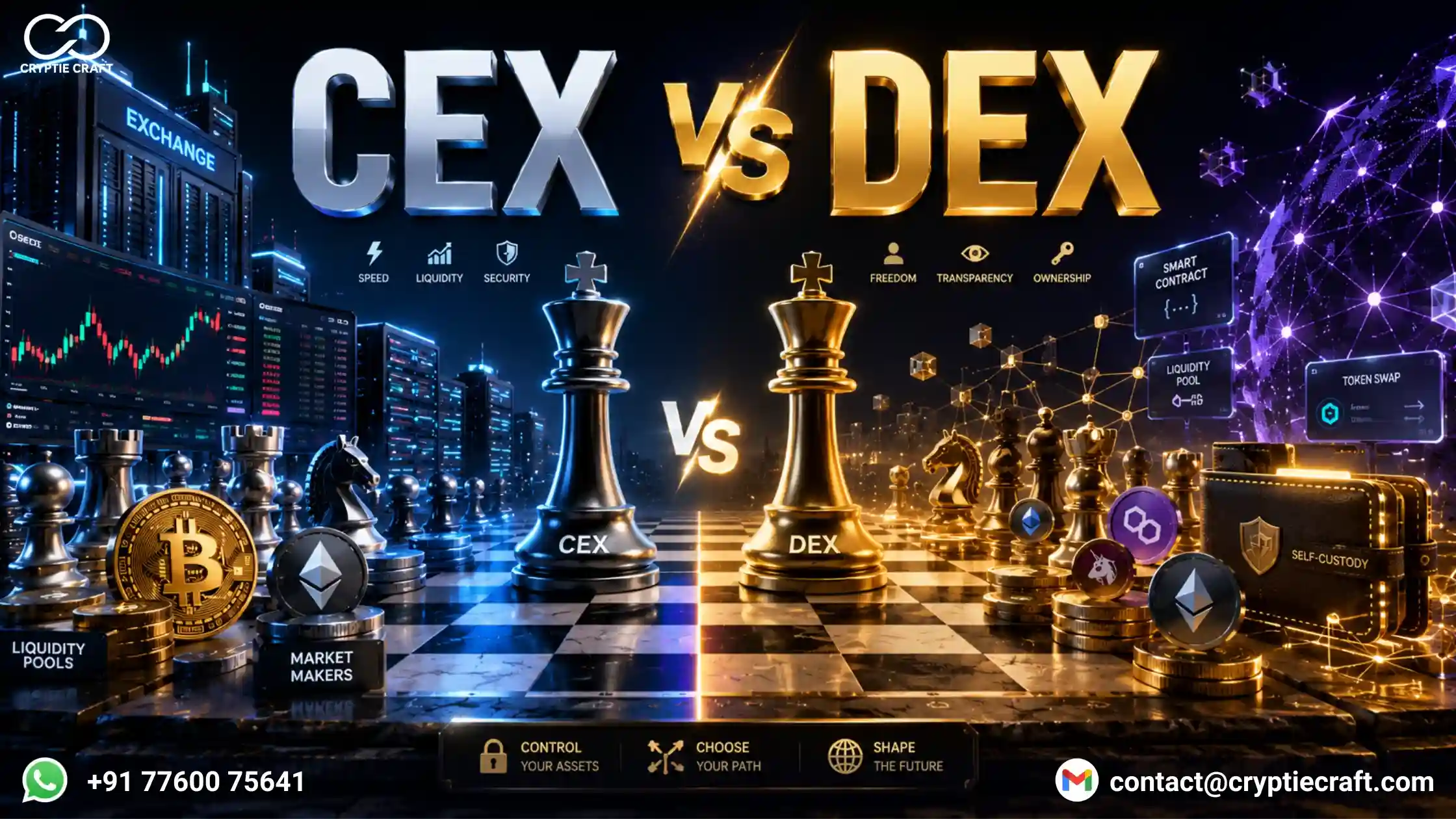
Choosing between a CEX and a DEX is a big step for any entrepreneur, as each has different business goals and customer needs. Also, the cryptocurrency exchange industry remains a magnet for startups, investors, and fintech companies that are hunting for fresh profit avenues. Crypto exchanges help users buy, sell, and trade digital assets. But not all exchanges work the same way.
On the contrary, a decentralized exchange (DEX) gives users more control over their funds, offers an increased level of transparency, and helps trading directly on the blockchain. Besides, factors like security, scalability, compliance, operating costs, and market demand will also play an important role in deciding the overall success of your platform. Every successful crypto exchange platform development begins with the right business model, more than technology alone.
This blog helps you understand CEX vs DEX to assist crypto founders in making confident strategic decisions.
What is a Centralized Exchange (CEX)?
A centralized exchange is a platform where all crypto trades are managed directly by the platform. It is like a trusted intermediary between the buyers and sellers. The exchange keeps your money in a custodial wallet system. The matching of orders and trade execution occur on the internal servers. Users sign up and get verified via KYC to start trading. CEX platforms usually have great liquidity and allow transactions at a rapid pace. They easily provide access to a large number of trading pairs.
Core Concept of CEX
- Central authority controls trading: A CEX is responsible for handling all the trades, users accounts, and security policy enforcement, as well as crypto trading operations.
- Order book-based execution system: Crypto trade orders get matched effectively by the order book, which includes buy and sell orders.
- Custodial wallet infrastructure: CEX will hold user funds in its custodial wallets while ensuring the security of the private keys.
Key Characteristics of CEX
- High-liquidity environment: Trading very high volumes of crypto ensures liquidity, price stability, and crypto transaction comfort.
- Fast execution speed: Advanced trading engines always ensure the processing of orders at an instant rate; because of this, they allow quicker crypto exchange transactions.
- Fiat on-ramp support: Purchasing cryptocurrencies with a bank transfer, card, and fiat currency can be made directly by the users.
Example Platforms
- Binance
- Coinbase
- Kraken
Thus, developing centralized exchanges remains a preferred choice for many startups. This is due to high liquidity, fast transactions, strong user support, and seamless fiat integration. Making them ideal for both beginners and businesses.
What is a Decentralized Exchange (DEX)?
A Decentralized Exchange (DEX) is a blockchain crypto trading platform that allows users to trade directly with each other without any third party. Using smart contracts, they can exchange digital assets while maintaining full control over their wallets and private keys.
Core Concept of DEX
- No intermediaries: Users do the crypto trading directly without any brokers or banks, or centralized exchange operators connecting them.
- User-controlled wallets: Traders are able to keep their private keys and their digital assets under their control even when they make transactions.
- Smart contract execution: Smart contract-based crypto trades are done automatically and securely without any human involvement or control by a third party.
Key Characteristics of DEX
- Transparent on-chain trading: All the transactions on the blockchain are open to public verification, which enhances the transparency and the level of trust in trading.
- Permissionless access: Anyone who has a crypto wallet can engage in decentralized trading without the need for an extensive verification process.
- Liquidity pool-based system: Liquidity pools make it possible to swap tokens efficiently and at the same time support the decentralized operations of cryptocurrency exchanges.
Example Platforms
- Uniswap
- PancakeSwap
- SushiSwap
Decentralized exchanges enable secure, transparent, and instantaneous crypto trading without custody of funds. Due to their user-centric nature through blockchain technology, DEXs are emerging as a preferred tool within the evolving Web3 environment.
How Both Crypto Exchanges Work
CEXs and DEXs operate on completely different backend architectures. Knowing both can help you confidently pick the right trading platform for your needs.
CEX Working Model (Order Book System)
- Central matching engine: Every buy and sell order goes into one central pool, and the engine matches them in real time and with optimal efficiency.
- Off-chain execution: Trades are executed off-chain on private servers before they can be finalized on the blockchain.
- Internal ledger updates: Instead of putting every trade on the blockchain, user balances are usually updated in the internal database of the exchange.
- Custodial wallet storage: The exchange keeps hold of all the users crypto assets in wallets they control.
DEX Working Model (AMM System)
- Automated Market Maker (AMM): The role of AMMs is to use preset pricing formulas that adjust automatically instead of relying on a traditional order book.
- Liquidity pools mechanism: Users supply token pairs to smart contract-powered liquidity pools where they remain until swapped by other users.
- Smart contract execution: Each time a swap changes the composition of this liquidity pool, a smart contract is triggered and executes the swap.
- On-chain settlement: Every trade happens on the blockchain, so anyone can audit it at any time, and it will never be changed.
Key Execution Differences
- Off-chain vs on-chain processing: For transaction speed, CEX goes off-chain, whereas DEX stays on-chain for safety and transparency.
- Centralized vs decentralized control: While the touch of a human operator or owner settles the fate of CEX, DEX smart contracts execute autonomously and without any intermediaries.
- Speed vs transparency trade-off: CEX acts at lightning speed; a DEX lets you see the full public ledger history of your trades and their effects.
While CEXs are all about speed and control by centralizing things, DEXs are more focused on transparency and independence by having decentralized smart contract execution.
CEX vs DEX Comparison – A Feature Breakdown
One has to understand the CEX vs. DEX comparison, as it helps businesses and traders evaluate custody, security, liquidity, fees, compliance, and overall cryptocurrency exchange performance effectively.
| Feature | CEX | DEX |
| Custody of Assets | The platform holds user funds. | Users control their own funds. |
| Security Model | Platform-managed security. | Blockchain and smart contract security. |
| Speed & Latency | Faster trade execution. | Depends on blockchain speed. |
| Liquidity Depth | Higher trading liquidity. | Liquidity pool dependent. |
| Fees & Gas Costs | Platform trading fees. | Network gas fees apply. |
| User Experience | Easy for beginners. | Requires wallet knowledge. |
| Regulation Compliance | KYC and AML supported. | Permissionless access. |
Hence, one trader chose CEX for simplicity and liquidity. Another preferred DEX for control and transparency. Both succeeded because they selected the cryptocurrency exchange to match their needs.
CEX vs DEX Fee Structure – A Complete Cost Breakdown
Your trading fees will each time directly affect your crypto profits. Hence, understanding the whole cost structure will put you in a better position to trade more efficiently.
CEX Fee Model
- Maker & taker fees: CEX charges both makers and takers a small percentage for completing a trade.
- Withdrawal charges: If you withdraw crypto from a CEX wallet, you usually have to pay fixed network fees.
- Spread-based hidden costs: CEX platforms make hidden profit through the differences in buy and sell spreads on every trade.
DEX Fee Model
- Gas fees: Every DEX transaction implies paying gas fees to the validators of the blockchain network.
- Swap (LP) fees: Liquidity providers receive a small fee from each token swap performed in the decentralized trading platform.
- Slippage costs: Price slippage due to low liquidity pools results in an indirect increase in the cost of your trade.
- Network congestion impact: At times, heavy network traffic leads to a sudden increase in gas fees, making DEX trading more expensive.
Real Cost Comparison
- Small vs large trades: As it is because of the gas fees, performing a trade on a DEX becomes more expensive for small trades.
- Gas spike scenarios: It is during the time of highest demand on the network when the fees on DEX can become so high that they are unpredictable.
- Hidden cost impact analysis: Both CEX spreads and DEX slippage lessen your real trading profits without you even realizing it.
Every fee layer is a hit to user retention as a founder. Knowing the CEX and DEX cost structures will help you create a more profitable exchange platform.
CEX vs DEX Risks – A Security Comparison
Security is still the most important factor in the CEX vs DEX comparison. Knowing the risks of an exchange is a great way for traders and businesses to effectively secure their digital assets.
Risks in CEX
- Exchange hacks: Centralized exchanges hold large amounts of cryptocurrencies, so they might become a target for hackers.
- Custodial risk: Users basically give them the responsibility of keeping their funds safe. So, users are dependent on the security of the platform.
- Regulatory shutdown risks: When regulators take action, they may limit operations. It affects users who can access the platform as well as trading activities.
Risks in DEX
- Smart contract exploits: Code vulnerabilities in smart contracts can be the reason for the loss of unauthorized access to the funds.
- Bridge vulnerabilities: Cross-chain bridges may have security weaknesses that the attackers will exploit to steal the assets.
- MEV and slippage attacks: Manipulation of transactions and changes in prices will eventually lead to user’s dissatisfaction with the execution of trades.
Responsibility Model
- Platform-controlled security (CEX): The platform takes care of the entire security protocol, the compliance processes, and the safekeeping of the assets.
- User-controlled security (DEX): Users control the security of the private keys and wallets. It gives them the maximum control over their assets.
The security risks linked to CEX and DEX are quite different. Still, the focus should be on knowing the responsibilities and putting in place effective measures to secure cryptocurrency assets.
Liquidity & Market Depth of CEX and DEX – A Market Availability Analysis
Liquidity is something important in determining the efficiency of your exchange when it comes to handling big trades. More market depth leads to better pricing and reduced slippage for every participant.
CEX Liquidity System
- Order book depth: CEX keeps order books long and well-stocked with both buy and sell price levels by the minute.
- Institutional market makers: Professional market makers make a difference in supplying liquidity, which helps sustain high trading volumes on CEX.
- High-volume trading pools: CEX trading venues are favorites among high-frequency traders, who are the ones largely responsible for the natural market liquidity deepening.
DEX Liquidity System
- Liquidity pools (AMM model): AMM-based liquidity pools do away with the familiar order books and instead use token-pair deposit mechanisms.
- LP incentives: Those who provide liquidity to the pools are rewarded with swap fees as well as tokens for their contribution.
- Fragmented liquidity across chains: Decentralized exchange (DEX) liquidity is divided over a number of different blockchains, which makes it difficult to have very deep market depth.
Liquidity Efficiency Comparison
- Slippage differences: With CEX order books, slippage is kept to a minimum, whereas with DEXs, there is much more slippage, mostly under low liquidity.
- Market depth for large orders: Using the help of deeper institutional market depth, executing large orders is smoother on CEX.
- Capital availability across platforms: CEX can concentrate capital very efficiently. Then again, with DEX, capital gets fragmented amongst different chains and pools.
Not enough liquidity can destroy user experience very quickly. So always choose carefully what kind of exchange you are making, where traders will be giving their trust with every large order.
CEX and DEX Performance Trade-offs – A Execution Behavior Analysis
Performance of execution is one of the biggest factors determining the attractiveness of one exchange type over the other. The major differences between speed, latency, trading throughput, and reliance on the blockchain directly affect how smoothly a trade is carried out.
CEX Performance Characteristics
- High-speed order execution: Centralized exchanges use highly efficient trade engine architectures to carry out trades immediately.
- Low-latency infrastructure: Using dedicated servers, CEX platforms manage to lower delay times while enhancing their overall responsiveness as crypto trading venues.
- Optimized matching engines: Matching engines that are efficient and able to handle multiple buy and sell orders with barely any waiting time.
- Off-chain transaction processing: Many transactions are processed off-chain, allowing for quicker transaction executions and decreased dependence on the network.
DEX Performance Characteristics
- On-chain transaction dependency: Every single DEX transaction has to be validated by the blockchain before the trade is considered complete.
- Blockchain confirmation delays: The requirement for network confirmation can result in increased transaction durations when the blockchain is heavily used.
- Gas fee impact on execution speed: The paid gas fees tend to be the main reason for deciding which transaction is included first. Paying more gives you priority and accelerates the transaction.
- Network congestion sensitivity: If the blockchain traffic is heavy at the time, transaction execution via decentralized exchanges will be quite a bit slowed down.
Performance Trade-off Analysis
- Speed vs decentralization: CEX is the winner in faster execution, while the DEX is the one to go for if you want utmost transparency and control over your trades.
- Cost vs transparency: While lower costs can still vary from one platform to another, the transparency on the blockchain is a constant and publicly verifiable feature.
- Scalability vs trustless execution: Increasing system scalability results in better performance, whereas trustless execution is the way of the future as it eliminates the need for intermediaries.
CEX has faster execution and lower latency, while DEX offers transparent trading and decentralized control. The best option depends on your performance needs, transaction costs, and operational preferences.
Trading Experience in CEX and DEX – A Real-World Usage
Trading experience is one of the key factors that determines whether users will stay on any given exchange platform. Make sure to understand that CEX and DEX actually cater to very different types of trader behavior, needs, and levels of comfort.
CEX Trading Experience
Typically, CEX platforms provide traders with a clean and friendly interface for beginners; they also ensure that the order execution is very quick and seamless, besides having very easy processes to convert fiat currencies to crypto ones.
DEX Trading Experience
To trade on a DEX, the user should have a wallet where he/she has control over the private keys (self-custody) and should be quite tech-savvy, and the user should accept that, apart from higher transaction times, there will also be higher transaction fees.
User Behavior Scenarios
New traders would mostly go for the simple CEX, whereas DeFi-oriented people would go for DEX because of the self-control, whereas traders who make profit from price differences in different markets usually do the trading on these two platforms simultaneously.
Your exchange UX directly decides who stays and who leaves. Build for your target trader’s real behavior and comfort level.
Regulation & Compliance of CEX and DEX – A Global Perspective
Understanding regulatory compliance can be the very factor that throws one exchange into the realm of sustainability and quite another one into the pool of risk. Plainly, a good knowledge of CEX and DEX regulatory setups at the very least can create a proper legal basis for platform founders to build in a confident manner.
Regulatory Framework for CEX (Compliance-Based Model)
- KYC (Know Your Customer) systems: KYC onboarding is a compulsory process in every CEX platform wherein they verify the user’s identity.
- AML (Anti-Money Laundering) compliance: Effective crime prevention through money laundering calls for the constant tracking of the different transactions of a DEX.
- Licensing and government oversight: For their part, CEXs have to acquire local licenses and should always be under the control of some governmental regulatory authority.
Regulatory Framework for DEX (Protocol-Based Model)
- No central authority: Since there is no central entity at DEXs, there is no one to enforce regulations in a direct manner. This makes regulatory enforcement virtually impossible.
- Smart contract-based execution: As the trade is carried out through smart contracts without any interruption by a human person, there is simply no compliance party who can be pointed to as responsible.
- Jurisdiction challenges: Since the DEX protocol covers the operation of many countries, the application of the regulatory structure of any one of them would simply be ineffective.
Global Regulatory Trends
- US tightening crypto laws: Both the SEC and FinCEN are intensifying their efforts to regulate cryptocurrency exchanges at all levels.
- EU MiCA framework: The MiCA regulation is a set of rules governing the crypto industry in all the European Union member countries, ensuring the standardization of compliance.
- Asia-Pacific adoption growth: On top of Singapore and Japan, the list of countries relentlessly working on shaping ideal crypto regulatory environments will most definitely keep growing.
- Shift toward hybrid regulation: What is happening now is that regulators all over the world are considering coming up with regulatory systems that will suit both CEX and DEX models.
For founders of exchanges, regulation is no longer optional. Build compliant infrastructure now to protect your platform from costly legal disruption down the road.
Real-World Use Cases & Decision Framework of CEX and DEX
Your choice of exchanging crypto through a CEX or a DEX should mainly be based on your trading objectives, individual preferences, and the nature of your business. After all, a good understanding of the use cases leads to insightful decisions.
When Centralized Exchange is Preferred
- Fiat trading: Centralized exchanges are a straightforward means of purchasing cryptocurrencies through bank transfers, card payments, and use of fiat currencies.
- High-liquidity markets: The major benefit of high trading volumes is that they facilitate quick and efficient order execution and offer stable prices for cryptocurrencies.
- Beginner-friendly usage: Intuitive UIs combined with customer support are what makes the experience of crypto trading less daunting for new users.
When Decentralized Exchange is Preferred
- DeFi participation: Decentralized exchanges are the only way for users to get direct access to DeFi protocols and blockchain applications.
- Token discovery: Such users gain opportunities to be early-to-market with tokens, even ahead of exchanges listing the same.
- Privacy-focused trading: DEXs provide consumers with a much greater level of privacy since they do not require so much user verification.
Hybrid Usage Scenarios
- Arbitrage strategies: Such individuals base their decisions on the price discrepancies in different exchanges to earn the maximum from their trading of cryptocurrencies.
- Portfolio diversification: With multiple exchanges, one will only be exposing oneself to the least possible risks in the crypto trading arena of choice.
- Cross-platform trading: When one accesses CEX and DEX, then one is in the position to trade with maximum flexibility and excellent market coverage.
Final Decision Framework – Which Should You Choose?
- Choose CEX → Those looking for convenience to trump all, the desire for fast execution, and the need for the easiest crypto purchase.
- Choose DEX → This can be a top priority for those who wish to own their assets, operate in an open blockchain, and have decentralized trading.
- Choose Hybrid → This will bring together the best of both centralized efficiency and decentralized control for wider trading opportunities.
A good crypto trader selects an exchange based on their needs. When trading needs are mapped onto the right exchange model, it improves efficiency, security, flexibility, and long-term growth.
Why Choose Cryptiecraft for Cryptocurrency Exchange Development Services?
Cryptiecraft builds crypto exchange platforms that are performance-oriented, scalable, and compliant right from the beginning. Our experts provide solutions for centralized exchanges, create decentralized exchange platforms, and develop hybrid trading platforms for your market needs.
Security is the top priority in every platform we develop; we implement multi-layer security systems, conduct smart contract auditing, and establish risk management systems. Our robust matching engines and DeFi liquidity integration can handle institutional-grade trading volumes without any sacrifice. We manage all the processes from the initial concept to full implementation and even further. White-label exchange solutions enable you to get a product ready for market in less time. Post-launch optimization ensures that your platform continues to be competitive over the long term.
Cryptiecraft is one of the best cryptocurrency exchange development company offering end-to-end exchange growth teams.
Frequently Asked Questions
Q1. What is the difference between CEX and DEX?
Ans: The difference between CEX and DEX is that CEXs are platforms that facilitate trading by a central authority, whereas DEXs are autonomous platforms where trading is done directly peer-to-peer through smart contracts.
Q2. Centralized or Decentralized Exchange, which is safer?
Ans: Neither is universally safer. Centralized exchanges offer stronger compliance and support, while decentralized exchanges provide greater asset control through self-custody. Hybrid exchanges aim to combine the security benefits of both models.
Q3. Do I need KYC for CEX?
Ans: Yes, regulated centralized exchanges operate under laws that only allow users to engage in any type of trading after the identity verification process.
Q4. What are gas fees in DEX trading?
Ans: Gas fees are, in essence, the underlying blockchain network fees that are paid to the validator nodes for every transaction on DEX.
Q5. Why do DEX trades fail sometimes?
Ans: Slippage tolerance limits, insufficient liquidity, or sudden network congestion are some reasons why trades fail.
Q6. Why does Binance have higher liquidity than Uniswap?
Ans: Binance’s liquidity is higher because it is supported by institutional market makers and deep order books. Uniswap, however, is a decentralized exchange that operates from Automated Market Making (AMM) fragmented liquidity pools.
Q7. Can DEX replace centralized exchanges in the future?
Ans: DEX is getting popular at a fast pace, but CEX is still the leader in terms of volume, speed, and mainstream user adoption as of today.
Q8. CEX or DEX Development: which is better for beginners?
Ans: The answer is CEX is, without a doubt, better for beginners, as it has a very simple user interface, support for fiat currency, and a straightforward guided onboarding process.