Binance Clone Script
  KuCoin Clone Script
  Bybit Clone Script
  Kraken Clone Script
  OKX Clone Script
  ERC-20 Token Development
  TRC-20 Token Development
  BEP-20 Token Development
  Crypto Token Development
  ICO Development
  STO Development
  Binance NFT Clone
  OpenSea Clone Script
  Rarible NFT Clone
  NFT Marketplace Development
  MetaMask Clone Script
  Trust Wallet Clone Script
  Crypto Wallet Development
  DeFi Wallet Development
  Uniswap Clone Script
  PancakeSwap Clone
  SushiSwap Clone
  Crypto Payment Gateway
  Binance Pay Clone
  Crypto MLM Software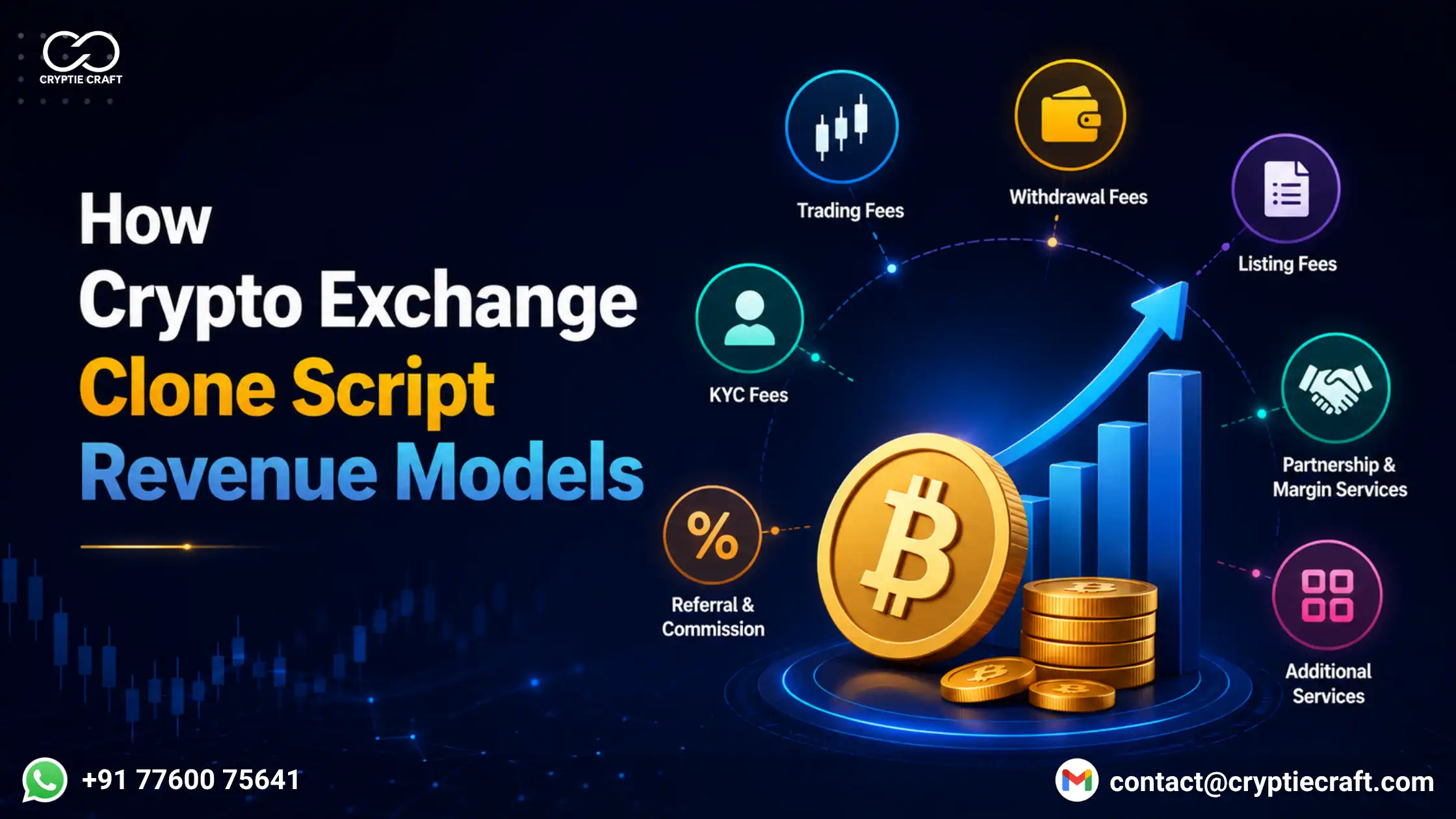
A crypto exchange does not become a revenue-generating business simply because users can buy and sell digital assets. Sustainable income comes from choosing the right monetization structure, attracting active users, and managing the costs required to operate the platform.
That is where crypto exchange clone script revenue models become commercially important. A customizable exchange solution can provide the infrastructure needed to configure trading fees, memberships, listings, APIs, P2P services, and other monetization mechanisms without building every business rule from the ground up.
For founders and entrepreneurs, the better question is not “How many ways can my exchange charge users?” but “Which revenue structure fits my exchange, delivers clear user value, and can remain profitable as the business scales?”
This guide covers the major clone script revenue models, how to combine them, the software capabilities needed to support monetization, the factors that affect profitability, and what to evaluate when choosing an exchange solution.
Top Crypto Exchange Clone Script Revenue Models
An exchange can generate income from trading activity, premium services, professional access, token-related services, and marketplace functionality. The right mix depends on the platform’s products, target users, market position, and operating model.
Trading Fees and Maker-Taker Commissions
Trading fees are one of the most direct exchange revenue sources because the platform earns income when eligible orders are executed.
A maker-taker fee structure can differentiate between orders that add liquidity to the order book and those that remove it. Operators can also use volume-based pricing to offer different rates to users according to their trading activity.
A well-designed fee engine can support:
- Percentage-based or fixed charges
- Maker and taker rates
- Trading-volume tiers
- User-specific pricing
- VIP fee structures
- Promotional discounts
- Trading-pair-specific fees
For a spot-focused exchange, transaction fees can form the core revenue stream because income increases alongside eligible trading activity.
Deposit and Withdrawal Fees
Deposit and withdrawal charges can provide another source of platform income when users move digital assets or fiat funds into or out of the exchange.
Charges may vary according to the asset, blockchain network, payment method, or processing arrangement. However, these fees should not automatically be considered pure profit.
Blockchain network costs, payment-processing expenses, liquidity arrangements, and third-party service charges may need to be covered first. Clear fee disclosure is therefore important both for user trust and for accurate margin calculations.
Token Listing and Featured Listing Fees
Token projects may pay for listing-related services or enhanced promotional exposure. Standard listings and featured placements can therefore represent separate commercial opportunities.
However, payment for a listing should not guarantee asset approval. Asset screening, due diligence, risk assessment, and applicable compliance procedures should remain independent of promotional payments.
The exchange software can support workflows for:
- Listing requests
- Asset review
- Approval status
- Listing schedules
- Standard listings
- Featured placements
- Administrative review
This allows listing services to become a structured business function rather than an informal promotional process.
Margin Trading and Leverage Revenue
Margin trading allows eligible users to trade with borrowed capital. Depending on the platform structure, revenue can come from trading commissions, borrowing charges, interest, or applicable liquidation-related fees.
This model introduces additional technical and operational requirements. The platform may need to manage collateral, margin ratios, open positions, risk limits, liquidation rules, and account-level controls.
For that reason, leverage-based monetization should be considered only when the exchange has the infrastructure and operational capabilities required to support it.
Futures and Perpetual Trading Fees
Futures and perpetual contracts provide another transaction-based revenue opportunity. Exchanges can charge commissions when users open or close derivatives positions.
Perpetual markets may also involve funding mechanisms between market participants and applicable liquidation processes. These products require derivatives-specific infrastructure for:
- Position management
- Margin calculations
- Risk controls
- Liquidation management
- Contract administration
- Trading and settlement workflows
Derivatives can increase monetization opportunities, but they also increase platform complexity and operational requirements.
Staking, Lending and Earn Commissions
An exchange can expand beyond trading by offering staking, lending, or other earn-related products.
Revenue may come from service charges or commissions associated with these offerings. The commercial structure depends on how each product is designed, including asset handling, rewards, fees, eligibility, and user terms.
Because these products can introduce additional technical, operational, and regulatory considerations, they should be evaluated as individual business lines rather than simply added as extra features.
Premium Membership and Subscription Revenue
Subscriptions create recurring revenue instead of relying entirely on transaction volume.
Membership tiers can offer benefits such as:
- Reduced trading fees
- Advanced analytics
- Higher API limits
- Premium trading tools
- Priority support
- Enhanced account services
This model works when the benefits provide enough continuing value for users to maintain their membership.
For example, professional traders may value higher API limits and advanced analytics, while frequent retail traders may prioritize lower trading fees.
API and Market Data Monetization
Professional traders, institutions, and third-party applications may require programmatic access to trading functionality or market information.
An exchange can monetize this access through:
- API service tiers
- Usage limits
- Premium API packages
- Professional market-data services
- Institutional access plans
Important controls can include:
- API key generation
- Permission management
- Trading access
- Read-only access
- Rate limits
- Usage monitoring
- Market-data access
- Account-level restrictions
This allows professional customers to receive differentiated services without changing the core experience for ordinary users.
Advertising and Promotional Revenue
Advertising provides a supplementary revenue channel through promotional placements such as featured assets, sponsored campaigns, banners, and promoted trading pairs.
Promotional content should remain clearly distinguishable from core exchange functionality. Excessive advertising can damage the trading experience, so placements should be relevant, controlled, and consistent with the platform’s positioning.
Referral and Affiliate Revenue
Referral and affiliate partnerships can generate commissions when referred users complete qualifying activities under applicable partnership terms.
This creates another revenue layer without requiring every income source to come directly from trading.
A referral program can also support user acquisition, but its economics should be evaluated against acquisition costs, incentives, retention, and the revenue generated by referred users.
Crypto Exchange Clone Script Revenue Models at a Glance
| Revenue Model | Who Pays | When Revenue Is Generated |
| Trading fees | Traders | When eligible trades are executed |
| Deposit/withdrawal fees | Users | When assets or funds are deposited or withdrawn |
| Listing fees | Token projects | When listing-related services are purchased |
| Featured listings | Token projects | When promotional visibility is purchased |
| Margin and leverage | Margin traders | When applicable trading, borrowing, or related charges are generated |
| Futures and perpetuals | Derivatives traders | When derivatives positions are traded |
| Staking, lending, and earning | Participating users | When related services generate commissions |
| Subscriptions | Premium users | Through recurring membership payments |
| API and market data | Professional users | Through paid access or service tiers |
| Advertising | Projects and partners | Through promotional placements |
| Referral and affiliate | Partners | When qualifying activities generate commissions |
How to Combine Clone Script Revenue Models
Multiple revenue streams can reduce dependence on a single source of income, but adding every available monetization feature does not automatically make an exchange more profitable.
Each revenue stream should have a defined purpose, target customer, expected adoption level, and cost structure.
A practical framework is:
Core revenue → Complementary revenue → Expansion revenue → Promotional revenue
For example, trading fees may form the core revenue stream for a spot exchange. Subscriptions or APIs can then target professional users, while listings or advertising can provide additional business revenue.
Start With a Core Revenue Stream
The primary monetization mechanism should match the exchange’s main activity.
For a spot-trading platform, trading fees may provide the foundation.
For a P2P marketplace, possible core and supporting revenue sources include:
- Transaction fees
- Escrow-related charges
- Merchant plans
- Featured trade advertisements
- Premium marketplace services
The objective is to establish a model users understand and consider reasonable while maintaining enough margin to support platform operations.
Add Complementary Revenue Streams
Once the core model is established, additional services can target specific customer segments.
Examples include:
- Trading + Listing + Subscription for transaction, business, and recurring revenue.
- Trading + Staking + Earn for asset-based services.
- Trading + Derivatives + API for active and professional traders.
- P2P Fees + Featured Ads + Merchant Plans for marketplace-oriented platforms.
- Trading + Market Data + Institutional API for professional customers.
The right combination depends on the exchange’s products, audience, market positioning, and ability to operate each service effectively.
Combine Transactional and Recurring Revenue
Transaction-based income changes with trading activity, while subscription revenue is generated over a defined billing period.
Combining both can make the revenue mix less dependent on short-term trading volume.
For example, active traders may contribute transaction revenue while professional customers generate recurring income through premium analytics, API access, or enhanced account services.
The recurring product still needs clear ongoing value. A subscription that provides little practical benefit is unlikely to retain users simply because it exists.
Create User-Specific Monetization Tiers
Different customers have different activity levels and service requirements. Tiered pricing can align fees and benefits with those differences.
Possible segments include:
- Regular traders
- High-volume traders
- VIP users
- Professional traders
- Institutional customers
- Merchants
Higher tiers can provide reduced fees, increased API limits, advanced tools, or dedicated support while keeping entry-level pricing accessible.
A Practical Revenue Model Selection Framework
Not every exchange needs the same monetization mix.
| Exchange Model | Potential Primary Revenue | Complementary Revenue |
| Spot exchange | Trading fees | Subscriptions, listings, API services |
| P2P exchange | Transaction fees | Merchant plans, featured ads, premium services |
| Professional exchange | Trading fees | Institutional API, market data, premium tiers |
| Derivatives exchange | Trading commissions | Funding-related services, applicable liquidation fees |
| Asset-focused platform | Trading or listing services | Staking, earn products, premium services |
This framework is a starting point rather than a fixed formula. Expected user demand, operating costs, liquidity, product complexity, and applicable requirements should determine the final model.
What Features Does a Crypto Exchange Clone Script Need for Monetization?
Revenue models only become operationally useful when the underlying software can calculate, apply, manage, and report the associated business rules.
The important question is therefore not simply whether an exchange solution lists a particular monetization feature. You need to determine whether the software can implement the pricing logic, control access, record transactions, and report the resulting revenue accurately.
Fee Management and Revenue Rules
A configurable fee engine allows administrators to establish pricing rules without rebuilding the platform whenever the business changes its pricing strategy.
Important controls can include:
- Maker and taker rates
- Fixed or percentage-based charges
- User-specific fees
- Trading-pair fees
- Volume-based tiers
- VIP pricing
- Membership discounts
- Promotional fee rules
The administrative panel should make these rules manageable while maintaining appropriate permissions and auditability.
Trading, Staking and Derivatives Modules
Different revenue strategies require different product infrastructure.
Spot trading may require:
- Matching engine
- Order management
- Wallet infrastructure
- Trading interfaces
- Account management
Derivatives, staking, lending, and earn products require additional workflows and controls.
These modules should integrate with account, wallet, transaction, risk-management, and administrative systems rather than operate as isolated features.
Token Listing and Subscription Management
Listing monetization requires tools for managing assets, reviewing requests, controlling listing status, and differentiating standard from featured placements.
Subscription functionality requires:
- Membership tiers
- Recurring payments
- Benefit management
- Discounts
- Access permissions
- Subscription status tracking
This turns commercial services into manageable platform functions.
API and Institutional Access
Professional customers may require programmatic trading and market-data access.
API infrastructure should provide authentication, permissions, rate limits, usage monitoring, and access-level controls.
Institutional and high-volume customers can then receive differentiated service packages without changing the basic trading experience for retail users.
Revenue Analytics and Reporting
A monetization strategy is difficult to optimize without reliable reporting.
The administrative environment should provide visibility into revenue sources and business performance.
Useful metrics include:
- Revenue by source
- Trading-fee income
- Subscription revenue
- Listing-related income
- API revenue
- Product performance
- User activity
- Trading volume
- Revenue trends
- Revenue by user segment
Revenue reporting should ideally connect income with the activity that generated it. This helps operators identify which products are producing meaningful commercial results and which require adjustment.
What Affects Crypto Exchange Clone Script Profitability?
Revenue and profit are different outcomes.
An exchange can generate income from several sources and still operate at a loss if user activity is weak, acquisition costs are high, liquidity is expensive, or operating expenses exceed revenue.
A simple way to understand the relationship is:
Profit = Total Revenue − Total Operating Costs
Actual profitability depends on the exchange’s cost structure, product mix, user activity, market conditions, and operating efficiency.
Trading Volume and Active Users
Trading volume directly influences transaction-based income when fees are charged on executed trades.
Registered users alone do not indicate revenue potential.
A smaller audience with consistent trading activity can generate more transaction revenue than a larger audience of inactive accounts.
Important indicators include:
- Active traders
- Trading frequency
- Trading volume
- Average transaction value
- Repeat usage
- Revenue per active user
These metrics provide a more useful picture of commercial activity than registration numbers alone.
Liquidity and Market Activity
Liquidity affects how efficiently users can execute trades at competitive prices. Deeper markets can support smoother execution and encourage continued activity.
For an exchange that depends heavily on trading fees:
Liquidity → Trading Activity → Trading Volume → Fee Revenue
Liquidity should therefore be evaluated not only as a trading feature but also as a business cost and revenue consideration.
Liquidity arrangements can involve external providers, market-making relationships, integrations, or other operating expenses. Those costs should be included when calculating the actual margin generated by trading activity.
Revenue Module Adoption
Adding a monetization module does not guarantee that users will pay for it.
Subscriptions, staking, APIs, derivatives, and other services become meaningful revenue sources only when they achieve sufficient adoption and provide clear value.
Before introducing another revenue stream, evaluate:
- Target audience
- Expected usage
- Implementation requirements
- Operating costs
- User value
- Revenue potential
- Applicable compliance considerations
This prevents the exchange from accumulating expensive features that generate little commercial return.
Operating and Infrastructure Costs
Revenue needs to be evaluated against the costs required to generate and maintain it.
Depending on the business model, expenses can include:
- Cloud and infrastructure
- Liquidity arrangements
- Blockchain network fees
- Security operations
- Compliance-related expenses
- Software maintenance
- Development and upgrades
- Customer support
- Payment services
- Third-party integrations
The actual cost structure varies according to the exchange model, jurisdiction, products, integrations, and operating arrangements.
User Retention and Repeat Trading
Acquiring a user does not create lasting value if that customer leaves after one transaction.
Repeat trading and continued platform usage can support more consistent revenue over time. Transparent fees, reliable execution, competitive liquidity, useful products, security, and a convenient trading experience can all influence retention.
A revenue model should therefore be evaluated alongside the user experience required to sustain it.
How to Choose a Crypto Exchange Clone Script for Your Revenue Goals
Choosing exchange software should begin with the business model, not a feature checklist.
The objective is to determine whether the software can actually support the revenue strategy you plan to operate.
Check Available Monetization Modules
Map each planned revenue stream against the software’s actual capabilities.
If your model depends on subscriptions, derivatives, staking, APIs, P2P trading, token listings, or merchant services, verify that the required modules are available and can work together.
Do not select software simply because a sales page lists many features.
Determine:
- What is available out of the box?
- What can be configured?
- What requires customization?
- What requires third-party integration?
- How are transactions recorded?
- How are administrators expected to manage the feature?
This distinction can prevent unexpected development costs after purchase.
Verify Fee Customization
Pricing strategies often change as an exchange moves from launch to growth.
Check whether administrators can configure:
- Maker and taker rates
- Fixed or percentage-based fees
- User-specific pricing
- Trading-pair fees
- Volume-based tiers
- VIP pricing
- Discounts
- Promotional rates
Flexible fee management makes it easier to adjust pricing without major redevelopment.
Evaluate Liquidity Integration
If trading fees are part of the business model, liquidity deserves close attention.
Ask:
- How does the software connect with liquidity sources?
- How is order-book depth supported?
- Which liquidity integrations are available?
- What third-party arrangements are required?
- What costs apply to those arrangements?
- Can the liquidity setup support the intended trading markets?
A feature labelled “liquidity integration” does not explain what is actually included. Review the implementation method and associated costs before making a decision.
Check Security and Compliance Capabilities
Revenue generation needs to be supported by appropriate platform controls.
Review capabilities related to:
- KYC/AML integration
- Wallet security
- Transaction monitoring
- Authentication
- User permissions
- Administrative access
- Withdrawal controls
- Account protection
Regulatory obligations vary by jurisdiction and business model. FATF standards for relevant virtual asset service providers address areas such as licensing or registration, supervision, customer due diligence, record keeping, and suspicious transaction reporting. Applicable requirements for target markets should be verified with qualified legal and compliance professionals before launch.
Confirm Scalability and Customization
Revenue strategies can change as an exchange grows.
Future-ready software should have room for additional:
- Trading products
- Integrations
- User tiers
- Payment methods
- Business workflows
- Administrative controls
Ask what can be customized at the:
- Code level
- Module level
- User-interface level
- Administrative level
- Integration level
Also determine how future modifications can be introduced without unnecessarily disrupting existing users or platform operations.
Assess Revenue Analytics
The administrative environment needs enough visibility to determine whether the monetization strategy is working.
Ideally, reporting should connect revenue with:
- Users
- Trading activity
- Products
- Fees
- Subscriptions
- API usage
- Listings
- Monetization channels
Without this visibility, it becomes difficult to identify which revenue streams are performing and where the business model needs improvement.
Also Read>>> https://cryptiecraft.com/how-to-choose-right-crypto-exchange-clone-script/
Launch Your Crypto Exchange With Cryptiecraft
Your monetization strategy should influence the exchange infrastructure you choose from the beginning.
Cryptiecraft provides a customizable crypto exchange clone script that can be adapted for different business models, including trading fees, token listings, subscriptions, staking, derivatives, P2P services, and API-based offerings.
The solution can be configured around your target users, fee structure, liquidity requirements, integrations, trading products, and administrative workflows.
Instead of treating monetization as something to add after launch, you can design the exchange architecture around the revenue mechanisms that matter to your business.
Whether your priority is transaction-based revenue, recurring subscriptions, professional API services, P2P merchant monetization, or a combination of models, the required modules and business rules should be defined before development begins.
Planning an exchange around multiple revenue streams? Discuss your trading model, fee structure, required modules, liquidity requirements, and customization needs with the Cryptiecraft team.
Frequently Asked Questions
Q1. What is the most common revenue model for a crypto exchange?
Ans: Trading fees are one of the most common starting points because the exchange earns revenue when eligible trades are executed. Other models can be added according to the platform’s users, products, and business strategy.
Q2. Can a crypto exchange make money without trading fees?
Ans: Yes. An exchange can potentially monetize subscriptions, token listings, APIs, market data, advertising, staking, lending, P2P services, and other value-added products. The viability of each model depends on user demand and operating costs.
Q3. How does a P2P crypto exchange clone script make money?
Ans: A P2P exchange can generate revenue through transaction fees, escrow-related charges, merchant plans, featured trade advertisements, and premium marketplace services.
Q4. Are withdrawal fees pure profit for an exchange?
Ans: Not necessarily. Withdrawal-related charges may need to cover blockchain network costs, payment-processing expenses, or other third-party costs. The actual margin depends on the exchange’s cost structure.
Q5. Can exchange fees be changed after launch?
Ans: Yes. A configurable exchange solution can allow administrators to adjust trading fees, user tiers, discounts, trading-pair charges, and other pricing rules, depending on the software architecture.
Q6. How does liquidity affect crypto exchange clone script revenue?
Ans: Liquidity can influence execution quality and trading activity. For an exchange that earns primarily from trading fees, stronger market activity can contribute to higher trading volume and therefore greater fee revenue. Liquidity arrangements themselves can also create operating costs that should be included in profitability calculations.
Q7. Can a crypto exchange clone script support multiple revenue models?
Ans: Yes. A sufficiently configurable solution can combine trading fees, subscriptions, listings, APIs, derivatives, P2P services, and other monetization modules. The exact combination depends on the available infrastructure and required customization.
Q8. What is the break-even point for a crypto exchange business?
Ans: Break-even occurs when total exchange revenue covers operating, infrastructure, liquidity, compliance, security, support, and other ongoing business expenses.
Q9. What revenue model is best for a new crypto exchange?
Ans: There is no universal best model. Trading fees may provide a practical starting point for a spot exchange, while subscriptions, listings, APIs, P2P services, or other revenue streams can be introduced according to the target audience and platform capabilities.
Q10. How much does a crypto exchange clone script with multiple revenue streams cost?
Ans: The cost depends on customization, trading modules, integrations, liquidity requirements, security architecture, compliance requirements, revenue features, and overall platform complexity. A solution supporting several monetization models generally requires more configuration and integration than a basic exchange.