Binance Clone Script
  KuCoin Clone Script
  Bybit Clone Script
  Kraken Clone Script
  OKX Clone Script
  ERC-20 Token Development
  TRC-20 Token Development
  BEP-20 Token Development
  Crypto Token Development
  ICO Development
  STO Development
  Binance NFT Clone
  OpenSea Clone Script
  Rarible NFT Clone
  NFT Marketplace Development
  MetaMask Clone Script
  Trust Wallet Clone Script
  Crypto Wallet Development
  DeFi Wallet Development
  Uniswap Clone Script
  PancakeSwap Clone
  SushiSwap Clone
  Crypto Payment Gateway
  Binance Pay Clone
  Crypto MLM Software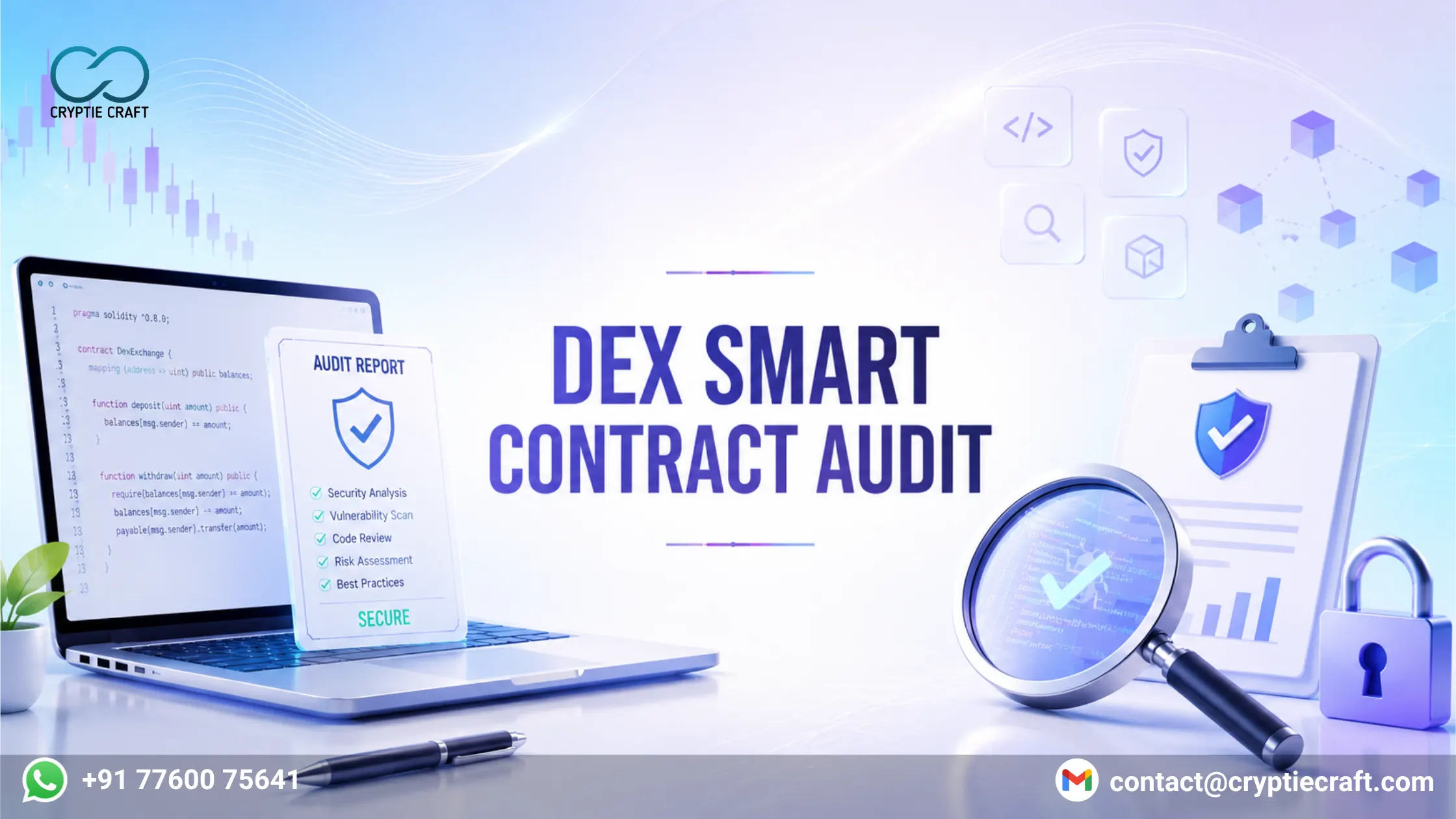
Developing a decentralized exchange is an exciting milestone for crypto teams. Yet, security weaknesses can break your platform overnight. And a DEX smart contract audit is essential. It protects funds from bad hackers. It also increases overall platform trust from day one. From security tips and custodial wallet usage to ensuring correct smart contract architecture, this blog covers it all.
You will understand how to identify insecure hooks with key insights in a dynamic liquidity pool’s code. The security specialists cover flash loan attack mitigation techniques in detail. Completing these steps ultimately helps deliver a secure, scalable, regulation-ready product launch. Maintain your digital asset ecosystem with effortless, bug-free, audited code.
What is a DEX Smart Contract Audit?
A DEX smart contract audit is a very focused and technical security check that involves deep examination of the entire blockchain code infrastructure of a decentralized exchange to find and fix security issues before launching a product on the mainnet. Compared to a simple token audit, a detailed decentralized exchange audit tightly looks into the way different interdependent network protocols handle automated market maker invariants. This exercise also examines the factory contract for security factors in token pair deployment as well as the router contract for the most efficient transaction path routing with gas consumption.
Besides that, auditors confirm that liquidity pool formulas act as intended and slippage stays in control. Other types of checks focus on governance, treasury, and staking code layers, which are analyzed aiming at preventing unauthorized collateral withdrawals. Finally, the confirmation of fee distribution calculations guarantees the exact allocation of passive income throughout the platform ecosystem. Adopting such a thorough validation scheme not only safeguards key protocol assets but also paves the way for a scalable, go-to-market, and fully compliant project launch.
Who Needs a DEX Smart Contract Audit?
Conducting a DEX smart contract audit can be of great help for any blockchain project aiming to minimize security vulnerabilities before launch. Besides providing an additional layer of security around the wallets, such a move also assists in creating a loyal user base, upgrading the security measures of the smart contract, and paving the way for the steady growth of the platform soon.
Startup Founders Launching a New DEX
Startup founders must carry out comprehensive audits of smart contracts before the actual launch to secure user funds, establish trust, avert hacking incidents, and attract stable liquidity.
DeFi Protocol Development Teams
Given the intertwined nature of DeFi protocols, professional auditing is necessary to check discrete contract collaborations, fix any issues, and guarantee safe decentralized financial transactions across different ecosystems.
Blockchain Enterprises and Web3 Businesses
Getting an external security audit of smart contracts becomes a top need for blockchain enterprises to unlock the potential of their code, remain compliant, build a solid reputation, and minimize business risks.
DAO and Community-Governed Projects
Security audits become essential for DAO projects if they want to be able to dependably manage the smart contract for governance, treasury, which can be at risk, voting system, and the operations of a community-controlled decentralized exchange environment.
Existing DEX Platforms Releasing New Features
Every DEX improvement calls for a re-audit to pinpoint new loopholes, ensure secure integrations, safeguard liquidity, and retain the platform’s stability post-release.
All decentralized exchanges need smart contract audits at least from time to time during development. The regular validation of security through such contracts leads to asset protection and confidence-building among users and ultimately helps blockchain platforms achieve long-term success.
Why Smart Contract Audits Are Essential for DEX Security
Smart contract audits are a necessity for decentralized exchanges to ensure that they are well protected against any possible exploitation that might cause both huge financial losses and damage to their reputations, which, in turn, cause permanent loss of user confidence.
Preventing Security Breaches and Financial Losses
Highly skilled auditors can discover major security loopholes in smart contracts that hackers can use to their advantage. This reduces the chances of opening the door to the kinds of attacks that ruin finances for the affected DEX but also ultimately cause a complete shutdown of the platform.
Protecting User Funds and Liquidity Pools
One has to thoroughly check the code; auditors tremendously contribute to safeguarding user funds as well as the liquidity provider’s money and the on-chain protocol’s reserves, among many other sources of funds.
Building User Trust, TVL, and Investor Confidence
DEX platforms that have been thoroughly audited are more appealing to potential users, liquidity providers, and institutional investors. Getting a security check increases the total value locked and greatly supports the platform’s growth soon.
Supporting Compliance, Transparency, and Long-Term Growth
Smart contract audits assure governance integrity and operational transparency and augment readiness for compliance with regulations; besides that, the audited protocols will be able to foster sustainable DeFi ecosystems trusted by global communities.
Frequent smart contract audits of DEXs regularly contribute not only to security but also to building user trust and long-term platform credibility in the face of competition in DeFi markets.
What Does a DEX Smart Contract Audit Cover?
A DEX smart contract audit checks the essential security layers at various points, right from the development phase until go-live. It involves code, protocol logic, permissions, tokenomics, integrations, and performance review from the point of the decentralized exchange security perspective by professional auditors.
Smart Contract Source Code Review
One deeply analyze the source code to uncover any vulnerabilities, logic loopholes, non-compliance with coding standards, poor readability, or any aspects of insecure development, etc.
Business Logic and Economic Security Validation
They ensure that swap logic, liquidity calculations, protocol economics, and reward mechanisms are aligned and do not present any risk of financial exploitation.
Access Control and Permission Analysis
Auditors analyze ownership permissions, administrative roles, multisig controls, and authorization mechanisms to ensure that illicit platform access is not allowed.
Tokenomics and Incentive Mechanism Review
Auditors assess token allocations, rewarding and incentivizing plans to identify if they are encouraging decentralized exchange ecosystem growth in a sustainable manner.
Oracle, Cross-Chain, and Third-Party Integration Security
Auditors check the security of Oracle feeds, bridges, external integrations, and interoperability from usual blockchain attack vectors.
Gas Optimization and Performance Analysis
Auditors come up with improvements with better smart contract performance by pointing out the parts of code that are not efficient, consume too much gas, slow down execution, etc.
Conducting a full-fledged DEX smart contract audit will not only raise the level of blockchain security but also help in saving the user funds, enhancing protocol performance, reducing the number of vulnerabilities, and finally gearing up decentralized exchanges for secure, scalable, and reliable long-term growth.
Core Smart Contracts Audited in a Decentralized Exchange
Every DEX contract layer needs a thorough security check to ensure safety from hacks and keep user funds safe.
Factory and Router Contracts
Auditors inspect the deployment steps, routing precision, and access control in the DEX factory and router contracts. Incorrect routing logic can cause users to be exploited severely and incur significant losses.
Liquidity Pool and AMM Contracts
Security audits check the most important functions of liquidity management, swap operations, LP tokens, and the automated market-making (AMM) mechanisms. AMM contracts that are vulnerable lead liquidity providers to face price manipulation and irreversible drainage.
Governance and Treasury Contracts
One conducts a thorough investigation of governance voting mechanisms, treasury management systems, and on-chain fund security. If governance contracts are weakly coded, it becomes easy for malicious proposals to drain protocol reserves without being noticed.
Staking, Rewards, and Vesting Contracts
They check the accuracy of reward calculation, staking logic, and vesting schedules precisely and also verify the security of the claim mechanism. Mistakes in reward distribution contracts will result in financial losses as well as damage to platform trust.
Oracle and Bridge Integration Contracts
Audits look closely at how well external protocol integrations, cross-chain bridge communication, and on-chain data are maintained. A major reason for big DeFi exploits is compromised oracle feeds and bridge vulnerabilities.
Every DEX smart contract layer deserves a security check by an independent body, not only before deployment but also after upgrades.
The Complete DEX Smart Contract Audit Process
Performing an audit of DEX smart contracts is a must to identify weak spots, upgrade the security of blockchains, and keep decentralized exchanges performing well.
Defining the Audit Scope and Reviewing Documentation
Auditors go through the documents, the plan’s purpose, the goals of smart contracts, etc., before starting a thorough security check of the contracts.
Automated Security Scanning
Automated security tools can quickly find standard smart contract bugs, design errors, and the most common security issues in blockchain.
Manual Code Review and Business Logic Testing
Auditors do a manual inspection of the contract logic, transactions, interactions, and security measures to find vulnerabilities that are not obvious, as well as possibilities of an exploit.
Penetration Testing, Fuzz Testing, and Attack Simulation
Security professionals carry out simulated attacks, change inputs randomly, and conduct penetration tests to reveal complicated decentralized exchange security flaws.
Vulnerability Classification and Risk Assessment
Auditors separate vulnerabilities into groups by how severe they are, assess the risks, and then decide on which should be taken care of first for better protection of the blockchain.
Remediation Validation and Final Audit Report
Auditors check the changes that have been made, carry out the tests again, and write a detailed DEX smart contract audit report.
Choosing a well-organized DEX smart contract audit procedure will lead to safe launches, a higher level of protection of the protocol, enhanced efficiency, and the raising of user trust.
Common Vulnerabilities Found in DEX Smart Contracts
Smart contract audits are a proactive measure to spot major DEX weaknesses that, if left untreated, could be exploited by hackers to cause financial losses that are impossible to recover.
Flash Loan and Liquidity Manipulation Attacks
Hackers can manipulate liquidity pools in a matter of seconds to take advantage of the loopholes in the DEX protocol mechanisms. The audits, because of this, address the problem of price manipulation and the abuse of uncollateralized loans before the DEX is even launched.
Reentrancy and Access Control Vulnerabilities
It is actually reentrancy attacks where the hackers keep calling smart contract functions recursively to take out the funds even before the update of the balances is done. Audits also come with a thorough analysis of unauthorized access risks, privilege escalation flaws, and broken permission controls.
Oracle Manipulation and Price Exploits
If the attackers get their hands on the price feeds from oracles, then not only will they be able to change the valuation of the on-chain assets, but they will also be able to take advantage of the trading mechanisms. With the help of audits, data source integrity can be checked, and vulnerabilities due to reliance on a single oracle point can be found effectively.
Front-Running, MEV, and Sandwich Attacks
One of the main weaknesses linked to transaction ordering is that it paves the way for miners and bots to extract value through sandwich and front-running attacks. Audits, that is, are able to expose the risks of mempool disclosure and also advise on the implementation of the most efficient MEV mitigation strategies for DEX platforms.
Business Logic Flaws and Governance Risks
Mistakes in the protocol processes and governance voting logic that have gone wrong lead to very serious on-chain security vulnerabilities for DEX platforms. Through auditing, it was found that attackers can use malicious governance proposals to exploit business logic inconsistencies.
Arithmetic Errors, Gas Inefficiencies, and Upgrade Risks
The existence of integer overflow and underflow errors, as well as gas execution that is not as efficient to its highest level, are the three main sources of critical smart contract vulnerabilities during DEX operations. However, audits also bring proxy upgrade-related risks to the platform’s attention, giving rise to post-deployment exploit attempt possibilities.
Awareness of these vulnerabilities improves smart contract security, protects assets, and boosts the reliability and trustworthiness of decentralized exchanges.
What Does a Professional DEX Smart Contract Audit Report Include?
One of the most effective security measures you can take is to hire an expert analyst who will provide you with a verbatim, step-by-step report of security loopholes within your system, ensuring a secure and well-audited launch of your ecosystem/protocol.
Executive Summary and Security Assessment
The architectural vulnerabilities to the platform are broadly discussed in this part, and the primary health condition of your protocol is confirmed at the end.
Vulnerability Severity Classification
Security auditors classify the vulnerabilities of the program from the most dangerous level of risk to minor issues that are considered purely informative and pose no threat to the user.
Technical Findings and Risk Analysis
The main discussion revolves around highlighting specific code defects, identifying possible exploitation channels, and evaluating the financial consequences of the implementation of the exploit in the real world.
Remediation Recommendations
Apart from the discovered problems, the developers also get detailed programming fixes by being guided through each step in the process.
Fix Verification and Final Audit Status
The ultimate stage of the audit ascertains that your programmers have effectively fixed all the vulnerabilities that have been identified.
All in all, carefully review each part before delivery to make sure that your digital assets are fully protected and ready for deployment through multiple contracts.
DEX Smart Contract Audit vs Smart Contract Testing vs Bug Bounty Programs
For strong blockchain security, several protection layers are a must. DEX smart contract audits, smart contract testing, and bug bounty programs like Immunefi each serve different purposes, but together they enhance the security of decentralized exchanges.
| Feature | DEX Smart Contract Audit | Smart Contract Testing | Bug Bounty Program |
|---|---|---|---|
| Primary Objective | Detect security vulnerabilities | Verify code functionality | Discover real-world security issues |
| When Used | Before deployment and upgrades | Throughout development | After deployment |
| Performed By | Independent security auditors | Internal development teams | Ethical hackers and security researchers |
| Key Advantage | Comprehensive security validation | Improves code quality and reliability | Continuous vulnerability discovery |
| Main Limitation | Snapshot at audit time | May miss advanced attack scenarios | Depends on community participation |
Integrating audits, testing, and bug bounty programs results in more robust smart contract security and offers well-rounded protection during the whole lifecycle of a decentralized exchange.
Benefits of a DEX Smart Contract Audit
Conducting a DEX smart contract audit is a core factor in enhancing the security of blockchain, guarding one’s digital assets, establishing reputation, and eventually supporting the long-term thriving of a decentralized exchange through the informed strategies that emerge from it.
Protecting User Funds and Reducing Security Risks
An audit of a security is a process that detects potential vulnerabilities that might be exploited to cause damage. So, without a doubt, it is one of the most effective ways to safeguard users’ money and minimize the risks of a security breach of the blockchain even before the system is officially launched.
Building Investor and User Confidence
A decentralized exchange that has undergone an audit is like a brand that has been through rated & reviewed processes, thereby increasing not only the confidence of the investors but also enabling the trust of the users, which further translates into more liquidity being generated throughout the trading platform.
Supporting Exchange Listings and Strategic Partnerships
Authenticating audit reports not only raises the trustworthiness level of the projects but also that of the team, helping to secure exchange listings, form business partnerships, and find long-term cooperation opportunities in the blockchain space.
Strengthening Brand Reputation and Long-Term Growth
Ensuring the security of smart contracts at an excellent level is not only what will help in building a good brand image and attract users who are loyal users, but will at the same time contribute towards the long-term growth of the decentralized exchanges.
Conducting DEX smart contract audits routinely will lead to the overall strengthening of security, raising the level of trust, lowering the number of breaches, and ultimately laying down the stronger infrastructure that is necessary for the long-lasting success of blockchain businesses.
How to Choose the Right DEX Smart Contract Audit Company
When selecting a DEX smart contract audit company, you should look for a company that has been tried and tested, features a high level of expertise, is clear about its workflow, and has extensive experience in blockchain security.
Evaluate Experience with DEX and DeFi Protocols
It helps to entrust auditors who offer not only security auditing of DEX, DeFi, and smart contracts but also have experience in working with different blockchain networks.
Review Audit Methodology and Security Standards
One has to consider their security techniques, the share of testing and audit tools, standards for audits, and the extent to which vulnerabilities are assessed in their process.
Assess Report Quality and Technical Transparency
The audit reports that you should prefer are those that provide a good amount of detail in revealing the loopholes, explaining fixes, disclosing security issues, and making recommendations for remediation with the highest level of transparency.
Verify Post-Audit Support and Remediation Assistance
Find out about the extent to which auditors will assist you with the remediation, re-testing, and verification of vulnerabilities after the smart contract audit is completed.
Check Reputation, Previous Audits, and Client Portfolio
Look into the audit partner’s client testimonials, prior audits, accomplished projects, and their standing in the industry.
Only the best DEX smart contract audit company can help you strengthen your security, give you trustworthy advice, and make the blockchain project successful in the long run.
Best Practices for Maintaining DEX Smart Contract Security
The best DEX smart contract security is not a one-time achievement but a result of continuous monitoring, regular audits, and secure development that spans the entire lifecycle of a blockchain project.
Follow Secure Smart Contract Development Standards
Secure coding practices, peer reviews, and extensive testing must be followed rigorously to minimize the occurrence of smart contract security vulnerabilities.
Perform Regular Security Audits After Updates
When changes are made to your smart contracts, such as upgrades, integrations, or even governance modifications, you should carry out audits to discover any new risks related to the security of the blockchain.
Implement Continuous Monitoring and Threat Detection
Keep an eye on smart contracts all the time to identify at the earliest possible stage, any suspicious activities, exploits, and new threats that may arise in the blockchain security domain.
Launch a Responsible Disclosure or Bug Bounty Program
Give ethical researchers the green light to report their findings about vulnerabilities through responsible disclosure channels and a well-structured bug bounty program.
Hence, continual adherence to smart contract security measures is a means of safeguarding decentralized exchanges, minimizing exposure to risks, and ensuring the sustained reliability of blockchain platforms.
Conclusion
A DEX smart contract audit is a crucial step in the process of creating a decentralized exchange. It matters a lot in uncovering potential vulnerabilities in smart contracts before they are exploited in a security breach, resulting in major losses. A thorough audit by experts not only safeguards users’ funds but also enhances the overall security of the blockchain and the performance of the platform. It works by gaining the confidence of investors, traders, liquidity providers, and other stakeholders. But security should not be considered a one-time measure after the deployment of the platform. Each time the protocol is updated or upgraded, a new feature is implemented, an integration is done, or the governance is changed, the system will need a security assessment once again. Conducting regular audits, continuous monitoring of the system, the implementation of secure development practices, and offering bug bounty programs result in comprehensive protection against emerging threats. By adhering to these best practices, one can ensure that the smart contracts remain secure and the overall protocol stays stable. Through the integration of DEX smart contract audits into the security strategy of an enterprise in a continuous manner, a reduction in risks can be achieved, enhanced user trust can be promoted, sustainable growth can be promoted, and ultimately, the establishment of a decentralized exchange that is trusted and capable of thriving in the competitive Web3 environment can be accomplished.
Frequently Asked Questions
Q1. What is a DEX smart contract audit?
Ans: A DEX smart contract audit is a security check done by a third party to find loopholes, validate the code, and ensure the safety of decentralized exchange (DEX) smart contracts.
Q2. Why is a smart contract audit important before launching a decentralized exchange?
Ans: Conducting a smart contract audit helps identify security loopholes before the launch, safeguarding funds, minimizing risks, and also making investors and traders more confident in the project.
Q3. What does a DEX smart contract audit cover?
Ans: A DEX smart contract audit covers scanning the source code, checking the business logic permissions, tokenomics integrations, finding potential vulnerabilities, optimizing gas, adhering to security best practices, etc.
Q4. Which smart contracts are typically audited in a DEX?
Ans: A DEX audit comprises various contracts like liquidity pools, swap governance, staking treasury token, bridge, and administrative, to name a few. These are the main contracts that the auditors look at for finding security issues or vulnerabilities.
Q5. What are the most common vulnerabilities found during a DEX audit?
Ans: The most frequently found vulnerabilities during a DEX audit include reentrancy attacks, flash loan exploits, oracle manipulation, access control issues, business logic flaws, and inefficiencies in gas consumption.
Q6. How long does a DEX smart contract audit take?
Ans: The typical timeframe for a DEX smart contract audit is 1 to 4 weeks, contingent on factors like the intricacy of the protocol, the number of lines of code, and the seriousness of potential security vulnerabilities that are found.
Q7. How much does a DEX smart contract audit cost?
Ans: The price for a DEX smart contract audit covers several factors, such as project complexity, blockchain network, codebase size, audit scope, and the extent of security testing needed.
Q8. Can a smart contract audit guarantee complete security?
Ans: Conducting a smart contract audit is like significant risk mitigation on vulnerabilities, but it does not equate to 100% security or immunity to new attack vectors or methods in the blockchain domain.
Q9. How often should a decentralized exchange undergo a smart contract audit?
Ans: It makes sense for a decentralized exchange to have a smart contract audit not only when it is released but also after each of these major upgrades, integration of new features, governance changes, and any kind of modification in smart contracts.
Q10. How do I choose the right DEX smart contract audit company?
Ans: One can choose the right DEX smart contract audit company by analyzing which one has the best match, has a good track record, follows open and transparent processes, produces high-quality report materials, has a reputation that is well-known and respected, and also offers reliable support after audits are done.