Binance Clone Script
  KuCoin Clone Script
  Bybit Clone Script
  Kraken Clone Script
  OKX Clone Script
  ERC-20 Token Development
  TRC-20 Token Development
  BEP-20 Token Development
  Crypto Token Development
  ICO Development
  STO Development
  Binance NFT Clone
  OpenSea Clone Script
  Rarible NFT Clone
  NFT Marketplace Development
  MetaMask Clone Script
  Trust Wallet Clone Script
  Crypto Wallet Development
  DeFi Wallet Development
  Uniswap Clone Script
  PancakeSwap Clone
  SushiSwap Clone
  Crypto Payment Gateway
  Binance Pay Clone
  Crypto MLM Software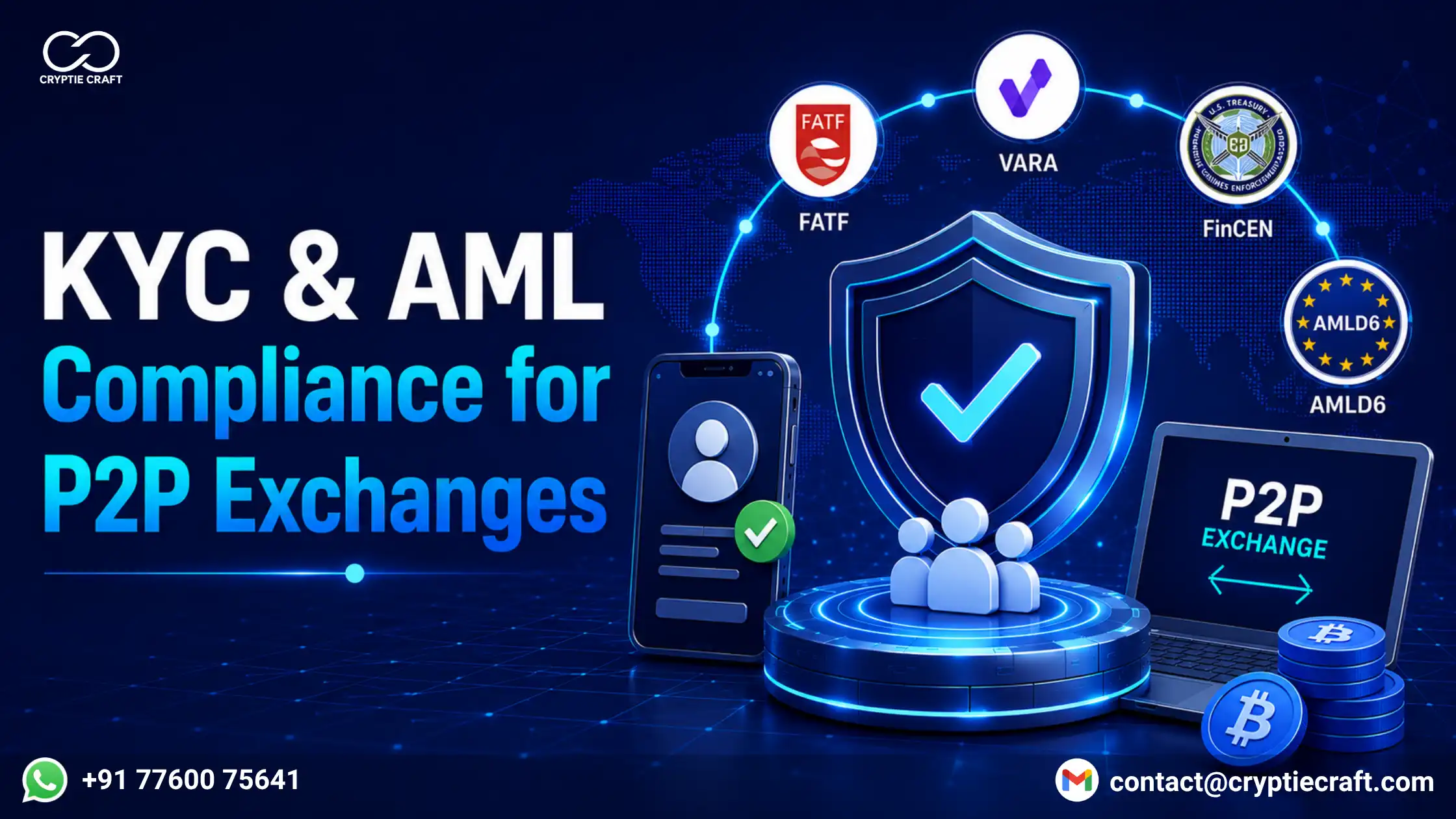
Peer-to-peer (P2P) crypto exchanges have made it easier for users to trade digital assets directly, but that flexibility also creates significant compliance challenges. Unlike traditional centralized trading models, P2P platforms connect buyers and sellers directly, increasing exposure to identity fraud, money laundering, sanctions violations, third-party payments, and suspicious transaction activity.
This makes KYC & AML compliance for P2P exchanges more than a standard verification step. A compliant platform needs a structured framework covering customer identification, risk assessment, sanctions and PEP screening, transaction monitoring, suspicious activity detection, and regulatory reporting.
The challenge becomes more complex when operating across different markets. FATF, VARA, FinCEN, and AMLD6 establish different regulatory expectations that can affect how a P2P exchange onboards users, monitors transactions, manages risk, and maintains compliance records.
So, what KYC and AML controls does a P2P exchange actually need, and how do these major regulatory frameworks apply? This guide breaks down the key requirements and explains how compliance can be integrated into a P2P crypto exchange development process from the ground up.
Why KYC & AML Compliance Matters for P2P Exchanges
KYC and AML compliance helps a P2P crypto exchange understand who is using the platform, assess customer risk, and identify transactions that may require further investigation. This is especially important in P2P trading, where buyers and sellers interact directly and may use different payment methods and blockchain wallets.
Protecting the Platform From Financial Crime
P2P exchanges can face risks such as fraudulent accounts, mule activity, sanctions exposure, money laundering, and suspicious movement of digital assets. Effective KYC and AML controls help operators identify higher-risk users and transactions before they create larger compliance or operational problems.
Building Trust With Users and Partners
Strong identity verification and transaction monitoring can improve trust in the platform. Users are more likely to trade on a marketplace when they know that accounts, wallets, and transactions are subject to appropriate security and compliance checks.
Supporting Regulatory and Operational Readiness
Compliance should not be added after the exchange is launched. KYC onboarding, customer risk assessment, sanctions screening, transaction monitoring, record keeping, and reporting workflows should be considered during platform design. The specific controls required will depend on the exchange’s business model, activities, users, and operating jurisdictions.
Compliance should be treated as part of the platform architecture, not simply as a KYC verification screen. Connecting identity, wallet, transaction, and risk data allows compliance teams to make better-informed decisions throughout the customer lifecycle.
Core KYC & AML Compliance for P2P Exchanges Requirements
A P2P exchange needs more than basic identity verification to manage financial crime and compliance risks. The compliance framework should combine customer checks, risk assessment, screening, transaction monitoring, and ongoing review.
KYC, CDD & EDD
KYC begins by verifying a user’s identity before allowing activities that require verification. Depending on the business model and applicable regulations, this may involve government-issued identification, personal information, proof of address, and other verification checks.
Customer Due Diligence (CDD) helps the exchange understand the customer’s profile and assess their risk level. Higher-risk customers may require Enhanced Due Diligence (EDD), such as additional information about their source of funds or source of wealth.
Sanctions, PEP & Wallet Screening
A P2P exchange should screen customers against applicable sanctions and politically exposed person (PEP) databases. Wallet screening can also help identify blockchain addresses associated with known or elevated-risk activity.
These checks are particularly useful when users deposit, withdraw, or trade digital assets through external wallets. The exact screening requirements depend on the platform’s jurisdiction and regulatory obligations.
KYT, Transaction Monitoring & Suspicious Activity Reporting
Know Your Transaction (KYT) complements KYC by examining the activity associated with crypto transactions. Transaction monitoring can assess factors such as transaction patterns, wallet risk, transaction frequency, and unusual behavior.
When activity triggers defined risk rules, the platform can generate an AML alert for investigation. Depending on the applicable jurisdiction and legal requirements, confirmed suspicious activity may need to be reported to the relevant authority.
Together, these controls create a continuous compliance process:
Verify the customer → Assess risk → Screen the customer and wallet → Monitor transactions → Investigate alerts → Report when required
FATF vs VARA vs FinCEN vs AMLD6: Key P2P Compliance Requirements
KYC and AML obligations vary by jurisdiction, but major frameworks share common principles such as customer due diligence, risk assessment, transaction monitoring, record keeping, and suspicious activity controls. For a P2P crypto exchange, the important step is translating those regulatory expectations into practical platform controls.
| Framework | Primary Relevance | Key Compliance Focus | P2P Consideration |
| FATF | Global AML/CFT standards | Risk-based controls, CDD, reporting, Travel Rule | P2P and unhosted-wallet risks |
| VARA | Dubai virtual asset market | AML/CFT, customer controls, transaction and wallet monitoring | Requirements depend on regulated activity |
| FinCEN | United States | BSA, MSB obligations, AML program, reporting | Business model determines applicable obligations |
| AMLD6 | European Union | AML/CFT framework, customer due diligence and supervision | Applies within the wider EU AML framework |
FATF Requirements for Virtual Asset Service Providers
The Financial Action Task Force (FATF) provides global AML/CFT standards for virtual asset activities. Its framework emphasizes risk-based customer due diligence, record keeping, suspicious transaction reporting, and the Travel Rule for applicable virtual asset transfers.
For detailed regulatory guidance, businesses can review the FATF’s official virtual asset guidance.
For P2P platforms, FATF’s work is particularly relevant because it addresses risks associated with peer-to-peer transactions and unhosted wallets. This makes wallet risk assessment and transaction monitoring important considerations when designing a compliance framework.
VARA AML & KYC Requirements in Dubai
The Virtual Assets Regulatory Authority (VARA) regulates applicable virtual asset activities in Dubai. Depending on the licensed activity and business model, a P2P platform may need controls covering customer due diligence, AML/CFT risk management, transaction monitoring, sanctions screening, and wallet-related checks.
Businesses can review the VARA regulatory framework when assessing applicable virtual asset requirements.
VARA’s requirements should be evaluated against the exact activities the business intends to conduct rather than treating every P2P platform as subject to identical obligations.
FinCEN AML Requirements for P2P Crypto Platforms
In the United States, the Financial Crimes Enforcement Network (FinCEN) applies Bank Secrecy Act requirements to businesses that fall within applicable money services business or money transmitter definitions. Depending on the platform’s activities, obligations can include registration, an AML program, record keeping, and suspicious activity reporting.
Businesses should review FinCEN’s official guidance when determining the applicable U.S. compliance requirements.
A P2P exchange should determine its regulatory classification before selecting its compliance architecture. Simply calling a platform a marketplace or P2P service does not by itself determine whether U.S. BSA obligations apply.
AMLD6 and EU Crypto Compliance
AMLD6 forms part of the European Union’s broader AML/CFT framework and strengthens requirements around customer due diligence, beneficial ownership, supervision, and financial crime controls.
Businesses can review the EU AML/CFT framework alongside other applicable European crypto regulations.
For a P2P exchange, this means compliance planning should consider customer identification, risk classification, ongoing monitoring, record keeping, and reporting obligations rather than treating KYC as a one-time onboarding process.
FATF provides global standards, while VARA, FinCEN, and EU rules establish jurisdiction-specific obligations. A P2P exchange should map each applicable requirement to an actual platform control before launch. Regulatory requirements can change, so businesses should verify the latest official rules and obtain appropriate legal advice for their target markets.
How KYC & AML Compliance Works Inside a P2P Exchange
KYC and AML controls work best when they are connected across the entire P2P trading lifecycle. Instead of treating compliance as a single verification step, the exchange can use customer, wallet, and transaction data to continuously assess risk.
User Onboarding & Identity Verification
The process starts when a user creates an account. Depending on the platform’s requirements, the exchange can collect identity information and integrate a KYC provider to verify documents and other customer details.
Once verification is complete, the platform can assign a customer risk profile based on factors such as location, account information, business activity, and other relevant risk indicators. Higher-risk profiles may require additional due diligence.
Risk Scoring, Wallet Screening & Trade Monitoring
After onboarding, compliance controls can continue during deposits, withdrawals, and P2P trades. A risk engine can evaluate customer activity and assign risk scores based on predefined rules.
Wallet screening and blockchain analytics can help identify addresses associated with elevated-risk activity. At the same time, transaction monitoring can detect unusual trading patterns, rapid movement of funds, abnormal transaction volumes, or other activity that falls outside expected behavior.
For platforms using escrow-based P2P transactions, the payment and asset-release process should also be considered within the overall compliance workflow. Businesses evaluating escrow functionality can explore a Bitcoin escrow script as one example of technology used in P2P trading infrastructure.
Alerts, Investigations, Reporting & Audit Trails
When a transaction or account triggers a compliance rule, the system can generate an AML alert for review. Compliance teams can investigate the activity, record their findings, and take appropriate action based on the platform’s policies and applicable requirements.
An audit trail should preserve relevant compliance actions, including verification results, alerts, reviews, decisions, and reporting records.
A practical compliance workflow can therefore follow this sequence:
User Registration → KYC Verification → Risk Scoring → Wallet Screening → P2P Trade → Transaction Monitoring → AML Alert → Investigation → Reporting
This connected approach helps turn KYC and AML from isolated features into an ongoing compliance process across the P2P exchange.
Common AML Risks in P2P Crypto Trading
P2P trading can introduce risks that require closer monitoring because users transact directly with counterparties and may use external wallets and multiple payment methods. Understanding these risks helps operators design more effective compliance controls.
Fraud, Mule Accounts & Third-Party Payments
Fraudulent identities, compromised accounts, and mule accounts can be used to move or receive illicit funds through P2P trades. Third-party payments can create additional risk when the person making a payment does not match the verified account holder or trading counterparty.
P2P platforms can reduce these risks through identity verification, account monitoring, payment consistency checks, transaction limits, and risk-based review processes.
Sanctions, High-Risk Wallets & Suspicious Trading Patterns
External wallets can expose a P2P exchange to addresses associated with sanctions, scams, illicit services, or other elevated-risk activity. Rapid transactions, unusual trading volumes, repeated counterparties, sudden changes in account behavior, or unusual fund flows may also warrant investigation.
Wallet screening, blockchain analytics, transaction monitoring, and configurable risk rules can help identify these patterns. However, automated alerts should support—not replace—appropriate human investigation and compliance decision-making.
P2P AML controls should evaluate more than the customer’s identity. The relationship between the user, payment method, wallet, counterparty, and transaction behavior provides a more complete view of risk.
P2P Exchange KYC/AML Compliance Checklist
Before launching a P2P crypto exchange, operators should map their compliance requirements to the platform’s actual features and workflows. A practical KYC/AML checklist includes:
| Compliance Area | Key Control |
| Identity verification | Verify customer identity during applicable onboarding stages |
| Customer due diligence | Assess customer profile and risk |
| Enhanced due diligence | Apply additional checks to higher-risk customers where required |
| Sanctions & PEP screening | Screen customers against relevant risk lists |
| Wallet screening | Assess blockchain addresses for applicable risk indicators |
| KYT | Monitor crypto transactions and fund flows |
| Transaction monitoring | Detect unusual or potentially suspicious activity |
| Risk scoring | Assign and update customer or transaction risk levels |
| AML alerts | Flag activity that meets defined risk rules |
| Case management | Investigate and document compliance alerts |
| Regulatory reporting | Submit required reports to relevant authorities where applicable |
| Audit trails | Maintain appropriate records of compliance actions |
| Travel Rule | Implement applicable transfer-data requirements |
| Ongoing monitoring | Reassess customer and transaction risk over time |
The checklist should be adapted to the exchange’s business model, supported assets, payment methods, customer base, and operating jurisdictions.
Paxful Case Study: What P2P Platforms Can Learn
The 2025 FinCEN enforcement action involving Paxful highlights why AML controls cannot be treated as a secondary feature of a P2P crypto platform. FinCEN announced a $3.5 million civil money penalty against Paxful for alleged Bank Secrecy Act violations, including failures related to an effective AML program and suspicious activity reporting.
For the primary regulatory source, readers can review FinCEN’s Paxful enforcement action.
The case demonstrates an important lesson for P2P exchange operators: compliance needs to extend beyond verifying users at registration. Platforms also need appropriate processes for monitoring transactions, identifying suspicious activity, investigating alerts, maintaining records, and meeting applicable reporting obligations.
For businesses planning a P2P crypto exchange, the practical takeaway is clear: KYC establishes who the customer is, while ongoing AML and transaction monitoring help determine whether their activity presents an unacceptable risk.
Building a Compliance-Ready P2P Crypto Exchange
KYC and AML compliance should be planned during P2P crypto exchange development, rather than added after the core trading platform is complete. A compliance-ready architecture connects identity verification, risk assessment, wallet screening, transaction monitoring, and compliance reporting with the exchange’s existing trading and wallet systems.
Businesses that are still evaluating the development process can also refer to this P2P crypto exchange development guide for a broader look at the platform’s development considerations.
Essential Compliance Features
A P2P exchange may need features such as:
- KYC and identity verification integration
- Customer risk assessment and risk scoring
- Sanctions and PEP screening
- Wallet screening and blockchain analytics
- KYT and transaction monitoring
- Automated AML alerts
- Compliance case management
- Suspicious activity reporting workflows
- Audit logs and compliance records
- Travel Rule capabilities where applicable
These features should work together rather than operate as isolated modules. For example, a transaction-monitoring system can use customer risk information and wallet-risk signals to determine whether a transaction requires additional review.
Compliance-First Technical Architecture
A practical architecture can connect the user layer, KYC provider, risk engine, wallet system, blockchain analytics, transaction monitoring engine, and compliance dashboard through secure APIs and controlled data flows.
The architecture should also consider role-based access control, encryption, auditability, data protection, scalability, and reliable monitoring. The exact design will depend on the exchange model, supported assets, jurisdictions, custody structure, and compliance obligations.
For businesses planning to build a compliant P2P crypto exchange, selecting the right compliance architecture early can reduce costly redesigns and make future regulatory or operational changes easier to manage.
Businesses comparing development providers can also evaluate a specialized crypto exchange development company based on its experience with trading infrastructure, security, compliance integrations, and scalable exchange architecture.
Ready to Build a Compliance-Ready P2P Crypto Exchange?
KYC and AML compliance should be built into a P2P crypto exchange from the beginning rather than added after launch. A compliance-ready platform should connect identity verification, customer risk scoring, sanctions and PEP screening, wallet monitoring, transaction monitoring, AML alerts, case management, and audit trails with the core trading and wallet infrastructure.
The right architecture should also adapt to your business model, supported assets, payment methods, custody structure, target market, and applicable regulatory requirements. This approach can help reduce costly redesigns while creating a more secure and scalable foundation for future compliance and operational needs.
Cryptiecraft helps businesses build P2P crypto exchange platforms with trading, security, risk management, and compliance capabilities integrated into the development process. If you’re planning to launch a secure and compliance-focused platform, explore our P2P Crypto Exchange Development solution to learn more about the development approach, essential features, compliance integrations, security measures, and customization options.
With the right development architecture and compliance strategy, businesses can create a scalable P2P exchange designed to support evolving operational and regulatory requirements.
Frequently Asked Questions
Q1. Is KYC mandatory for a P2P crypto exchange?
Ans: KYC requirements depend on the platform’s business model, activities, and operating jurisdiction. Applicable regulations should be verified before launch.
Q2. What are the AML requirements for P2P exchanges?
Ans: Common requirements include KYC, customer due diligence, risk assessment, sanctions screening, wallet screening, transaction monitoring, record keeping, and applicable regulatory reporting.
Q3. Does FATF regulate P2P crypto exchanges directly?
Ans: No, FATF establishes global AML/CFT standards. Individual jurisdictions implement and enforce requirements through their own regulatory frameworks.
Q4. What are FinCEN requirements for a P2P crypto platform?
Ans: Depending on its activities and regulatory classification, a U.S.-based or U.S.-connected platform may have BSA obligations such as AML controls, registration, record keeping, and suspicious activity reporting.
Q5. What does VARA require for crypto AML compliance?
Ans: Applicable VARA-regulated businesses must follow relevant AML/CFT and virtual asset requirements based on their licensed activities and business model.
Q6. How does AMLD6 affect crypto businesses?
Ans: AMLD6 forms part of the EU’s broader AML/CFT framework and can affect areas such as customer due diligence, beneficial ownership, supervision, and financial crime controls.
Q7. What is the difference between KYC, AML, and KYT?
Ans: KYC focuses on verifying customers, AML covers broader financial crime controls, and KYT focuses on monitoring crypto transactions and related wallet activity.
Q8. How do P2P exchanges detect suspicious transactions?
Ans: They can combine customer risk profiles, wallet screening, blockchain analytics, transaction monitoring, risk rules, behavioral analysis, and compliance investigations.
Q9. What AML features should a P2P exchange have?
Ans: Key features can include KYC integration, sanctions and PEP screening, wallet screening, KYT, transaction monitoring, risk scoring, AML alerts, case management, reporting workflows, and audit trails.