Binance Clone Script
  KuCoin Clone Script
  Bybit Clone Script
  Kraken Clone Script
  OKX Clone Script
  ERC-20 Token Development
  TRC-20 Token Development
  BEP-20 Token Development
  Crypto Token Development
  ICO Development
  STO Development
  Binance NFT Clone
  OpenSea Clone Script
  Rarible NFT Clone
  NFT Marketplace Development
  MetaMask Clone Script
  Trust Wallet Clone
  Crypto Wallet Development
  DeFi Wallet Development
  Uniswap Clone Script
  PancakeSwap Clone
  SushiSwap Clone
  Crypto Payment Gateway
  Binance Pay Clone
  Crypto MLM Software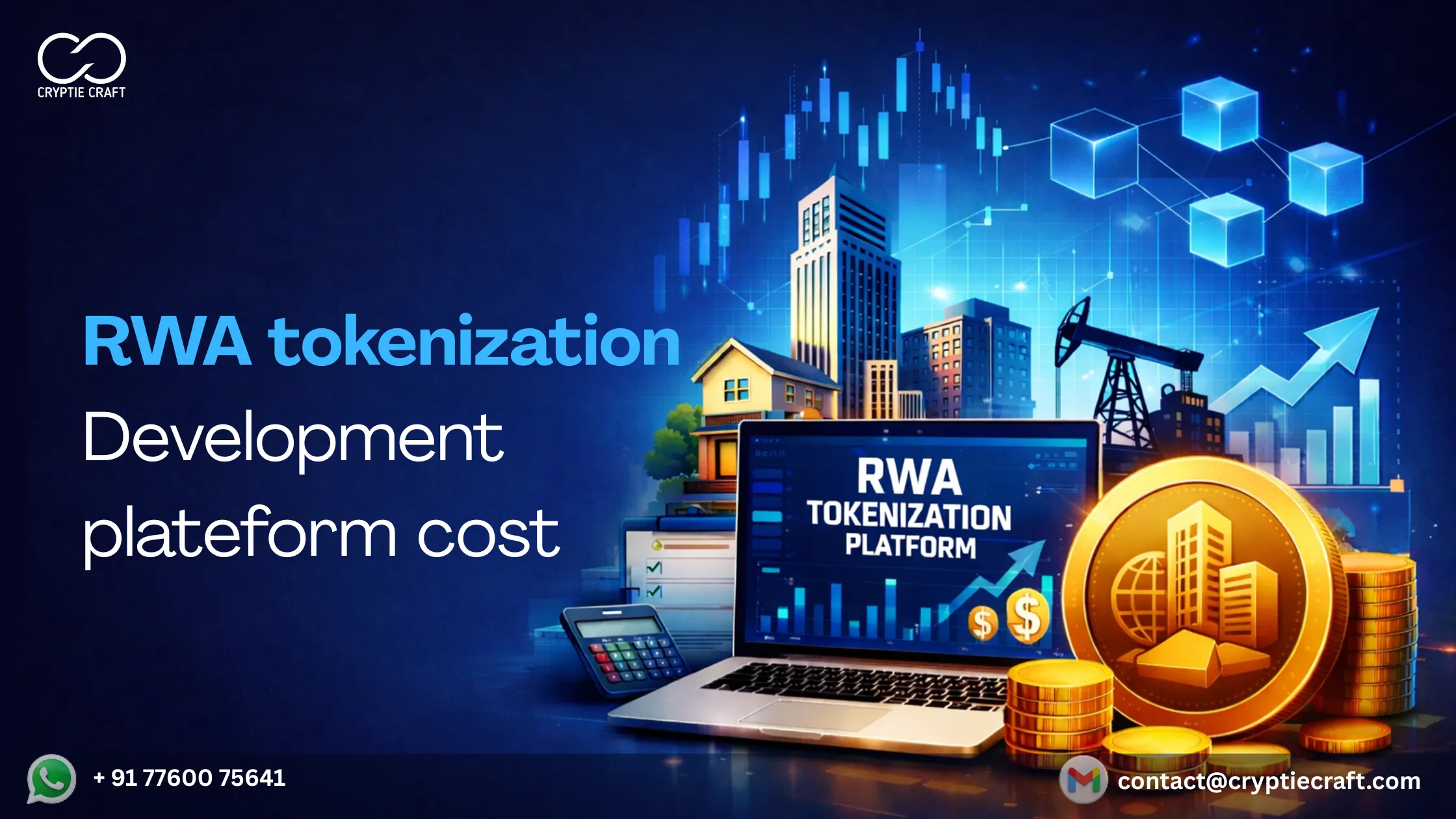
If you’re a founder evaluating real-world asset tokenization, the first practical question is almost always the same. What’s this actually going to cost? That’s not a shallow question; it’s the right one. And the answer depends on more variables than most development companies will tell you upfront.
The RWA tokenization market has grown nearly fivefold in three years, reaching approximately $24 billion in on-chain assets. Industry projections from Mintlayer and GrandView Research place the addressable market between $16 trillion and $30 trillion by 2030. Industry players like BlackRock, JPMorgan, and Franklin Templeton are not only exploring but have already rolled out production-scale tokenized assets.
That context matters because it tells you what you’re building into. This blog will break down the cost of your specific platform.
What is RWA Tokenization?
RWA tokenization means turning real-world assets into digital tokens on the Blockchain. These tokens signify ownership of tangible or financial assets, like property, commodities, or bonds. The price varies with the complexity of the asset, its compliance, and the features of the platform.
Smart contracts and blockchain networks like Ethereum or Polygon convert physical assets into on-chain digital tokens. Investors benefit from transparency, security, and the potential for fractional ownership through such an arrangement.
The key thing to understand about RWA tokenization cost is that it scales with two variables above all others, such as asset complexity and compliance requirements. A commodity token representing gold ounces needs a price oracle, a custody proof, and basic KYC; that’s a manageable build. A private equity fund token needs investor accreditation, SEC Reg D compliance, transfer restrictions, dividend automation, and secondary market controls. Same Blockchain, entirely different engineering scope & legal overhead.
How Much Does RWA Tokenization Cost?
RWA tokenization cost depends on what you aim to gain from your project. And the number of features you want it to have. The complexity of your platform, your compliance requirements, and the number of desired integrations all influence pricing. Businesses should analyze different levels of development before deciding on the investment strategy for a tokenization platform.
| Project tier | Includes features | Estimated cost range | Key variable impacting cost |
| MVP | Basic tokenization, simple smart contracts | $15,000 – $40,000 | Asset type, blockchain choice |
| Mid-Tier | KYC/AML, wallets, dashboard | $40,000 – $100,000 | Compliance, integrations, UI complexity |
| Enterprise | Full-scale platform, advanced security | $100,000+ | Audits, scalability, legal requirements |
Knowing the cost of RWA platform development will enable organizations mid-to-long-term planning. Choosing the right level meets growth and regulatory requirements. It maximizes ROI and offers effective real-world asset tokenization platform expansion.
RWA Tokenization Cost Based on Asset Type
The cost of RWA tokenization develops different requirements because assets require different levels of complexity. The development costs and tokenization prices for real-world assets need special compliance requirements and smart contract development and system integration work.
Real Estate Tokenization Cost
Real estate is the most expensive asset class to tokenize, and the reasons are straightforward. Legal arrangements for mapping property ownership on-chain usually call for a title company to be involved, a securities law check at the level of the relevant jurisdiction, and property verification processes. KYC and investor accreditation mechanisms have to be strong enough to pass SEC Reg D (for US offerings) or corresponding regimes internationally. In addition, smart contracts should take care of the issuance of tokens, the imposition of transfer restrictions, the distribution of dividends or rental yield, and governance rights. Typically, the development cost for a real estate tokenization platform can be anywhere from $50,000 for a narrowly focused MVP (single property, only accredited investors, basic compliance) to $120,000+ for a multi-property platform with secondary market trading. Besides building, the cost of auditing goes from $10,000 to $25,000.
Private Equity and Fund Tokenization Cost
Fund tokenization is almost as complex as real estate but unlike property law, you’re mostly dealing with securities regulations when it comes to fund interests – in most cases, that also means investment company regulations and not just Reg D. The technical requirements are investor whitelisting based on acreditation, smart contract’s cap table management logic, and fund administrator’s reporting needs that must be supported with an audit trail system. Developing a solution can cost between $60,000 and $150,000 based on whether you also want features like automatic carry calculations, LP/GP distinctions, and secondary trading. Compliance and legal structuring could put the price up another $20,000 to $50,000 before any token is issued.
Commodity Tokenization Cost
Commodities such as gold, oil, or agricultural products are in most cases the first logical asset class for tokenizing from a legal perspective, which is why founders testing the market are often advised to start with them. The main technical necessity is a trusted proof-of-reserve system: a method that confirms that the physical asset is really existing and in the possession of a custodian, with the update being done on-chain through oracle integration. To develop a commodity tokenization Minimum Viable Product (MVP) typically costs between $30,000-$60,000. Prices rise substantially if the requirements include multi-commodity support, exchange connectivity, or cross-border custody verification. Integrating Chainlink or Pyth oracles costs between $5,000 and $15,000, in addition to the base build.
Bond and Fixed-Income Tokenization Cost
Bond tokenization is gradually becoming institutional, and left behind are only the complexities of the contract. Programmers have to be able to properly encode the logic for automated coupon payments, maturity date executions, and callable bonds, and thoroughly audit them as well. Any mistake in coupon distribution logic at a large scale would be not only a bug but a material financial error as well. Estimated cost: $40,000-$90,000 based on the complexity of the bond type (fixed vs. floating rate, callable vs. bullet). Building for institutional use means that audit requirements will likely drive costs to the upper end of this range. Compliance with MiFID II or SEC, however, will incur separate legal costs.
Art and Collectibles Tokenization Cost
The challenge of art tokenization lies in a feature that differentiates it from other financial assets: verification of authenticity. The tokenization of a painting or collectible can only proceed once the item’s provenance, condition, and market value have been documented – and this documentation likewise benefits from being accessible on-chain without creating counterfeit risk. Usually, this would be IPFS storage for provenance records coupled with integration with physical authentication services. Building costs: $25,000-$55,000 for a highly specialized art tokenization platform. When working on a general collectible marketplace with fractional ownership feature for different types of asset, you can take as a reference a price of $60,000-$90,000 with a 4-6 month timeline.
Blockchain RWA tokenization cost needs to be understood according to asset categories so businesses can create effective plans. The different categories need specific financial resources to achieve compliance and security and scalability needed for success before building RWA platforms.
RWA Token Development Cost Breakdown by Component
RWA token development costs include multiple technical & compliance needs. Each module impacts overall pricing. Understanding these elements helps estimate accurate tokenization platform development costs. And also optimized blockchain asset tokenization investment.
Smart Contract Development Cost
The price for smart contract development includes ERC-20, ERC-3643 standards, and tokenomics design prices. It costs $15,000-$60,000 depending on token standard complexity and number of transfer restriction rules. The creation of secure asset-backed tokens for scalable blockchain token deployment.
KYC/AML and Investor Whitelisting Module
KYC/AML feature creation enables on-chain compliance, setting up investor accreditation feature, and safe onboarding of institutional investors on regulated real-world assets tokenization platforms. The price of it varies from $8,000-$25,000 for integration with providers like Sumsub, Onfido, or Jumio. Custom on-chain compliance logic sits toward the higher end.
Asset Custody and Proof-of-Reserve Integration
Asset custody services consist of custodial wallets and proof-of-reserve integration. These ensure safe asset storage and transparency in the on-chain management of tokenized real-world assets. The cost range varies between $10,000-$30,000. Non-custodial setups are faster to build; custodial arrangements require additional legal review.
Investor Portal and Admin Dashboard
The investor portal features dashboards, on-chain asset management tools, and reporting systems. So the pricing varies from $12,000-$35,000 depending on reporting complexity and whether you need real-time on-chain data visualization. The Admin panels efficiently handle user, transaction, and compliance workflow management across tokenization platforms.
Oracle Integration for Real-Time Asset Pricing
Oracle networks are capable of giving real-time asset pricing data. They serve as the link between off-chain assets and blockchain systems, thus ensuring accurate valuation for DeFi liquidity infrastructure and tokenized assets. The cost start from $5,000-$18,000. More complex for assets with frequent valuation updates.
Smart Contract Audit Cost
A smart contract audit is the process of verifying the security of the code and detecting any potential vulnerabilities. The cost of conducting an audit depends on the complexity of the project; it is a necessary step to ensure safe blockchain interoperability. Smart contract security audit requires $5,000-$30,000. Budget $10,000+ for enterprise-grade audits by firms like CertiK, Trail of Bits, or OpenZeppelin.
Understanding each component in RWA tokenization cost helps businesses allocate budgets effectively. Proper planning ensure secure, compliant platforms. These improve long-term success in real-words asset tokenization development.
RWA Tokenization Cost by Jurisdiction
RWA tokenization cost differs depending on the jurisdiction and local regulations. Regulatory compliance is one of the main factors affecting the cost of real-world asset tokenization. To operate effectively in international markets, businesses have to consider licensing and on-chain compliance expenses.
United States – SEC Reg D, Reg S, and Reg A+ costs
Complying with the U.S. regulations might increase the RWA tokenization cost substantially. As per the SEC laws, legal structuring and accreditation of the investors are compulsory. If you’re building transfer agent functionality or running a regulated ATS for secondary trading, budget an additional $30,000-$80,000 for legal and licensing. The investor accreditation verification module adds $8,000-$15,000 in development.
European Union – MiCA compliance cost
MiCA rules affect the cost of creating a RWA tokenization platform in a European country. Besides, the law mandates the development of KYC/AML modules. Compliance build costs for MiCA include KYC/AML integration ($8,000-$20,000), white paper preparation (required for most token types, $5,000-$15,000 in legal fees), and ongoing reporting infrastructure. Licensing fees vary by country and token classification. Total MiCA compliance overhead for a new platform is $25,000-$60,000.
UAE – VARA and ADGM framework costs
UAE recognized the framework costs involved in tokenizing blockchain assets. VARA and ADGM are the required licensing & secure custodial wallets. VARA licensing for virtual asset service providers costs $15,000-$40,000 in application and initial licensing fees. ADGM in Abu Dhabi operates under a Financial Services Regulatory Authority framework with similar pricing.
Singapore – MAS licensing costs
Obtaining a licence from MAS indicates resistance to compliance, the presence of investor protection mechanisms, and a regulated tokenization platform. MAS licensing (typically a Capital Markets Services license for regulated activity) runs $20,000-$60,000, including application preparation.
Getting a clear picture of compliance can pave the way for effective management of RWA token development costs. With proper planning, one can follow regulatory alignment, which results in reduced risks & supportive compliant tokenization platforms for global markets.
Hidden Costs in RWA Tokenization Projects
The actual costs of RWA tokenization projects become apparent to businesses when they encounter hidden expenses that exist throughout their projects. The total RWA tokenization cost and platform development increased because of the mandatory compliance costs. The required infrastructure and ongoing maintenance costs.
Legal Opinion and Securities Law Review
Legal opinions ensure compliance with securities laws and regulations. The cost of security token offerings increases because compliance requirements lead to extra expenses.
Third-Party Asset Valuation and Appraisal Fees
Asset valuation establishes the correct market value for real-world assets. The fees show their effect on real-world asset tokenization pricing and trust.
Secondary Market Liquidity Infrastructure
Decentralized exchanges and platforms depend on liquidity infrastructure to support their trading activities. DeFi liquidity infrastructure and blockchain asset tokenization cost increases.
Ongoing Maintenance and Smart Contract Upgrade Costs
Platform security and performance optimization receive protection through regular updates. The costs of maintaining smart contract audits and upgrades will increase in the upcoming years.
The hidden RWA token platform development cost is something a business should know to manage their budgets. The success of a real-world asset tokenization platform and operations depends on proper planning.
Build vs White-Label vs Platform — Which Fits Your Budget?
There are various methods of RWA tokenization, and the choice depends on your budget and objectives. Custom, white-label, and SaaS platforms differ in pricing, flexibility, and scalability.
| Approach | Description | Benefits | Limitations | Cost range |
| Custom development | Fully customized tokenization platform | Full control, scalable | High cost, slow launch | $80,000+ |
| SaaS platform | Ready-to-use cloud platform | Quick setup, affordable | Limited control | $5,000 – $20,000 yearly |
| White-label | Pre-built solution | Faster launch, lower cost | Limited flexibility | $20,000 – $60,000 |
The choice of tokenization platform is a critical factor for achieving success in the long run. Companies have to consider costs, extensibility, and adaptability. Selecting the perfect model guarantees the developing RWA platform for higher return on investment.
Blockchain Choice and Its Impact on RWA Tokenization Cost
Blockchain choice directly affects both the cost of tokenizing real-world assets and the performance of the platform. Different blockchain networks vary in their scalability, transaction fees, and levels of regulatory compliance, all of which will affect the total cost of developing a tokenization platform as well as its operational efficiency in the long run.
| Blockchain type | Key benefit | Cost level | Limitation |
| Ethereum | Strong security, high credibility | High | High gas fees |
| Public Blockchain | Transparency, global access | Variable | Compliance challenges |
| Polygon / Avalanche | Low fees, faster transactions | Medium | Moderate decentralization |
| Private Blockchain | Better control, compliance support | Medium-High | Limited decentralization |
| Stellar / XDC | Built for asset tokenization | Low | Limited ecosystem |
Conclusively, a well-informed decision regarding blockchain can not only minimize the cost of tokenizing assets on the blockchain but also improve scalability. Therefore, to create tokenization platforms for real-world assets that are both efficient and capable of meeting future demands, businesses need to find a good balance between cost, compliance, and performance.
Factors that can Double Your RWA Tokenization Cost
Real-world asset tokenization costs are likely to rise if complicated integration and compliance features are added to the blueprint of a product. Legal requirements, advanced features, and infrastructure needs can have a great impact on the pricing of real-world asset tokenization and the overall cost of platform development.
Multi-Jurisdiction Compliance Requirements
Worldwide compliance contributes to the RWA tokenization cost, as it involves meeting legal frameworks, obtaining licenses, and getting approvals from regulators across different countries and regions.
Custom Investor Accreditation and KYC Logic
Custom modules of KYC and investor accreditations are one of the factors that increase the complexity of the development process. Identity verification systems must be secure, and there is a need for on-chain compliance integrations.
Fractional Ownership and Dividend Distribution Complexity
Adding fractional ownership smart contracts and dividend logics increases the costs of blockchain asset tokenisation. They involve complex calculations, automated dividend payouts, and systems of managing investors.
Real-Time Oracle and Valuation Infrastructure
A tokenization platform with real-time oracle integration will be pricier than one without it. Such an integration is necessary to have fair asset pricing, reliable data feeds, and dependable on-chain valuation systems.
Recognizing these cost contributors is the first step toward controlling the development cost of RWA platform. Careful planning of advanced features leads to better budgeting, improved scalability, and successful deployment of secure and compliant real-world asset tokenization platforms.
ROI Analysis of RWA Tokenization Projects
Tokenization of real-world assets (RWA) projects have the potential to deliver a significant return on investments (ROI) via different sources of revenue. Apart from the transaction fees issuing and listing fees and asset management services, issuers will also earn from the secondary market liquidity and trading spreads. The tokenization price for RWA varies by asset class and platform features.
On average, property and private equity sectors have the longest time to reach a break-even profit, which is the period of 18 to 36 months in most cases. Their platform revenue depends on the deal flow which is normally the establishing process that may take time. Besides that, commodity and bond platforms have the potential to achieve break-even very fast – especially if their interactions are with institutional clients who have already well-established deal pipelines.
Going ahead to 2026, the reduced main chain Layer-2 network infrastructure costs (Polygon, Avalanche) are drastically reducing the development budgets – those of two years ago – a platform which, in 2023, cost $120,000 can now, quite often, be built for $70,000-$85,000 with the same functionalities.
Why Choose Cryptiecraft as Your RWA Tokenization Platform Development Partner?
Cryptiecraft helps to develop a RWA tokenization platform for founders who want to transition from just an idea to a compliant live product without spending a whole year on hiring blockchain experts internally. Our developers master everything from smart contract designs (ERC-20, ERC-3643, ERC-1400), KYC/AML module integration, custodial and non-custodial wallet systems, investor portals, and oracle connectivity. We operate on Ethereum, Polygon, Solana, and Avalanche. Furthermore, we’ll advise you on which blockchain network is compatible with your asset type and compliance requirements, not simply the cheapest one. Each platform that we produce must also undergo a security audit by a trusted third party before being made public. We don’t omit this process. If you give a short call to discuss the project, our specialists are able to provide you with a preliminary budget for your kind of asset and location within 48 hours.
Frequently Asked Questions
Q1. How much does a smart contract audit cost for an RWA token development?
Ans: A RWA token smart contract audit requires an expense that falls between $5000 and $30000 based on the project’s intricate nature and its needed security features.
Q2. Can I tokenize real estate for under $100,000?
Ans: People can utilize property tokenization methods when they possess at least $100,000 because they need basic MVP functions and essential compliance elements.
Q3. What is the average cost to develop an RWA tokenization platform in 2026?
Ans: The expense of developing an RWA tokenization platform in 2026 starts at $30,000 for basic functions but reaches $150,000 for platforms that offer advanced features and complicated operations.
Q4. How much does real estate tokenization cost compared to other asset types?
Ans: The process of real estate tokenization demands higher expenses because it requires two major elements which are legal compliance work and ownership structure analysis and advanced smart contract development.
Q5. Which blockchain is the most cost-effective for RWA tokenization?
Ans: Both Polygon and Avalanche provide users with affordable blockchain solutions that enable them to develop RWA tokenization platforms through their combination of low fees and scalable systems.
Q6. What is the ROI of investing in RWA tokenization?
Ans: Investors can expect returns from RWA tokenization through three main sources which include transaction fees and increased liquidity and market value growth of tokenized assets.
Q7. How long does it take to develop an RWA tokenization platform?
Ans: The duration for developing an RWA tokenization platform ranges from four weeks to six months depending on platform features and compliance requirements and system complexities.
Q8. What hidden RWA tokenization cost do most agencies not mention upfront?
Ans: A lot of agencies don’t inform their clients about the hidden RWA tokenization costs connected to maintenance-upgrade, keeping the company compliant, smart contract audits, and the use of third-party integrations.
Q9. How does regulatory compliance affect tokenization cost?
Ans: In order to comply with regulatory requirements a rise in the RWA tokenization cost is expected. Legal approvals, KYC systems, and the complicated processes of multi-jurisdictional operations are the sources of these additional costs.