Binance Clone Script
  KuCoin Clone Script
  Bybit Clone Script
  Kraken Clone Script
  OKX Clone Script
  ERC-20 Token Development
  TRC-20 Token Development
  BEP-20 Token Development
  Crypto Token Development
  ICO Development
  STO Development
  Binance NFT Clone
  OpenSea Clone Script
  Rarible NFT Clone
  NFT Marketplace Development
  MetaMask Clone Script
  Trust Wallet Clone Script
  Crypto Wallet Development
  DeFi Wallet Development
  Uniswap Clone Script
  PancakeSwap Clone
  SushiSwap Clone
  Crypto Payment Gateway
  Binance Pay Clone
  Crypto MLM Software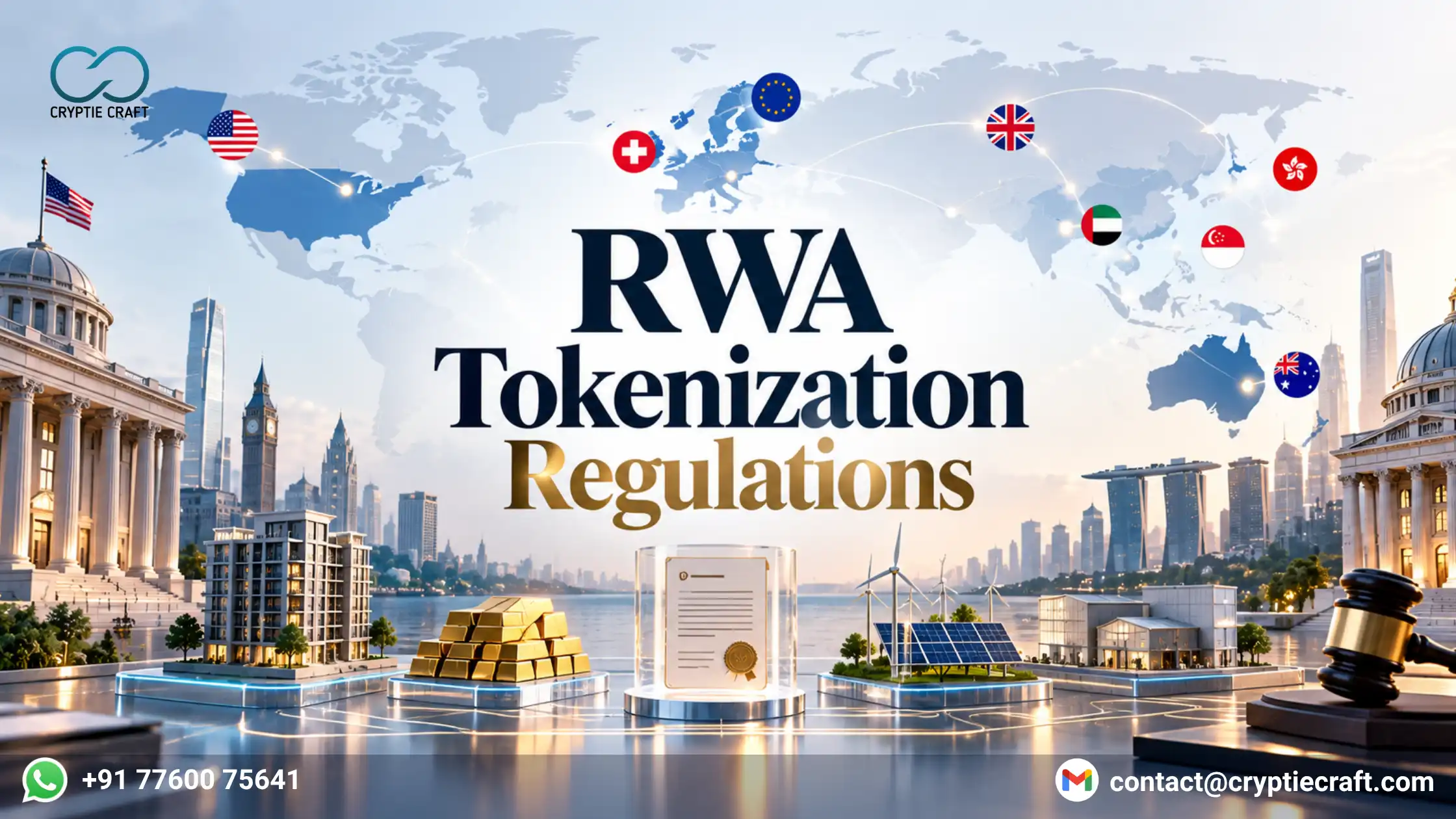
Real-world asset tokenization is moving deeper into financial markets. In August 2026, the total on-chain tokenized RWA market reached a record $34.7 billion, up 4.1% during the month, according to CoinDesk Research. Growth at this scale makes the legal structure behind tokenized assets increasingly important.
RWA Tokenization Regulations are the rules that govern how tokenized real-world assets can be issued, distributed, held, transferred, and traded. The applicable framework depends on what the token represents, the rights attached to it, the investors involved, the jurisdiction, and the activities performed around the asset.
This guide explains how major jurisdictions approach RWA tokenization in 2026, which compliance requirements matter, and how those requirements affect platform planning. Regulations can change, so businesses should verify current requirements with qualified legal or compliance professionals before launch.
Why RWA Tokenization Regulation Matters in 2026
RWA tokenization only creates lasting value when the token has a clear legal connection to the asset or financial right it represents. Regulation determines whether that claim is enforceable, who may acquire the token, where it can be distributed, and whether it can move into a secondary market.
A poorly structured model can restrict distribution, reduce investor access, create uncertainty over token-holder rights, or prevent participation in regulated markets. Cross-border projects face another layer of complexity because ownership, offering rules, investor eligibility, and trading permissions can change between jurisdictions.
For institutional participation, this clarity is especially important. Investors need to understand what they own, how their rights are protected, how the asset is held, and under which legal framework those rights can be enforced.
How Are RWA Tokens Regulated?
Regulators generally look beyond the blockchain and examine the economic substance of the token. The main questions are what the token represents, what rights it gives the holder, what activity the business performs, and who can participate.
In January 2026, U.S. SEC staff described tokenized securities as securities represented through crypto networks and distinguished issuer-sponsored tokenization from third-party structures that may provide different holder rights.
Asset Classification
The underlying asset sets the regulatory starting point. A token representing equity, debt, a fund interest, private credit, a commodity, or rights linked to real estate can fall under different legal frameworks.
Securities Treatment
If the represented interest qualifies as a security or financial instrument, moving the ownership record on-chain does not automatically change its legal status. The applicable securities framework can continue to govern issuance, distribution, trading, and investor rights.
Licensing Scope
Regulatory requirements also depend on the activity performed. Issuing a token, arranging transactions, managing investments, providing custody, or operating a trading venue can trigger different authorization requirements.
Investor Eligibility
An offering may be limited by investor classification, location, product type, or distribution model. Retail, accredited, professional, and institutional investors can therefore face different access conditions.
RWA Tokenization Regulations by Jurisdiction in 2026
There is no universal RWA regulatory framework. Some jurisdictions apply existing securities laws, while others have introduced DLT-specific market infrastructure, regulatory sandboxes, or controlled secondary-market frameworks.
United States — SEC Approach to Tokenized Securities
The U.S. does not create a separate securities category simply because an instrument is tokenized. SEC staff distinguishes issuer-sponsored tokenized securities from third-party models, making the rights attached to the token an important part of the regulatory analysis.
Market infrastructure is also evolving. On September 17, 2026, the SEC granted temporary conditional relief allowing certain Tokenized Securities Venues to trade tokenized NMS stocks through permissioned on-chain environments.
European Union — MiFID II, DLT Pilot, MiCA Scope
The key EU question is whether a token qualifies as a financial instrument or another type of crypto-asset. MiCA does not cover tokenized securities that remain governed by existing securities legislation.
For eligible tokenized shares, bonds, and UCITS, the DLT Pilot Regime allows approved market infrastructures to test trading or settlement under targeted exemptions from MiFID II or CSDR. Classification should therefore come before assuming MiCA is the relevant framework.
UAE — VARA, ADGM, DIFC Frameworks
The UAE cannot be treated as one regulatory zone. Dubai’s VARA, Abu Dhabi Global Market’s FSRA, and the DIFC’s DFSA operate distinct frameworks.
VARA’s real-estate tokenization pilot entered Phase 2 in February 2026, including testing of secondary-market mechanisms. In ADGM, Coinbase received Financial Services Permission in August 2026 to arrange investment deals and provide custody for a tokenized-securities hub. The DFSA also provides a controlled Tokenisation Regulatory Sandbox for tokenized equities, bonds, sukuk, and fund units.
Singapore — MAS Capital-Market Approach
Singapore’s tokenization activity is closely connected to regulated capital markets and institutional finance. MAS-led Project Guardian has included use cases involving digital bonds, private-credit funds, tokenized investment funds, foreign exchange, secondary trading, and on-chain execution.
For an RWA business, the regulatory analysis still depends on the nature of the financial product and the regulated activity being performed rather than tokenization alone.
Hong Kong — SFC Path to Secondary Trading
Hong Kong has moved beyond token issuance toward regulated secondary-market activity.
In April 2026, the SFC introduced requirements under which it may allow public secondary trading of tokenized SFC-authorised investment products. The framework addresses trading channels, pricing, liquidity, disclosure, client onboarding, and ongoing product requirements.
This makes Hong Kong particularly relevant to projects evaluating the full lifecycle of a tokenized investment product rather than issuance alone.
United Kingdom — FCA Route for Tokenized Funds
The UK is integrating tokenization into its existing financial-services framework rather than creating a separate regulatory category for every tokenized product.
In April 2026, the FCA finalized guidance explaining how authorised fund managers can use distributed ledger technology within the existing fund framework, including more advanced tokenized-fund models.
Switzerland — FINMA DLT Market Infrastructure
Switzerland already provides a dedicated legal route for DLT trading facilities.
FINMA licensed the country’s first DLT trading facility in March 2025 under the DLT Act and Financial Market Infrastructure Act. The licence permits multilateral trading of DLT securities, with downstream settlement services also planned.
For RWA businesses, this provides a practical example of tokenized securities operating within regulated financial-market infrastructure.
| Jurisdiction | Primary Regulatory Route | Key 2026 Direction |
| United States | Federal securities laws | Conditional route for on-chain trading of certain tokenized stocks |
| European Union | MiFID II, CSDR, DLT Pilot, MiCA where applicable | Wider DLT market-infrastructure testing proposed |
| UAE | VARA, FSRA, DFSA | Real-estate testing plus tokenized-securities infrastructure expanding |
| Singapore | Existing capital-markets framework | Institutional tokenization remains a major focus |
| Hong Kong | SFC securities framework | Secondary trading framework introduced |
| United Kingdom | FCA financial-market framework | Fund tokenization integrated into existing regulation |
| Switzerland | DLT Act, FinMIA | Licensed DLT trading infrastructure operational |
Core Compliance Requirements for RWA Tokenization
RWA compliance should preserve the connection between the legal asset, the token record, the eligible holder, and the rights attached to that token. The exact requirements differ by asset, jurisdiction, offering structure, and regulated activity.
Legal Ownership Structure
The project should clearly establish what the token holder receives. Depending on the structure, this could be direct ownership, beneficial ownership, a security entitlement, debt claim, fund interest, or rights through a special-purpose vehicle.
Redemption rights, distributions, insolvency treatment, and the authoritative ownership record should also be defined. Different tokenization structures can produce different legal rights even when they reference similar underlying assets.
KYC, KYB, AML Controls
Where applicable, regulated entities may need to identify customers or businesses, assess financial-crime risk, maintain records, and report suspicious activity.
FATF standards for virtual-asset activities within their scope require measures such as customer due diligence, record-keeping, suspicious-transaction reporting, and transfer information requirements.
Investor Eligibility Rules
The project needs to determine who can legally participate before distribution begins. Eligibility may depend on investor classification, residence, product restrictions, offering exemptions, or jurisdiction-specific rules.
Custody Requirements
Tokenization can create two separate custody questions: who controls the underlying asset and who safeguards the digital token or associated keys.
The appropriate structure depends on the asset, legal ownership model, and applicable financial-services requirements.
Transfer Restrictions
A blockchain transaction can be technically valid while still being restricted under the legal structure of the product. Investor eligibility, geographic restrictions, holding limits, lock-ups, or secondary-market rules may therefore affect transferability.
Regulatory Reporting
Compliance can continue after issuance through record-keeping, ownership records, disclosures, transaction monitoring, audit evidence, and required regulatory filings. The legal record and tokenized record should remain consistent.
How Regulations Shape RWA Tokenization Platform Development
The compliance requirements defined above need to become enforceable platform behavior. This is where regulation affects RWA tokenization platform development.
A scalable platform should avoid hard-coding one jurisdiction’s rules into every asset. Identity status, investment permissions, transfer policies, custody records, and reporting logic are better designed as configurable layers that can change with the asset or target market.
Identity Permission Layer
A wallet address alone does not prove that its owner is eligible to hold a regulated token. The platform can connect verified identity status to investor permissions before allowing subscription, holding, redemption, or receipt.
ERC-3643 demonstrates this architecture through an identity registry that separates verified participant identity from token-transfer permissions.
Transfer Policy Engine
Transfer rules can be checked before settlement rather than reviewed only after a transaction occurs.
Permissioned-token frameworks can evaluate the sender, receiver, jurisdiction, investor status, or other defined conditions before allowing a transfer. ERC-3643, for example, supports configurable compliance rules that can approve or reject transfers.
Custody Reconciliation Layer
Platform records should remain aligned with the underlying ownership or custody structure. This is especially important when the token is a digital representation of rights recorded elsewhere rather than the sole legal ownership record.
Compliance Audit Layer
Changes to permissions, transfers, freezes, redemptions, and administrative actions should remain traceable. A structured audit layer can support operational review, investigations, reconciliation, and regulatory reporting without changing the legal requirements themselves.
How to Plan a Compliance-Ready RWA Tokenization Project
The planning process should start with the asset rather than the blockchain.
Before development begins, the business should be able to answer five questions:
- What does the token legally represent?
- Who can hold it?
- Where can it be offered?
- How will ownership or redemption work?
- Can it enter a secondary market?
Those answers define the regulatory boundary for the project. The team can then select the jurisdiction, offering structure, custody model, token controls, platform architecture, and launch scope around that boundary.
This approach reduces the risk of building a technically complete platform that later requires major changes because its token model, investor access, or trading structure does not fit the intended market.
Why Choose Cryptiecraft for RWA Tokenization Platform Development?
Your jurisdiction, asset structure, investor model, and trading scope should shape the platform you build. Cryptiecraft develops RWA tokenization platforms around those requirements instead of forcing every project into the same technical setup.
We can build custom or white-label solutions with token issuance, investor onboarding, permissioned access, wallet controls, custody integrations, smart contract restrictions, asset management, secondary-market modules, compliance monitoring, reporting, and admin controls configured around your operating model. Regulatory requirements identified by your legal or compliance advisors can be translated into platform rules and workflows before launch.
Whether you are tokenizing real estate, funds, private credit, securities, commodities, or other real-world assets, our team can take your requirements from platform planning through development, integration, testing, and deployment.
Frequently Asked Questions
Q1. Are RWA Tokens Regulated as Securities?
Ans: Yes. RWA tokens can be regulated as securities when they represent shares, bonds, fund interests, investment contracts, or other regulated financial instruments.
Q2. Is RWA Tokenization Legal in the United States?
Ans: Yes. RWA tokenization is legal in the United States, but securities, commodities, custody, money-transmission, tax, or other rules may apply.
Q3. Does MiCA Apply to Tokenized Securities?
Ans: Usually not. Tokenized securities that qualify as financial instruments fall outside MiCA and remain subject to applicable EU securities frameworks such as MiFID II.
Q4. Do RWA Tokenization Platforms Require KYC or AML Checks?
Ans: Often, yes. KYC or AML obligations depend on the jurisdiction, token structure, regulated activity, investor type, and the entities operating the platform.
Q5. What Licenses Are Required for an RWA Tokenization Platform?
Ans: There is no universal RWA license. Required authorizations depend on jurisdiction, asset classification, issuance model, custody role, and the regulated activities offered.
Q6. Who Legally Owns the Underlying Asset After Tokenization?
Ans: Ownership depends on the legal structure. Token holders may receive direct ownership, beneficial rights, security entitlements, fund interests, or contractual claims.
Q7. Can RWA Tokens Be Offered Across Multiple Jurisdictions?
Ans: Yes, but each target jurisdiction may impose separate securities, offering, investor-eligibility, licensing, disclosure, and distribution requirements before cross-border access is permitted.
Q8. Can RWA Tokens Be Traded on Secondary Markets?
Ans: Yes, where the applicable framework permits it. Secondary trading may require approved venues, eligible investors, transfer controls, disclosures, and market safeguards.
Q9. Which Jurisdiction Is Suitable for an RWA Tokenization Project?
Ans: No single jurisdiction suits every RWA project. Selection should consider asset type, target investors, offering structure, licensing, custody, distribution, and secondary trading.
Q10. What Happens if an RWA Token Is Transferred to an Ineligible Investor?
Ans: The transfer may be blocked by platform controls. If completed, remediation depends on governing documents, contractual rights, platform rules, and applicable law.