Binance Clone Script
  KuCoin Clone Script
  Bybit Clone Script
  Kraken Clone Script
  OKX Clone Script
  ERC-20 Token Development
  TRC-20 Token Development
  BEP-20 Token Development
  Crypto Token Development
  ICO Development
  STO Development
  Binance NFT Clone
  OpenSea Clone Script
  Rarible NFT Clone
  NFT Marketplace Development
  MetaMask Clone Script
  Trust Wallet Clone Script
  Crypto Wallet Development
  DeFi Wallet Development
  Uniswap Clone Script
  PancakeSwap Clone
  SushiSwap Clone
  Crypto Payment Gateway
  Binance Pay Clone
  Crypto MLM Software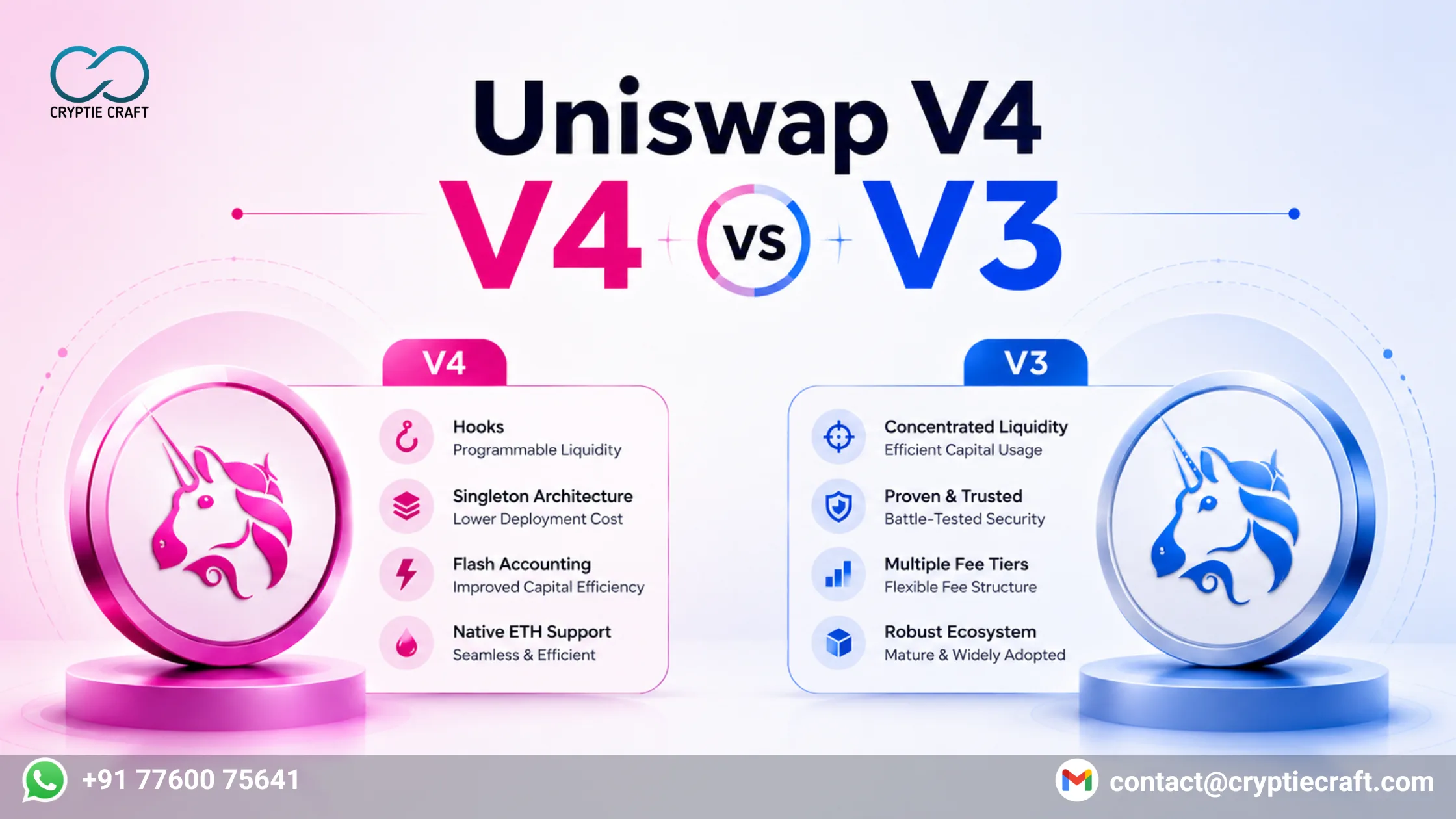
Uniswap V4 vs V3 will be one of the hottest debates for DEX developers in 2026. The choice of the right protocol can have a great impact on a DEX’s performance, costs, and ability to grow in the future. Decentralized exchanges are constantly changing as blockchain technology gets better and better. Uniswap has been at the forefront of automating market maker innovations over the years. Its protocols have set the standard for the operation of modern DeFi platforms.
Uniswap V3 brought in the concept of concentrated liquidity and made capital usage more efficient. That was a great tool for liquidity providers, as it resulted in better earnings from their active positions. Uniswap V4, with hooks, flexible pools, and reduced operational costs, completely changes the way things work. These improvements not only enhance the functioning of decentralized exchanges but also open up new avenues for their further development.
It is important for founders, developers, and crypto entrepreneurs to carefully decide on the protocol to use. Besides scalability, liquidity management, and customization, aspects like gas efficiency and user experience also play a big role. In this article, we provide an extensive comparison of Uniswap V3 and V4. Through it, you will be able to understand which protocol is the most appropriate one for DEX development in 2026 and the future.
Uniswap V4 vs V3 at a Glance
As Uniswap V3 and V4 are based on the same AMM system, their design and level of customization differ greatly. By knowing these distinctions, DEX developers can decide the best protocol with scalability, customization, liquidity efficiency, and decentralized exchange growth over time.
What is Uniswap V3?
Uniswap V3 is a decentralized exchange protocol that introduced concentrated liquidity. Liquidity providers are now allowed to designate their funding to one or more specific price ranges. This new approach capitalizes on liquidity to its fullest, decreases wasted liquidity, and results in higher trading performance. V3 has been a platform for current DEX development and more sophisticated AMM systems.
What is Uniswap V4?
Uniswap V4 is the latest protocol upgrade designed for greater flexibility. It includes hooks that allow custom logic, a singleton architecture that lowers the deployment cost, flash accounting that makes transactions effortless, and even native ETH support. These new features enable the building of DEX platforms that are highly customizable and also gas-efficient.
Uniswap V4 vs V3 Comparison Table
| Feature | Uniswap V3 | Uniswap V4 |
| Architecture | Multiple pool contracts | Singleton contract architecture |
| Liquidity Model | Concentrated liquidity | Concentrated liquidity with Hooks |
| Customization | Limited protocol customization | Highly customizable through Hooks |
| Gas Efficiency | Higher transaction costs | Reduced gas consumption |
| Native ETH Support | No | Yes |
| Flash Accounting | Not available | Available |
| Developer Flexibility | Moderate | Advanced |
| Security Model | Proven and mature | Flexible with additional Hook considerations |
| Pool Creation Cost | Higher | Lower |
| DEX Development Potential | Strong | More scalable and adaptable |
The Uniswap V3 vs V4 comparison highlights a clear evolution in decentralized exchange infrastructure. Besides V3 being very dependable and efficient, V4 offers the widest range of customization, is more gas-efficient, and offers developers more freedom to build DEXs.
Key Differences Between Uniswap V4 and V3
Uniswap V4 marks a fundamental shift in the development and operation of decentralized exchanges. In fact, each protocol layer has undergone a complete overhaul to significantly improve efficiency. Such changes will play a decisive role in DEX builders’ choices in 2026.
Singleton Architecture vs Factory-Based Pools
Under the V3 model, a new smart contract was created for each pool. V4, however, consists only of a singleton contract for all pools combined. This literally cuts down a lot of deployment costs and makes multi-hop swap execution a piece of cake for DEX builders.
Hooks and Programmable Liquidity
V4 pools get their own smart contract customizations via Hooks. They allow for features like changing fees on the fly, making limit orders, and even having custom oracles. There was actually no programmable liquidity in V3 that decentralized exchange developers could use.
Flash Accounting and Gas Optimization
In V4, net token balances are kept for the whole transaction before any property dealing is done. This means that the extra token movement seen in V3 has been removed. Gas fees for complicated multi-step DEX transactions have been greatly reduced.
Native ETH Support and Token Handling
To trade in V3, one had to first wrap ETH to WETH. With V4, the support for native ETH is back. This not only removes hurdles but also cuts down gas costs and makes DEX platform integration a whole lot easier for both users and developers.
Custom Fee Structures and Pool Flexibility
In V3, DEXs had to work within three predetermined fee tiers at most. V4 gives DEX builders a lot of freedom in setting the hook parameters, but they can basically set whatever fee they want at any time.
Uniswap V4, in fact, will provide DEX builders with greater architectural control compared to V3. Any upgrade is directed to boost efficiency, flexibility, and developer customization. Selecting the appropriate platform really depends on what you want to achieve with your DEX.
Uniswap V4 vs V3 for DEX Development
Both protocols serve DEX development differently. V4 offers more control while V3 provides proven stability. Your choice shapes long-term product growth and development speed.
Development Complexity and Learning Curve
V3 is a very straightforward and fast way of getting DEX up and running. Version 4 is for developers with a deeper understanding of smart contracts. The use of hooks and singleton architecture makes it more challenging for developers at the start.
Smart Contract Architecture Comparison
V3 has a scheme where each pool contract is deployed by a factory separately. Version 4 has a single contract, which can be changed and extended. Builders in DEX are the ones who will benefit the most from V4 in their work, as it is a more scalable solution; it also means less work for DEX developers when it comes to deployment.
Customization Opportunities for DEX Builders
V4 opens up new possibilities for customization, while V3 is an out-of-the-box product with limited flexibility. Developers can implement the new trading logic, dynamic fee structure, and custom liquidity behavior.
Ecosystem Adoption, Tooling, and Developer Support
V3 is a stable product with well-developed SDKs and a large base of community documentation. V4 tools and environments are constantly improving. Besides that, early adopters are getting ready for a competitive edge as the support for the ecosystem grows exponentially.
Scalability and Future Expansion Potential
V4 is a smart design that envisions long-term DEX scalability. V3 is up to date with the reliability standards. V4 can allow the integration of modular features without the need for a full redeployment of the protocol.
V4 is ideal for builders who want to build with customization and scalability in mind. V3 is for teams that need to ship faster. Both protocols are suitable for different stages of DEX development.
Liquidity Management and Capital Efficiency
Liquidity management and capital efficiency majorly impact the success of trading in decentralized exchanges. Uniswap V3 and V4 facilitate the optimization of liquidity usage, trading quality, and platform scalability through different approaches.
Liquidity Models in Uniswap V4 vs V3
Uniswap V3 implements the concentrated liquidity concept, whereas in V4, liquidity management can be customized using Hooks.
Liquidity Provider Experience Comparison
V3 is designed to make liquidity providers manage their liquidity actively, while V4 offers more mobility through the use of programmable automation features.
Trading Performance and Execution Efficiency Comparison
V4 significantly upgrades the routing efficiency and customization capabilities, so it helps to minimize slippage and improve trade execution.
Capital Efficiency Comparison
Both versions facilitate better capital utilization. Still, V4 also allows the possibility of molding liquidity through the use of hooks.
Impact on Market Makers and DEX Operators
Using V4, market makers get to use sophisticated liquidity strategies, enjoy greater operability, and have better revenue prospects.
Uniswap V3 achieves high capital efficiency through the concept of concentrated liquidity. Uniswap V4 not only covers the extent of V3’s capabilities but also gives liquidity mechanisms that are customizable, improves trading performance, and offers increased operational flexibility to market makers, liquidity providers, and decentralized exchange operators.
Cost Comparison Between Uniswap V4 and V3
Uniswap V4’s singleton architecture and flash accounting reduce the total cost of deployment and transactions, while V3 has higher operational costs.
| Cost Element | V3 | V4 |
| Gas Costs | Higher | Lower |
| Pool Deployment | Expensive | Cheaper |
| Development & Audit | Moderate | Higher |
| Infrastructure | More resources | Optimized |
| Long-Term Operations | Higher | Lower |
Uniswap V3 provides a sophisticated cost structure. The forthcoming Uniswap V4 keeps operation costs low and makes scaling easier for growing DEXs.
Security Comparison Between Uniswap V4 and V3
Security models for decentralized exchanges are useful for protocol builders to protect user collateral pools against smart contract exploits, while leveraging programmatic flexibility in a safe manner.
| Metric | Uniswap V3 Architecture | Uniswap V4 Framework |
| Security Architecture | Isolated factory contracts. | Unified Singleton contract. |
| Smart Contract Risk | Rigid, battle-tested code. | Transient storage vulnerabilities. |
| Hook-Related Risks | No external code interference. | Reentrancy and DoS vectors. |
| Audit Requirements | Standard security reviews. | Exhaustive multi-firm audits. |
To conclude, Uniswap V4 provides incredible app customizability, but decentralized exchange builders must implement strong guardrails to safeguard the unified Singleton core.
Use Cases for Uniswap V3 and Uniswap V4
Choosing the right AMM protocol will depend largely on your project commitment to either standardized concentrated liquidity or highly customizable modular pool behavior.
- Traditional Spot DEX Platforms
- Institutional and Enterprise DEX Solutions
- Automated and Dynamic Fee Trading Platforms
- Hybrid and Specialized Exchange Models
- Advanced DeFi Applications Enabled by Hooks
To sum up, one can choose Uniswap V3 if you are looking for instant, tested stablecoin pairings. With Uniswap V4, you will be able to create complex, hook-driven decentralized applications natively.
Uniswap V4 vs V3: Which One Should DEX Builders Choose?
Working through the pros and cons of the latest automated market maker designs helps decentralized exchange (DEX) developers decide how fast they want to roll out new features versus how customizable they want to make their protocols at the core level.
Key Factors to Evaluate Before Choosing a Protocol
Developers have to balance the up-front smart contract auditing expenses with the long-haul gas economies in transactions so that their businesses can scale in the best way.
Migration Considerations for Existing Uniswap V3 Projects
Switching over to shiny new technology necessitates a total overhaul of data indexing pipelines and liquidity provider positions.
When Uniswap V3 Is the Better Choice
Choose V3 if your project focus is on quick rollout, security standards that have been tried and tested, and standard concentrated liquidity pool arrangements.
When Uniswap V4 Is the Better Choice
You can choose V4 if you are planning to create sophisticated, hook-based dapps with features like dynamic fees and integrated on-chain limit orders.
Final Recommendation for DEX Builders in 2026
Look at your technology capabilities; pick V3 for straightforward market copying, but go for V4 when you want to be at the forefront of flexible modular innovation.
Ultimately, aligning your design requirements with the native limitations of the protocol shapes the architectural efficiency and performance of your marketplace.
Conclusion
In 2026, the choice between Uniswap V3 and V4 is going to be a big deciding factor in the future of DEX development. V3, a classic one, still stands strong and is the most common, the quickest to roll out for many teams. V4 presents a whole new world of possibilities for businesses that are not looking back, with hooks, a singleton architecture, and flash accounting features. So, it’s very hardly why anyone would say no to via the unlocked, countless customization options for scalable DEX platforms. While V3 is good for those who want proven infrastructure and do not wish to go through a steep learning curve, V4 targets teams who are not just thinking of the functionalities of the ordinary exchange.
Frequently Asked Questions
Q1. What is the biggest difference between Uniswap V4 and V3?
Ans: Hooks are the most notable difference between the two, as they introduce an expandable, customizable, and robust system that is capable of supporting new features without even modifying the core code.
Q2. Does Uniswap V4 have lower gas fees than V3?
Ans: Yes, through singleton architecture and Flash Accounting, Uniswap V4 can cut down gas fees much more, making trading more economical.
Q3. How do Hooks improve DEX customization in Uniswap V4?
Ans: Hooks give DEX developers the ability to implement very novel trade operations and strategies, rewards, fees, liquidity provisioning, etc. directly as a part of the trading protocol.
Q4. Can Hooks replace custom smart contracts in Uniswap V4?
Ans: Having hooks in Uniswap V4, custom smart contracts are not needed any longer, as most of the functionalities can be written as custom features/hooks.
Q5. Is Uniswap V4 more secure than V3?
Ans: Both are equally secure; still, V4 developers must do their best not only to write secure hooks but also to prevent hooks from harming other platform safety aspects.
Q6. Can existing DEXs migrate from Uniswap V3 to V4?
Ans: DEXs can transition to Uniswap V4 and continue leveraging the latest features, like improved efficiency, flexibility, customization, etc.
Q7. Which Uniswap version is best for new DEX projects?
Ans: For a brand-new project that needs a high degree of customization, low costs, and features of a highly advanced decentralized exchange, Uniswap V4 is here to stay.
Q8. Why is Singleton Architecture important in Uniswap V4?
Ans: Singleton architecture unifies all pools into one smart contract for a dramatic decrease in deployment cost and makes transactions more efficient across the network.
Q9. Does Uniswap V4 still use concentrated liquidity?
Ans: Uniswap V4 does not give up concentrated liquidity but adds Hooks as a complement, with which the possibilities of managing liquidity can be expanded.
Q10. Is Uniswap V4 suitable for enterprise-grade DEX development?
Ans: Uniswap V4 enables the development of a decentralized and customizable exchange with high scalability and low costs, which meets the standards of enterprise-grade blockchain platforms.