Binance Clone Script
  KuCoin Clone Script
  Bybit Clone Script
  Kraken Clone Script
  OKX Clone Script
  ERC-20 Token Development
  TRC-20 Token Development
  BEP-20 Token Development
  Crypto Token Development
  ICO Development
  STO Development
  Binance NFT Clone
  OpenSea Clone Script
  Rarible NFT Clone
  NFT Marketplace Development
  MetaMask Clone Script
  Trust Wallet Clone Script
  Crypto Wallet Development
  DeFi Wallet Development
  Uniswap Clone Script
  PancakeSwap Clone
  SushiSwap Clone
  Crypto Payment Gateway
  Binance Pay Clone
  Crypto MLM Software
Is blockchain the smartest business move in 2026?
The blockchain sector isn’t slowing down, but it’s accelerating, racing past most analyst forecasts. The worldwide blockchain market is projected to hit $943.8 billion by 2032, growing at an annual rate of 66.2%.
Entrepreneurs around the world are testing new blockchain business ideas every day. The opportunities span DeFi protocols, real-world asset tokenization, decentralized identity, and AI-blockchain integrations. Web3 business ideas are reshaping finance, supply chains, gaming, and identity infrastructure. Whether you’re a startup founder or running an established company, 2026 presents a unique window to enter this market.This guide outlines the most profitable blockchain business ideas worth starting right now with real cost benchmarks, regulatory considerations, and a decision framework to help you choose. If you’re evaluating blockchain across categories, our blockchain development services support every model.
What Makes a Blockchain Business Viable in 2026?
A blockchain business becomes viable when it solves a real problem. The most successful blockchain business ideas in 2026 combine utility, compliance, and scalability. Platforms built on Ethereum, Polygon, and Avalanche are drawing serious investor and user attention, as these networks have the developer ecosystems and infrastructure depth needed to support production-grade businesses.
The regulatory clarity created by MiCA in Europe, VARA in Dubai, and MAS in Singapore has made compliant business models more attractive to funding. Smart contracts can substantially reduce operational expenses, which is why DeFi protocols, tokenization platforms, and decentralized applications are not just viable, but they’re already generating substantial revenue. BlackRock BUIDL and JPMorgan Onyx have validated the institutional case for blockchain infrastructure, while smaller decentralized solutions and DApps continue to operate profitably at scale.
Entrepreneurs who adhere to KYC/AML compliance build the kind of reputation that lasts. The most profitable blockchain startup ideas solve specific industry pain points. Strong technology, a clean regulatory environment, and real market demand are the three pillars on which a viable blockchain business rests.
Top Blockchain Business Ideas with Real Traction in 2026
Are you thinking about getting into the blockchain business in 2026? There has never been a better time to start a blockchain business. Entrepreneurs are building real, scalable businesses, from tokenizing RWAs to making DeFi apps. Here is a list of the best blockchain business ideas for 2026 that are already making money, have clear opportunities, and give every serious entrepreneur a way to get started
1. Crypto-Based Business
Opportunities for a crypto business in 2026 are promising. There is a strong demand for crypto exchanges, wallets, and payment gateways. Clearer regulatory frameworks from the SEC, MiCA, and VARA increase institutional and retail investor trust. Selecting the right blockchain matters, and Ethereum or Polygon offers the broadest user and integration platform.
If you are building a centralized or peer-to-peer (P2P) exchange, our crypto exchange development services include order matching, payment gateway, and wallet integration. If you’re a founder focused on a P2P crypto exchange, our step-by-step guide to building a P2P crypto exchange walks you through the design, escrow mechanism, and regulatory aspects.
The four most popular sub-categories of this market include the launch of a crypto exchange, payment gateway, wallet, and consultancy services. These can be launched as independent offerings or as part of a larger fintech solution.
2. NFT Marketplace Development
Building an NFT marketplace is still a good Web3 business opportunity. The market is moving towards specialty marketplaces, such as gaming NFTs, digital art marketplaces, and real estate NFTs marketplaces, which are growing 3x faster than the general marketplaces. Launching a marketplace on Immutable X or Polygon allows gasless NFT transfers, which is essential for onboarding a casual audience.
Building a strong creator community and royalty automation are the main drivers of marketplace success. Our NFT marketplace development services support multi-chain support, automatically enforced royalties through smart contracts, and built-in creator monetization tools.
3. DeFi Application Development
DeFi applications generate substantial revenue at scale. The most popular DeFi applications include lending protocols, staking platforms, and yield aggregators, which continue to attract billions in total value locked. The professional approach is to leverage audited DeFi protocols on Avalanche or Ethereum. Chainlink oracle integration provides the reliable, real-time off-chain data that on-chain smart contracts need to function safely.
Whether it’s a lending protocol, a yield aggregator, or a staking platform, our DeFi development services cover the entire stack from smart contract design to frontend integration. If you’re a founder specifically looking to build a decentralized exchange, our DEX development services cover AMM design, liquidity pool architecture, and cross-chain swap systems.
4. Blockchain Supply Chain Platforms
Blockchain is an ideal fit for supply chain challenges such as fraud, transparency, and payment delays. Companies such as Walmart and Maersk track products across international supply chains using Hyperledger. Smart contracts automatically release funds upon delivery, eliminating payment delays and errors. This is one of the best high-leverage blockchain business ideas for enterprise founders with existing logistics relationships.
5. Blockchain Gaming Platforms
Blockchain gaming is the billion-dollar crypto opportunity. Play-to-earn ecosystems on Ronin and Immutable X are thriving both in revenue and community participation. Players don’t just play, but also own their avatars, guns, and accessories as NFTs with a tangible value and exchangeable in the marketplace. Gaming DAOs are transforming the community governance of virtual economies, putting decision-making power in the hands of the players who actually live in these worlds.
6. Healthcare Blockchain Applications
Blockchain ensures secure, verifiable medical data. Decentralized identities (DID) ensure that patients own their own health data, but service providers can use it if necessary to verify their health status. Healthcare data platforms can support KYC/AML compliance. The eIDAS 2.0 regulation establishes the basis for digital ID in Europe, including use cases within healthcare.
7. Banking Blockchain Platforms
JPMorgan Onyx and Franklin Templeton have demonstrated that blockchain banking is no longer a vision; it’s a reality. Central bank digital currencies (CBDCs) and tokenized deposits are adding a layer to the global financial system. The ERC-1400 or ERC-3643 (T-REX) standards are the most common for compliant banking platforms. Banking and fintechs need to comply with the Monetary Authority of Singapore (MAS) and the European Union’s Markets in Crypto-Assets (MiCA) regulations.
8. Real-World Asset (RWA) Tokenization
Real-World Asset (RWA) tokenization is the hottest 2026 trend in the blockchain industry. The tokenized treasury fund BlackRock BUIDL is the best example of institutional interest in tokenized assets. ERC-3643 and Reg D offer the compliance structure for asset tokenization in the United States, and MiCA does the same for the EU. Real estate, bonds, and commodity markets are the asset classes where tokenization investment is currently focused.
Our RWA tokenization platform development includes compliance-ready token issuance, investor onboarding, and secondary market support for real estate, bonds, and commodity-backed tokens.
9. Decentralized Identity (DID) Platforms
DID places control of personal data in the hands of users. Decentralized identity is used by companies to securely and efficiently complete customer onboarding and AML (anti-money laundering) workflows without a central data store. The eIDAS 2.0 directive is the main driver for the transition of DID to become mainstream in corporate infrastructure. Polygon and Hyperledger are the most popular platforms for production DID systems.
10. AI + Blockchain Agent Infrastructure
The AI agent and smart contract combination hold the potential to transform business operations. Decentralized AI-driven applications automate business processes without human intervention or central authority involvement. This is one of the most cutting-edge blockchain startup opportunities in 2026. Startup founders usually develop AI-agent systems on Ethereum or Avalanche, since smart contracts and node infrastructure can scale to enterprise workloads.
This category requires high expertise in smart contract development, and the smart contracts triggered by AI agents must be audited, gas-efficient, and robust against attacks.
In 2026, blockchain businesses are profitable, scalable, and real. Choose your niche, build it strategically, and launch with the help of an experienced blockchain development team.
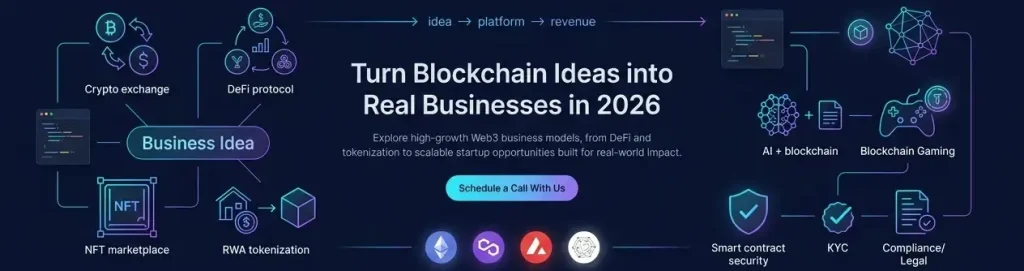
Blockchain Business Ideas – A Quick Comparison
Exploring Blockchain business ideas involves a strategic comparison among different sectors. This comparison focuses on factors like profit potential, scalability and consumer interest. It helps business owners become more certain about which Blockchain business to start in 2026.
| Business Idea | Market Maturity | Build Complexity | Time to Revenue | Min. Investment |
| Crypto-Based Business | High | Medium–High | 3–9 months | $80K+ |
| NFT Marketplace | Medium | Medium | 2–6 months | $50K+ |
| DeFi Applications | High | High | 4–10 months | $120K+ |
| Supply Chain Platform | Medium–High | Medium | 4–8 months | $80K+ |
| Blockchain Gaming | Medium | High | 6–12 months | $150K+ |
| Healthcare Blockchain | Medium | High | 6–18 months | $200K+ |
| Banking Blockchain | High | Very High | 8–18 months | $300K+ |
| RWA Tokenization | Very High | High | 3–9 months | $100K+ |
| DID Platforms | Medium–High | High | 5–12 months | $150K+ |
| AI + Blockchain Agents | Early–Medium | Very High | 6–15 months | $200K+ |
Selecting suitable blockchain business ideas will largely depend on the current market situation and the potential scalability aspects. Concentrate on promising and rapidly growing Web3 business ideas and collaborate with experienced professionals to successfully start profitable blockchain ventures in 2026.
Cost Breakdown and ROI Considerations
Before one starts experimenting with various Blockchain business ideas, understanding the cost and ROI is very important. Let us get to know about the fundamental investment areas and level of returns. So entrepreneurs plan profitable Web3 business ideas.
| Business model | ROI timeline | Estimated cost | Profit potential |
| Crypto Exchange | 12-18 months | $80,000–$150,000 | Very high |
| DeFi Platform | 12-24 months | $70,000–$140,000 | Very high |
| NFT marketplace | 6-12 months | $40,000–$90,000 | High |
| DID platform | 9-18 months | $45,000–$100,000 | Moderate |
| RWA tokenization | 9-15 months | $50,000–$110,000 | High |
| Blockchain gaming | 12-24 months | $80,000–$160,000 | High |
Selecting the most suitable method and a custom Blockchain development service provider can lead to the achievement. They help minimize the possibility of problems and increase the profitability to continue for a long time, even with competition in the Web3 market.
Regulatory and Compliance Considerations
To start a blockchain business, you’ll need to be on top of the worldwide regulatory frameworks. Laws such as MiCA, VARA, and MAS are transforming the industry. Lack of compliance could inadvertently destroy your business overnight.
Key Regulatory Frameworks to Know
- MiCA – This document depicts the crypto asset regulatory norm for Europe.
- VARA – It is the virtual asset regulatory authority in Dubai.
- MAS – This is the financial services compliance body of Singapore.
- SEC—The United States Securities and Digital Asset Oversight Body.
- Reg D – It offers private securities offering exemption in the U.S.
AML & KYC Procedures
It is mandatory for every Blockchain enterprise to have a well-established KYC/AML compliance procedure. Identifying users and tracking suspicious behaviors should be the norm. FAFT guidance is applicable to all virtual asset service providers.
Data Safety & Personal Identification
eIDAS 2.0 is the regulator of digital identification on the European blockchain systems. Decentralized identity (DID) methods are in line with privacy-first compliance frameworks. Safeguard your user’s data in accordance with GDPR and other relevant local data laws.
Token Compliance Regulations
ERC-1400 or ERC-3643 (T-REX) should be your token-standard choice for regulated token issuance. The Howey Test determines the token’s classification as a security. Ensure you seek advice from legal professionals before making any token offering public.
Regulatory compliance is a tool to shield your blockchain business against potential legal battles. Compliance is safety. Foundation your blockchain venture on a robust, legally compliant platform right from the start.
How to Choose the Right Blockchain Business Ideas for your Business
Choosing the right Blockchain business ideas is essential. It must reflect on the current market demand, but also your business strengths. These are some of the necessary factors that every startup should consider.
1. Discover Your Industry Alignment
One of the most effective ways to employ blockchain is to leverage your deep industry insights. For example, logistics and manufacturing companies would be the most suitable ones to use blockchain for a supply chain. On the other hand, fintech-oriented traders are the ones who benefit the most from DeFi protocols. Simply choose the field that you already know very well.
2. Study Market Needs
Find out in advance which crypto business opportunities are currently gaining the most traction. Two of the biggest growth sectors at the moment are RWA tokenization and blockchain gaming. Derive information from the Ethereum, Polygon, and Avalanche ecosystems, among others. Demand is the principal factor that confirms the validity of your idea even before you dedicate your resources.
3. Assess the Regulatory Situation
Until now, some blockchain markets have much clearer regulations than others do. MiCA, VARA, and MAS are only a few examples of countries worldwide that have established a structured compliance framework. It would be wise for you to pick a country with crypto licensing requirements very well outlined. Regulatory certainty is one of the factors that will definitely protect your business in the long run.
4. Know Your Financial Resources
Where you start a blockchain business will largely be decided by how much money you have. White-label solutions are a good option if you want to spend less than a fully custom development. The cost of developing an NFT marketplace and the making of DID platforms can be very different. The best way to run a business is to keep it simple and make it bigger with the money you earn.
5. Your Tech Stack Matters
Ethereum, Hyperledger, and Avalanche are three different blockchains that can be used for different business purposes. Using smart contracts that run on the wrong chain will make you spend funds that are not needed. It is very important that your blockchain stack should be the one that is suitable to your scalability needs. Technical fit will directly affect how well your product will be in the market for a long time.
The best Blockchain startup idea combines opportunity, budget, and compliance. That is why choosing wisely, building strategically and launching with the guidance of a knowledgeable expert are very important
Why Choose Cryptiecraft for Your Blockchain Project?
Cryptiecraft is your trusted Blockchain development company. We bring in deep technical expertise and experience in building crypto exchange development, DeFi, RWA tokenization, and Web3 solutions. Our team has successfully delivered projects globally. We have a thorough understanding of the regulatory frameworks like MiCA, VARA, and MAS. Each solution is customized to your business goals. We cover every step, from ideation to launch. We don’t just write source code but also build businesses. Hundreds of entrepreneurs and companies continue to count on Cryptiecraft for dependable, top-notch blockchain development.
Frequently Asked Questions
Q1. What are the most profitable blockchain business ideas in 2026?
Ans: DeFi platforms, cryptocurrency exchanges, and RWA tokenization are the most profitable blockchain business ideas in 2026. They combine high market demand, scalable infrastructure, and strong revenue potential, which is driven by both retail and institutional capital flowing into the space.
Q2. How much does it cost to start a blockchain business?
Ans: The cost of starting a blockchain business ranges from $40,000 to $300,000+. NFT platforms begin at $40,000-$90,000 with white-label solutions, while custom banking blockchain solutions can cost $300,000 or more. The price depends on the specific features, technology choices, security measures, and overall development complexity.
Q3. Which blockchain is best to build on in 2026?
Ans: Ethereum, Polygon, and Avalanche are the most popular platforms in 2026. They offer high security, scalability, developer tools, and user adoption, which are the four most important features needed to enable enterprise-grade Web3 applications. Hyperledger is still the preferred platform for enterprise and supply-chain applications.
Q4. What is the difference between DeFi and RWA tokenization?
Ans: DeFi is a decentralized financial system that operates without intermediaries, using smart contracts for lending, borrowing, and trading. RWA tokenization converts real-world assets like real estate, bonds, and commodities into digital tokens, expanding access, liquidity, and investment opportunities for assets that were previously illiquid or restricted to large investors.
Q5. How long does it take to build a blockchain?
Ans: The duration for creating a blockchain can vary between 3 months and 12 months, depending on the project complexity, business models, features, compliance requirements, and the technology stack or development approach selected.
Q6. What are the risks of starting a blockchain business?
Ans: The typical risks are compliance uncertainty, security, market risk and user adoption. These risks are managed by planning for compliance in advance, getting smart contract audits by a third party, KYC/AML, and realistic budgeting for go-to-market. Founders who treat compliance and security as Day 1 priorities have dramatically higher 18-month survival rates.