Binance Clone Script
 KuCoin Clone Script
 Bybit Clone Script
 Kraken Clone Script
 OKX Clone Script
 ERC-20 Token Development
 TRC-20 Token Development
 BEP-20 Token Development
 Crypto Token Development
 ICO Development
 STO Development
 Binance NFT Clone
 OpenSea Clone Script
 Rarible NFT Clone
 NFT Marketplace Development
 MetaMask Clone Script
 Trust Wallet Clone Script
 Crypto Wallet Development
 DeFi Wallet Development
 Uniswap Clone Script
 PancakeSwap Clone
 SushiSwap Clone
 Crypto Payment Gateway
 Binance Pay Clone
 Crypto MLM Software
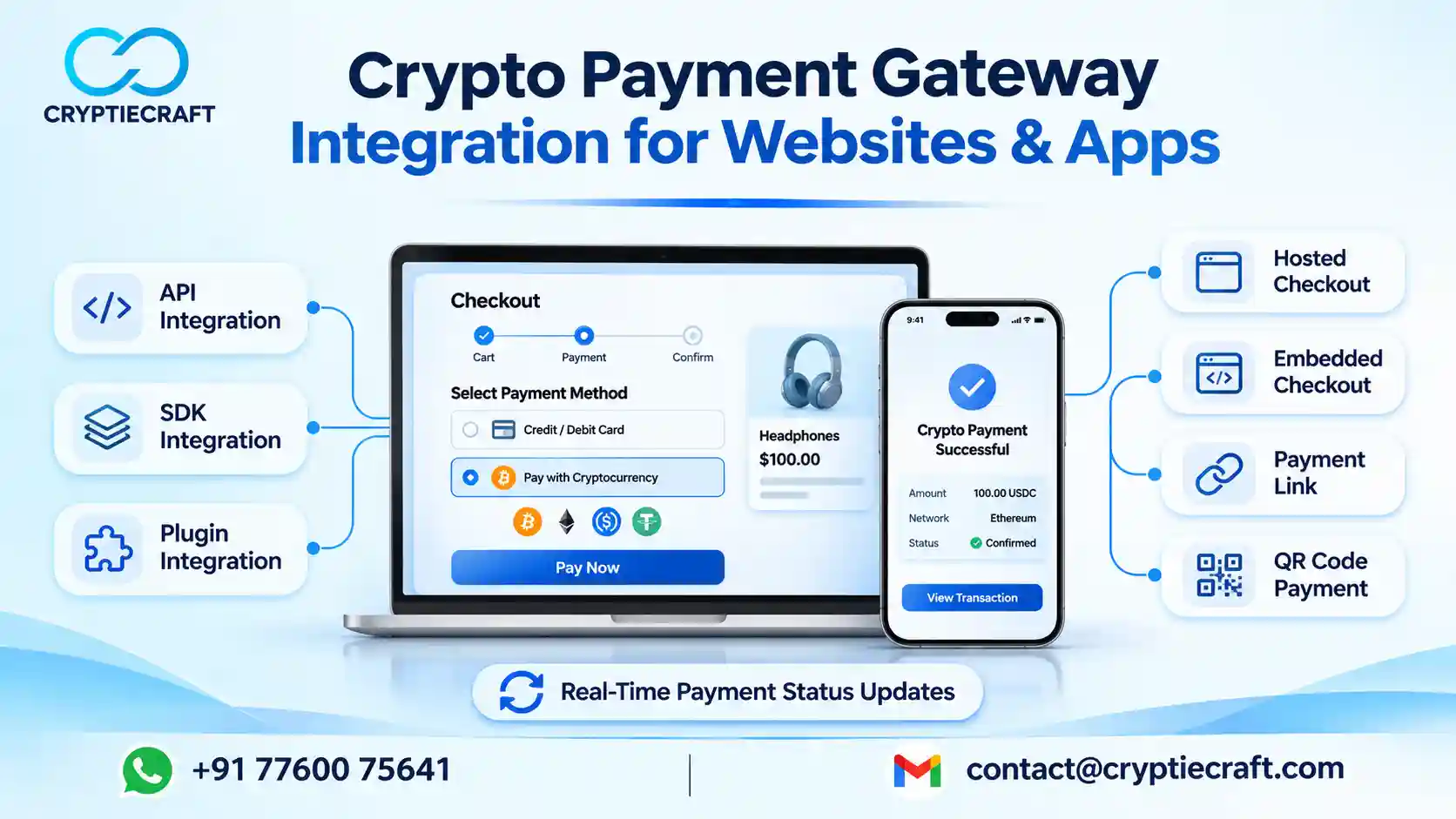
A cryptocurrency payment option should fit naturally into the existing checkout process without disrupting how customers place orders or how the platform manages payments. Achieving this depends largely on the integration method.
Crypto payment gateway integration through APIs, SDKs, plugins or hosted payment pages gives website and application owners different ways to accept digital currencies. While some methods require minimal development, others provide greater control over checkout design, transaction verification and payment automation.
The choice depends on how much control you need over checkout, which systems must exchange payment data and how cryptocurrency transactions will be managed once the integration goes live.
How Does Crypto Payment Gateway Integration Work?
Crypto payment gateway integration connects a platform’s checkout system with a cryptocurrency payment service, allowing it to generate payment requests, verify transactions and confirm customer orders automatically.
A typical cryptocurrency payment workflow involves five stages.
- Payment initiation begins when a customer selects cryptocurrency at checkout.
- Payment request generation creates an invoice with a unique reference, amount, currency and payment instructions.
- Transaction submission occurs when the customer authorises the payment through a compatible cryptocurrency wallet.
- Payment verification checks the received amount and required blockchain confirmations.
- Order confirmation takes place once the platform verifies that the payment meets its acceptance requirements.
Consider an online store accepting USDC for a $100 purchase. The gateway assigns a payment reference to the order. Once the transaction is verified, the store can automatically mark the order as paid, even if the customer has already closed the checkout page.
Crypto Payment Gateway Integration Methods
Crypto payment gateway integration methods fall into two categories. APIs, SDKs and plugins determine how a platform connects with the gateway, while hosted checkout, embedded checkout, payment links and QR codes determine how customers complete payments.
These options can work together within a single payment system.
API-Based Integration
Crypto payment gateway API integration gives developers direct control over payment functionality through an application programming interface (API). The platform can generate invoices, retrieve transaction information, check payment status and manage payment records.
An online marketplace, for example, can generate individual payment requests for purchases made across different sellers.
Using a cryptocurrency payment API also allows developers to connect payment functionality with existing billing and accounting systems. This approach suits platforms with custom payment rules but requires backend development, secure authentication and a payment gateway architecture that can support those rules.
SDK-Based Integration
A software development kit (SDK) simplifies cryptocurrency payment integration by providing ready-to-use libraries and functions. Developers can use these resources instead of manually building every connection with the payment API.
Crypto payment gateway SDK integration is particularly useful for mobile applications that require wallet connectivity or customised payment interfaces.
The development effort depends on the SDK’s programming language compatibility, available functions and ongoing support. Developers should also check whether the SDK covers all required payment operations or requires additional API requests.
Plugin-Based Integration
Crypto payment gateway plugins connect cryptocurrency payment services with established e-commerce platforms such as WooCommerce and Magento.
Store owners can install a compatible extension, configure their payment credentials and enable cryptocurrency at checkout without developing a separate payment module.
The main advantage is compatibility with existing shopping cart and order management functions. However, additional development may be required when the store needs payment rules or checkout features beyond the plugin’s capabilities.
Hosted Payment Page Integration
Hosted crypto checkout uses a payment page maintained by the gateway provider. The connected website creates a payment session and directs the customer to that page to complete the transaction.
The gateway manages the payment interface and displays the required payment instructions.
This approach suits websites that need to introduce cryptocurrency payments without redesigning their checkout system. Its main limitation is reduced control over the external payment page.
Embedded Checkout Integration
Embedded crypto checkout displays payment functionality within the platform’s existing interface using widgets, supported components or custom forms.
An online store can display cryptocurrency alongside card payments within the same checkout layout. Customers interact with a familiar interface, although transaction authorisation may require opening an external wallet.
Development effort depends on whether the gateway provides ready-made checkout components or requires a custom interface.
Payment Link Integration
Crypto payment link integration allows merchants to generate shareable payment URLs for invoices or individual purchase requests.
A service provider can send a cryptocurrency payment link through email or a messaging application instead of developing a complete online checkout system.
Payment links require minimal development, although connecting individual payments with billing records may require additional automation.
QR Code Payment Integration
QR code payment integration allows customers to access payment details by scanning a code with a compatible wallet or mobile device.
A static QR code contains fixed payment information, while a dynamic QR code can be generated for each order with a specific amount or unique payment session URL.
Dynamic QR codes are particularly useful for retail counters and individual orders where incoming transactions must be identified separately.
Technical Requirements for Crypto Payment Gateway Integration
Before implementation, developers must assess whether the existing platform has the necessary capabilities to connect with the payment gateway securely.
| Technical requirement | Purpose |
| API credentials | Authenticate requests through securely stored API keys or access tokens. |
| Platform compatibility | Confirm support for the existing software environment and checkout system. |
| Payment data structure | Define the information required to create and identify payment requests. |
| Webhook endpoints | Provide server endpoints that receive automated transaction notifications. |
| Secure communication | Protect information exchanged through the cryptocurrency payment API using HTTPS. |
| Testing environment | Evaluate payment functionality through a sandbox or testnet, where available. |
Private API credentials should remain on the server rather than being exposed through website code or mobile applications.
Cryptocurrency and network compatibility also require attention. A gateway may support USDT but not the specific blockchain network through which customers intend to pay.
The assessment should also confirm whether the platform can store payment references and maintain the transaction records required for reporting and reconciliation.
Crypto Payment Gateway Integration Process
The process of integrating a crypto payment gateway involves preparing payment settings, establishing the connection and validating the complete payment experience before accepting live transactions.
Preparing the Payment Configuration
Define the payment rules that the gateway must follow based on the platform’s requirements.
- Accepted cryptocurrencies and blockchain networks
- Pricing currency and exchange rate settings
- Invoice validity periods
- Minimum payment amounts, where applicable
- Settlement preferences
Implementing the Payment Integration
The implementation process varies depending on whether the platform uses an API, SDK or plugin.
| Implementation stage | Development activity |
| Gateway connection | Configure the selected integration method using the required credentials. |
| Checkout configuration | Enable cryptocurrency within the existing payment interface. |
| Payment mapping | Associate gateway payment IDs with internal order references. |
| Payment status updates | Connect gateway notifications with the platform’s order statuses. |
| Payment validation | Establish server-side checks before completing orders. |
| Live deployment | Activate live credentials after successful testing. |
Developers using the CoinGate order creation API can create payment requests and direct customers to the corresponding payment page.
Testing Before Deployment
Crypto payment gateway testing should evaluate how the system responds when customers interrupt checkout, network communication fails or unexpected payment notifications arrive.
Developers should verify that payment records remain accurate across the customer interface, gateway dashboard and internal order database before enabling live cryptocurrency payments.
Comparison of Crypto Payment Gateway Integration Methods
The available integration options differ in development effort, checkout flexibility and maintenance requirements.
| Integration method | Development effort | Customisation | Maintenance | Suitable use cases |
| API integration | Moderate to high | Extensive | Moderate to high | Custom platforms |
| SDK integration | Moderate | Depends on the SDK | Moderate | Web and mobile apps |
| Plugin integration | Low | Depends on the plugin | Low to moderate | E-commerce websites |
| Hosted checkout | Low | Limited | Low | Ready-made checkout |
| Embedded checkout | Low to high | Depends on the component | Varies | Integrated payment interfaces |
| Payment links | Minimal | Limited | Low | Invoices and direct sales |
| QR code integration | Low to moderate | Depends on the setup | Varies | Retail and wallet payments |
When comparing API vs SDK integration, the main difference is how developers access payment functionality. An SDK simplifies interaction with supported API operations, while direct API integration provides more freedom over implementation.
Hosted vs embedded crypto checkout is mainly a choice between a separate payment page and an interface within the existing platform.
These comparisons represent typical requirements. Actual development effort depends on the gateway’s features and existing platform.
Factors to Consider When Choosing a Crypto Payment Integration Method
The best crypto payment gateway integration method depends on the operational requirements of the platform rather than development convenience alone.
Consider how the following factors influence the decision.
- Transaction volume: Check whether API rate limits and notification handling can support peak payment activity.
- Checkout requirements: Determine how much control is needed over branding, payment options and customer interactions.
- Development resources: Assess the team’s ability to implement and maintain the selected connection.
- Financial operations: Check whether payment data can connect with existing accounting, refund and settlement processes.
- Future expansion: Consider whether additional payment networks, currencies or applications can be supported without replacing the integration.
An online marketplace requiring separate settlement records for each seller may need custom crypto payment gateway integration, even when a compatible plugin is available.
When existing gateway APIs cannot accommodate these requirements, the decision may also involve evaluating the cost of building a dedicated payment gateway.
Managing Crypto Payments After Gateway Integration
Once cryptocurrency payments go live, the platform must maintain accurate transaction information and respond to payment exceptions without disrupting customer orders.
Payment Tracking
Crypto payment webhook integration allows the platform to receive automated notifications when transaction statuses change.
Common payment statuses include:
- Pending indicates that the payment is awaiting detection or verification.
- Confirming indicates that additional blockchain confirmations are required.
- Paid indicates that payment has been received, although further verification may be necessary.
- Expired indicates that the payment request has exceeded its validity period.
Status definitions vary between providers. For example, BitPay’s invoice documentation distinguishes received payments from confirmed payments that qualify for order processing.
Handling Payment Exceptions
| Payment scenario | Recommended action |
| Underpayment | Request the remaining amount or review refund eligibility. |
| Overpayment | Identify the excess amount and process any required refund. |
| Expired payment | Review late payments according to the payment acceptance rules. |
| Delayed confirmation | Keep the order pending until verification requirements are met. |
Transaction Reconciliation
Crypto payment reconciliation involves matching gateway transaction records with customer orders, settlement reports, processing fees and refunds.
Regular reconciliation helps identify missing payments, inaccurate balances and differences between received amounts and recorded revenue.
Common Crypto Payment Gateway Integration Challenges
Technical failures can occur even after successful cryptocurrency payment gateway integration. The connected platform should be prepared to recover from communication errors and unexpected system behaviour.
| Integration challenge | Practical solution |
| API connectivity issues | Configure request timeouts, controlled retries and error monitoring. |
| Platform compatibility issues | Test software updates before applying them to the live payment environment. |
| Webhook delivery failures | Retrieve payment statuses through the gateway API to recover missed notifications. |
| Duplicate payment notifications | Record unique event identifiers to prevent processing the same notification twice. |
| Payment authentication failures | Check credentials and access permissions. Verify notifications using the provider’s recommended method. |
A connection timeout does not necessarily mean that a payment request has failed. The gateway may have created an invoice before the connection was interrupted.
Where supported, an idempotency key allows developers to retry the same request without performing the operation twice. If this feature is unavailable, the platform should check whether the original payment request exists before creating another one.
Handling these cryptocurrency payment API errors correctly prevents unnecessary duplicate invoices and maintains accurate payment records.
Why Choose Cryptiecraft for Crypto Payment Gateway Integration?
The quality of a payment integration depends on how well it supports the platform’s actual operations. A checkout connection alone cannot address every requirement involving billing, transaction management, customer payments and settlement.
At Cryptiecraft, we develop custom payment gateways around these requirements. Our development services cover API connectivity, SDK implementation, customised checkout interfaces and connections with internal financial systems.
Whether your platform requires a new cryptocurrency payment module or improvements to an existing integration, our approach considers the technical requirements and ongoing payment operations.
Connect with our team to discuss your crypto payment gateway integration requirements.
Frequently Asked Questions
Q1. Can I integrate a crypto payment gateway into an existing website?
Ans: Yes, crypto payment gateways can be integrated into existing websites through APIs, plugins or hosted checkout pages without rebuilding the entire payment system.
Q2. Can I accept cryptocurrency payments without coding?
Ans: Yes, payment links, prebuilt plugins and payment buttons allow website owners to accept cryptocurrency payments without coding, depending on the gateway’s available features.
Q3. Can I integrate a crypto payment gateway alongside traditional payment gateways?
Ans: Yes, cryptocurrency payment gateways can operate alongside traditional payment gateways, allowing customers to choose between cryptocurrency, credit cards and other supported payment methods.
Q4. Does crypto payment gateway integration require a blockchain node?
Ans: No, most managed crypto payment gateways handle blockchain connectivity internally. Independently hosted payment systems may require dedicated blockchain nodes or external node providers.
Q5. Can a crypto payment gateway be integrated into a mobile application?
Ans: Yes, developers can integrate cryptocurrency payment gateways into Android and iOS applications using compatible APIs or SDKs, subject to platform requirements and policies.
Q6. Can I integrate multiple crypto payment gateways into one website?
Ans: Yes, websites can integrate multiple crypto payment gateways through separate connections, although payment routing, order tracking, and reconciliation may require additional development.
Q7. How long does crypto payment gateway integration take?
Ans: Crypto payment gateway integration time depends on the selected method, platform complexity, customisation requirements, developer availability and the extent of transaction testing required.