Binance Clone Script
  KuCoin Clone Script
  Bybit Clone Script
  Kraken Clone Script
  OKX Clone Script
  ERC-20 Token Development
  TRC-20 Token Development
  BEP-20 Token Development
  Crypto Token Development
  ICO Development
  STO Development
  Binance NFT Clone
  OpenSea Clone Script
  Rarible NFT Clone
  NFT Marketplace Development
  MetaMask Clone Script
  Trust Wallet Clone Script
  Crypto Wallet Development
  DeFi Wallet Development
  Uniswap Clone Script
  PancakeSwap Clone
  SushiSwap Clone
  Crypto Payment Gateway
  Binance Pay Clone
  Crypto MLM Software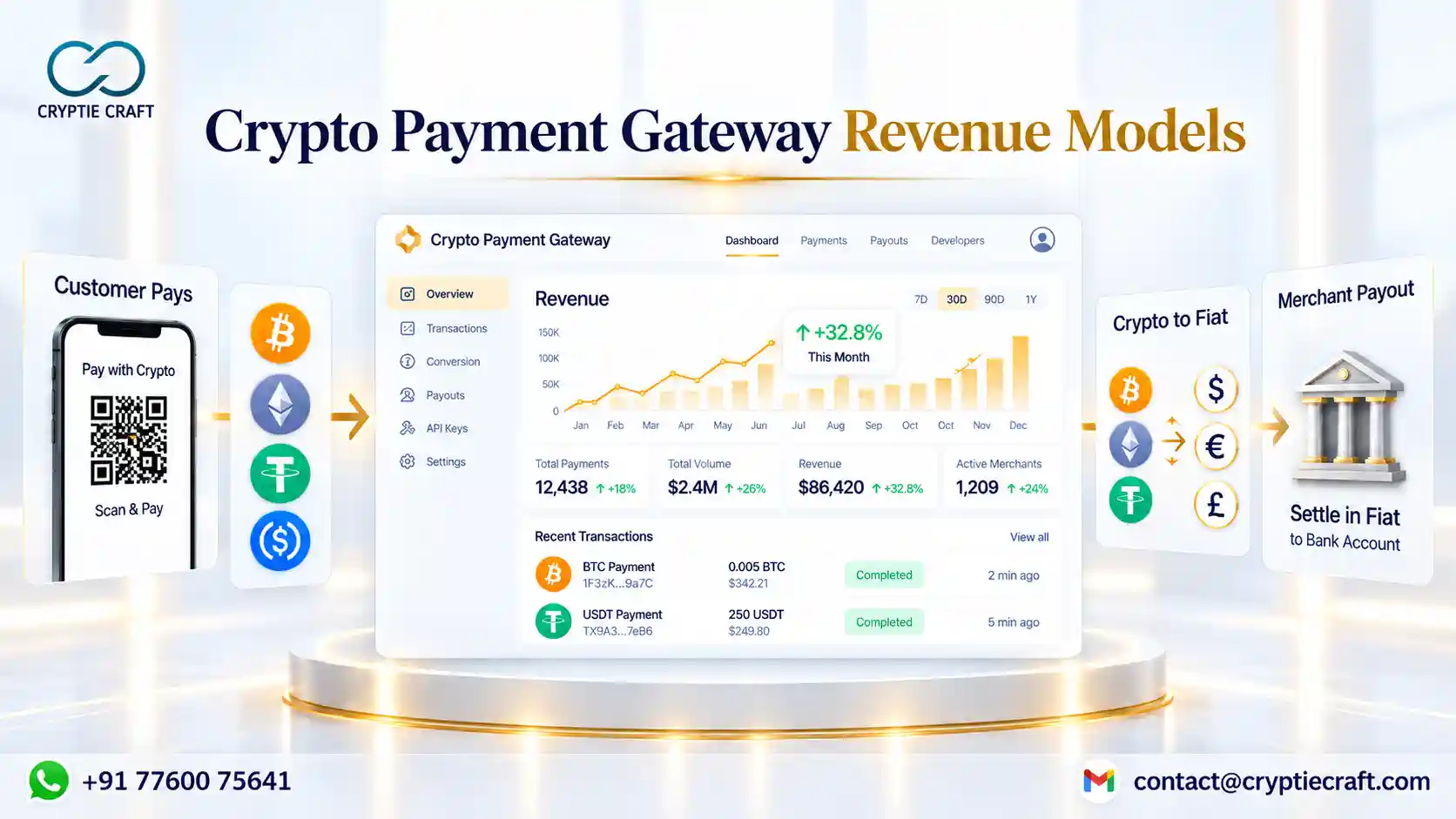
A crypto payment gateway can generate revenue at several stages of the payment process, not just when a merchant receives a payment. The main crypto payment gateway revenue models include transaction processing fees, crypto-to-fiat conversion charges, merchant subscriptions, settlement fees, API services, white-label licensing, onboarding fees, and premium payment services.
How much a gateway can earn depends on factors such as transaction volume, merchant type, supported currencies, settlement options, and the pricing model used. Some revenue streams grow with payment activity, while others provide predictable recurring income.
This guide explains how crypto payment gateways make money, compares the major revenue models, and shows how to evaluate revenue potential without confusing gross revenue with actual profit.
How Do Crypto Payment Gateways Make Money?
A payment gateway earns revenue by monetizing specific services across the payment lifecycle. Some income is tied directly to payment activity, while other revenue comes from recurring platform access, integrations, or value-added services.
Where Revenue Is Generated in the Payment Flow
A typical flow looks like this:
Customer Payment → Payment Processing → Conversion → Settlement → Merchant Payout
Processing, conversion, and settlement can each create a chargeable service. Revenue outside the transaction flow can come from subscriptions, API access, white-label infrastructure, setup work, or premium merchant tools.
Businesses that want the technical background can first understand how a crypto payment gateway works from checkout through blockchain confirmation and settlement.
Crypto Payment Gateway Revenue Streams at a Glance
| Revenue Model | How Revenue Is Earned | Revenue Type |
| Transaction fees | Fee on processed payments | Usage-based |
| Conversion | Fee or spread on conversion | Usage-based |
| Subscription | Merchant plan | Recurring |
| Settlement | Payout or withdrawal charge | Usage-based |
| API services | Access or integration fee | Usage/recurring |
| White label | Licensing or platform fee | Recurring |
| Setup | Onboarding or implementation fee | One-time |
| Premium services | Paid add-on services | Mixed |
8 Major Crypto Payment Gateway Revenue Models
Crypto Payment Gateway revenue mix should reflect the value a gateway provides, whether through payment activity, software access, integrations, or infrastructure services.
1. Transaction Processing Fees
Transaction processing fees are one of the most direct crypto payment gateway revenue streams. The gateway charges a fee when it successfully processes a merchant payment.
Pricing may use a percentage of transaction value, a flat fee, tiered rates, or volume-based pricing. Percentage pricing grows with transaction value, while flat pricing can make charges easier to forecast. Volume tiers may suit larger merchants. The rate still needs to support gateway costs while remaining competitive.
2. Crypto-to-Fiat Conversion Fees and FX Spreads
Gateways that convert cryptocurrency into fiat can monetize the conversion stage.
A conversion fee is an explicit charge for exchanging one asset into another. An exchange-rate spread is the difference between a reference market rate and the execution rate offered to the merchant. An FX markup may also apply when settlement involves different fiat currencies.
This model is most relevant when merchants prefer to receive fiat instead of the original cryptocurrency. Pricing should be clear because merchants often evaluate the full conversion cost, not just the advertised processing fee.
3. Merchant Subscription and SaaS Plans
A gateway can charge merchants a monthly or annual subscription for continued access to its platform.
Plans may differ by transaction limits, reporting, settlement options, support, API usage, or administrative controls. Higher tiers can support merchants that need more volume or integrations.
Subscription plans create predictable recurring revenue, but each tier should offer enough ongoing value to justify the fixed charge.
4. Settlement, Withdrawal, and Payout Fees
A gateway may charge for merchant withdrawals, fiat settlement, faster payouts, or bulk payout services.
These charges should be separated from blockchain network fees. A network fee pays validators or miners for processing or recording transactions on the underlying blockchain; it is not automatically gateway revenue. Revenue is created only when the provider applies a separate service charge or a clearly disclosed markup.
This model is more relevant to platforms that manage merchant balances, conversion, or payout workflows.
5. API, Integration, and Developer Service Fees
Businesses that embed payment functionality into their own products may pay for API access, higher usage limits, SDK support, webhooks, custom integrations, or enterprise implementation.
API pricing can be recurring, usage-based, or part of a higher merchant plan. Custom integration work can also create one-time implementation revenue.
This model fits B2B platforms, marketplaces, SaaS businesses, and enterprises that need deeper payment connectivity rather than a standard hosted checkout.
6. White-Label Licensing and Sub-Merchant Markups
White-label infrastructure can create revenue for both the technology provider and the operator using the platform.
The provider may charge setup, licensing, or recurring platform fees. A white-label operator may also set merchant pricing above its underlying infrastructure rate. The difference becomes gross markup before operating expenses.
This model can suit PSPs, fintech companies, merchant aggregators, and businesses offering crypto payments under their own brand. Businesses considering this approach should also assess how a white-label crypto payment gateway handles merchant pricing, branding, settlement, and platform control.
7. Setup, Merchant Onboarding, and Customization Fees
Some gateways generate one-time revenue from implementation work performed for merchants.
Charges may cover custom checkout configuration, ecommerce integration, branded payment pages, POS setup, migration, or enterprise deployment. Unlike subscription income, these fees are tied to a specific onboarding or customization task.
They are most defensible when the merchant receives clear implementation value rather than being charged an unexplained entry fee.
8. Premium and Value-Added Payment Services
A gateway can monetize services beyond basic payment acceptance.
Examples include recurring billing, advanced analytics, custom reporting, priority support, treasury tools, compliance-support features, POS capabilities, and specialized payout workflows.
These services can be sold as add-ons or included in higher subscription tiers. Strong premium services solve measurable problems such as manual work, reporting, or settlement complexity.
Crypto Payment Gateway Revenue Models Compared
Crypto Payment Gateway Revenue models differ in predictability, scalability, and dependence on payment volume. Comparing those characteristics helps operators decide where each model belongs in the overall pricing strategy.
| Revenue Model | Predictability | Scalability | Revenue Pattern | Best Fit |
| Transaction fees | Medium | Very High | Usage-based | High-volume gateways |
| Subscription plans | High | High | Recurring | SaaS-style platforms |
| Conversion fees | Medium | High | Usage-based | Fiat settlement services |
| API services | High | High | Usage/recurring | B2B platforms |
| White-label licensing | High | High | Recurring | PSPs and fintechs |
| Setup fees | Low | Medium | One-time | Custom deployments |
Transaction-Based vs Subscription-Based Revenue
Transaction pricing rises and falls with payment activity. It can scale quickly as volume grows, but monthly revenue may vary. Subscription pricing is more predictable, though merchants need enough ongoing value to justify the fixed charge.
Why Hybrid Revenue Models Can Be More Sustainable
A hybrid model combines recurring and usage-based income, such as a monthly platform fee, a lower transaction rate, and selected premium-service charges. This reduces dependence on one revenue source while allowing income to grow with usage.
How to Calculate Crypto Payment Gateway Revenue
A useful revenue estimate combines every monetized service rather than looking at transaction fees alone.
Simple Crypto Payment Gateway Revenue Formula
Crypto Payment Gateway Revenue = Processing Revenue + Conversion Revenue + Subscription Revenue + Settlement Revenue + API/Licensing Revenue + Other Service Revenue
The mix changes by business model. A transaction-led gateway may depend mainly on payment volume, while a SaaS or white-label platform may receive a larger share from subscriptions, licensing, or API access.
Example Revenue Calculation
Assume a gateway processes $1,000,000 in monthly payment volume and uses an illustrative 0.75% processing fee.
Processing revenue = $1,000,000 × 0.75% = $7,500 per month
If the same gateway earns another $2,000 from merchant subscriptions and $1,500 from API or settlement services, its illustrative monthly gross revenue becomes $11,000.
These figures are examples, not standard industry rates. Actual pricing varies by provider, merchant profile, transaction volume, supported assets, and settlement structure.
Gross Revenue vs Net Profit
Gross revenue is income before expenses. Net profit is what remains after operating costs.
When assessing a gateway opportunity, businesses should compare projected income with development and ongoing operating expenses. The cost to develop a crypto payment gateway can also vary based on features, integrations, blockchain support, security, and customization.
What Affects Crypto Payment Gateway Profitability?
Profitability depends on how efficiently a gateway converts payment activity into margin after direct and operating costs are paid.
Transaction Volume and Pricing Efficiency
Higher payment volume can increase fee income, but volume alone does not guarantee stronger margins. The effective take rate, merchant pricing, average transaction size, and negotiated enterprise discounts all influence how much revenue the gateway retains.
Settlement, Liquidity, and Network Costs
Crypto-to-fiat conversion, liquidity access, blockchain fees, off-ramp services, and settlement methods can change the cost of delivering a payment. Supporting additional networks or payout options can add value, but each one should be assessed against its operational cost.
Compliance, Security, and Infrastructure Costs
Cloud infrastructure, wallet security, transaction monitoring, compliance operations, technical support, and maintenance also affect net profit. A sustainable model should price services after the full delivery cost is understood, not simply copy a competitor’s headline transaction rate.
Which Revenue Model Is Best for Different Crypto Payment Businesses?
There is no universal model for every gateway. The best structure depends on what the business sells, who its merchants are, and how much operational responsibility the platform takes on.
Startups and New Payment Gateways
New gateways usually benefit from simple pricing. Transaction-based pricing can lower the entry barrier, while a subscription or hybrid model may work when the platform includes ongoing tools or support. Validate merchant demand before adding complex tiers.
PSPs and White-Label Payment Providers
Payment service providers and white-label operators can combine platform fees, licensing, API charges, and sub-merchant markups.
This approach works well when the business provides payment infrastructure to multiple merchants, brands, or resellers and needs revenue at both the platform and merchant-service levels.
Enterprise and Cross-Border Payment Platforms
Enterprise platforms may use volume-based pricing, API plans, stablecoin settlement, conversion services, treasury tools, and payout features.
Pricing should reflect transaction scale, settlement complexity, integration requirements, and negotiated service levels rather than one standard fee.
How Trends Are Changing Crypto Payment Gateway Revenue Models
As payment infrastructure matures, gateway operators need to adapt what they monetize and how transparently services are priced.
Stablecoin-First Payment and Settlement Models
Stablecoins are becoming more relevant to settlement and cross-border payment infrastructure because they can reduce exposure to crypto price volatility while keeping value on blockchain rails.
According to Visa’s stablecoin settlement data, stablecoin settlement volume surpassed a $20 billion annualized run rate in September 2026.
For gateway operators, stablecoin adoption can expand opportunities around processing, conversion, settlement, payouts, and treasury services.
White-Label and Embedded Crypto Payment Infrastructure
PSPs, fintech platforms, and merchant service providers can add crypto payment capabilities under their own brand without developing every infrastructure layer internally.
That creates room for licensing, API access, sub-merchant pricing, and specialized settlement services while allowing the operator to focus on merchant acquisition and service delivery.
Transparent Pricing and Pressure on Hidden Fees
Merchants need to understand the full cost of accepting and settling crypto, not only the advertised processing rate.
Effective merchant cost = Processing fee + Conversion cost + Network cost + Settlement or payout cost
Separating those components clearly makes pricing easier to compare and reduces confusion between provider revenue and third-party or blockchain costs.
How to Choose a Sustainable Crypto Payment Gateway Revenue Model
A sustainable model should generate enough revenue to support the service without making pricing difficult for merchants to understand.
Validate Unit Economics Before Finalizing Pricing
Estimate what it costs to process, convert, settle, secure, monitor, and support the service. Pricing should leave room for a sustainable margin after those costs rather than being based only on competitor rates.
Balance Recurring and Usage-Based Revenue
Combining recurring platform income with usage-based charges can reduce dependence on transaction volume alone. The mix should match the value merchants receive and the gateway’s actual cost structure.
Keep Merchant Pricing Transparent
Merchants should know what they are paying for and when each charge applies. Clear pricing supports easier comparison, better forecasting, and stronger trust.
If the selected model requires merchant tiers, custom fee rules, automated settlement, white-label controls, or API-based monetization, those requirements should be defined before beginning crypto payment gateway development.
Why Choose Cryptiecraft for Crypto Payment Gateway Development?
Cryptiecraft provides end-to-end crypto payment gateway development services for startups, fintech companies, payment service providers, ecommerce businesses, and enterprises planning to launch or upgrade a crypto payment solution. We develop custom and white-label gateways with crypto and stablecoin payment support, merchant dashboards, wallet integration, crypto-to-fiat settlement options, API and SDK integration, multi-chain support, transaction monitoring, and administrative controls. Every solution can be tailored around the target market, merchant requirements, supported currencies, settlement flow, branding, and preferred revenue model.
Whether you are launching a new gateway, adding crypto payments to an existing platform, or building a white-label payment product, Cryptiecraft can develop the infrastructure around your transaction flow, merchant pricing, integrations, security controls, and scalability requirements. Define the business model first, then build the payment architecture needed to support it.
Talk to Cryptiecraft about your crypto payment gateway development requirements and plan a solution around your business model.
Frequently Asked Questions
Q1. How do crypto payment gateways make money?
Ans: Crypto payment gateways earn through transaction fees, conversion charges, subscriptions, settlement fees, API services, white-label licensing, onboarding fees, and premium merchant services.
Q2. What is the most common crypto payment gateway revenue model?
Ans: Transaction-based pricing is one of the most common models because gateways earn from processed payments, often alongside subscriptions, conversion fees, or premium services.
Q3. How much do crypto payment gateways charge per transaction?
Ans: Transaction fees vary by provider, payment volume, supported currencies, settlement method, and merchant profile. Businesses should compare current provider pricing before choosing a gateway.
Q4. Are crypto payment gateways profitable?
Ans: Crypto payment gateways can be profitable when pricing, payment volume, merchant retention, and operating costs are managed effectively, but profitability depends on the business model.
Q5. What is the difference between a transaction fee and a blockchain network fee?
Ans: A gateway transaction fee pays for payment services, while a blockchain network fee compensates validators or miners for processing transactions on the underlying network.
Q6. How do crypto payment gateways earn from crypto-to-fiat conversion?
Ans: Gateways can earn through conversion fees, exchange-rate spreads, or FX markups when cryptocurrency payments are converted into fiat currency for merchant settlement.
Q7. Is a subscription or transaction fee model better for a crypto payment gateway?
Ans: Transaction pricing scales with payment activity, while subscriptions offer predictable recurring income. A hybrid approach can combine both when merchants receive ongoing platform value.
Q8. How do white-label crypto payment gateways make money?
Ans: White-label gateways can earn through platform licensing, recurring fees, setup charges, API services, and sub-merchant markups applied above underlying infrastructure costs.