Binance Clone Script
 KuCoin Clone Script
 Bybit Clone Script
 Kraken Clone Script
 OKX Clone Script
 ERC-20 Token Development
 TRC-20 Token Development
 BEP-20 Token Development
 Crypto Token Development
 ICO Development
 STO Development
 Binance NFT Clone
 OpenSea Clone Script
 Rarible NFT Clone
 NFT Marketplace Development
 MetaMask Clone Script
 Trust Wallet Clone Script
 Crypto Wallet Development
 DeFi Wallet Development
 Uniswap Clone Script
 PancakeSwap Clone
 SushiSwap Clone
 Crypto Payment Gateway
 Binance Pay Clone
 Crypto MLM Software
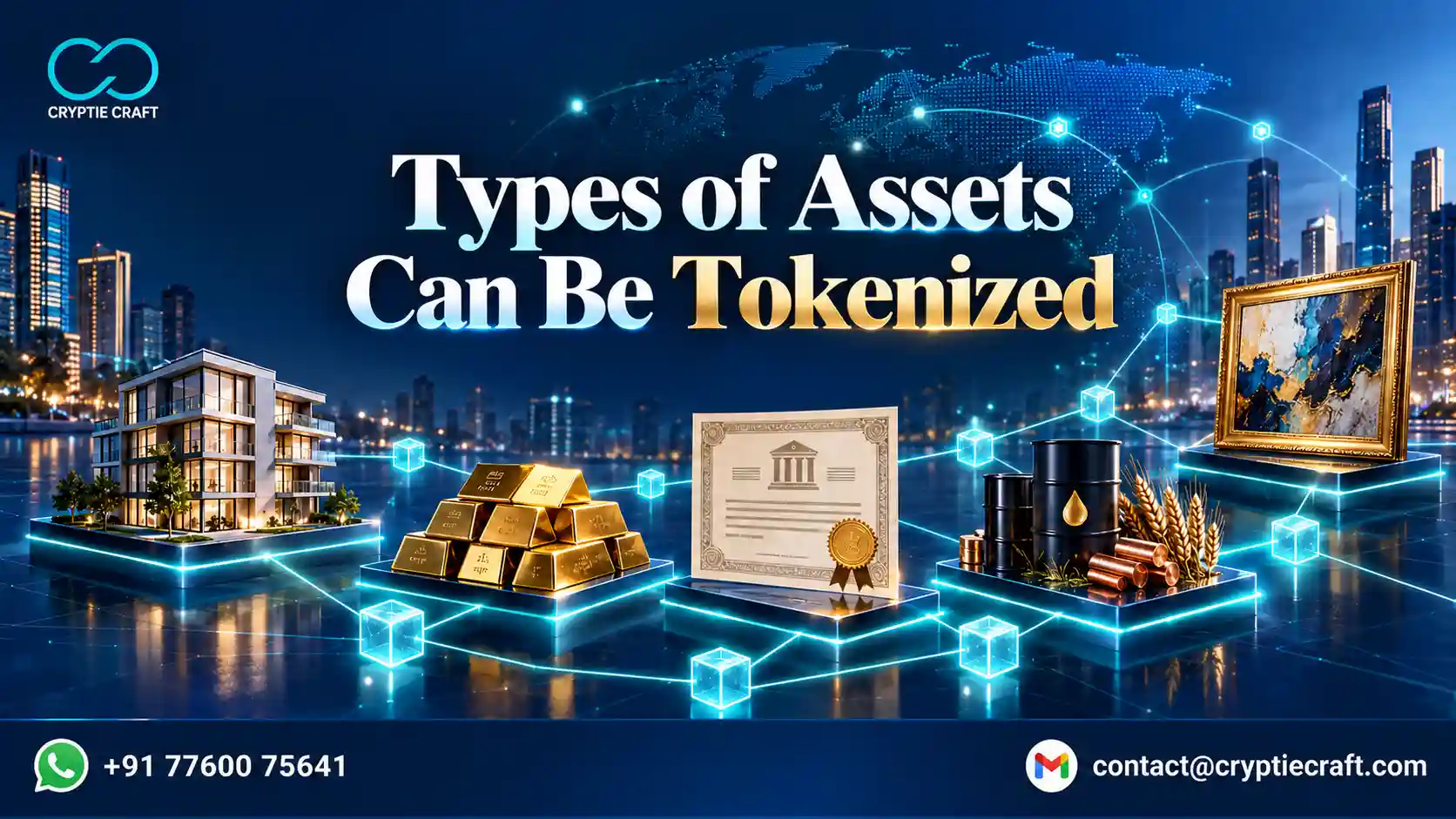
Real estate, government bonds, gold, private loans, and music royalties have different financial characteristics. Yet each can be represented through blockchain tokens, provided the underlying rights and supporting arrangements are properly established.
The commercial opportunity varies by asset. Property can generate rental income, bonds carry repayment obligations, and intellectual property may produce licensing revenue.
Understanding the types of tokenized assets helps businesses identify which assets can support a practical tokenization project.
Types of Tokenized Assets
An asset can be represented on a blockchain when its underlying ownership, financial claim, or contractual rights can be clearly established. The types of assets that can be tokenized extend across physical property, financial instruments, and intangible rights.
1. Real Estate
Real estate tokenization allows property-related interests to be represented through blockchain tokens. Eligible assets may include residential buildings, commercial properties, rental apartments, and land.
A commercial building, for example, could be held by a company that issues tokens representing defined interests in that entity. Investors would receive the rights established in the relevant agreements rather than automatically becoming registered property owners.
2. Gold, Silver, Precious Metals
Precious metals are suitable for tokenization when their quantity, quality, and storage arrangements can be independently documented.
Tokenized gold commonly uses a defined relationship between circulating tokens and gold held in professional vaults. Other metals, including silver and platinum, may use similar arrangements.
One operating example is Pax Gold (PAXG), where each token represents one fine troy ounce of allocated gold.
For issuers, the essential requirements include reliable custody records, metal identification, and clear redemption arrangements. These determine how the digital tokens remain connected to physical reserves.
3. Agricultural Commodities, Industrial Materials
Grain, coffee, cotton, crude oil, and industrial metals can support commodity-linked tokens when their underlying inventories or contractual claims are clearly identified.
Unlike tokenized precious metals, these commodities may involve varying grades, delivery locations, storage conditions, and quality standards.
Consider a warehouse holding an approved quantity of coffee. Tokens could represent documented claims linked to that inventory, provided the warehouse records and commercial agreements support the arrangement.
Tokenized commodities can serve inventory financing, commodity investment products, and trade settlement applications. Their design must account for the specific obligations associated with the underlying goods.
4. Art, Collectibles
Paintings, sculptures, rare watches, and valuable collectibles can be associated with digital tokens representing defined ownership interests or contractual economic rights.
A gallery holding a valuable painting might establish an investment structure allowing several participants to acquire interests connected to that artwork.
Unlike standardized financial instruments, collectibles often require specialist authentication and individual appraisals. Their value may also depend heavily on provenance, physical condition, and collector demand.
5. Government Bonds, Treasury Bills
Government securities are an important category within financial asset tokenization. Treasury bills and sovereign bonds can be represented through blockchain-based securities or investment structures linked to those instruments.
These products typically involve defined maturity dates, repayment obligations, and financial terms.
The tokenization arrangement matters. Investors might hold a directly issued government security, a custodial entitlement, or units in a fund that invests in government debt.
These structures are not interchangeable. A token linked to a Treasury investment fund does not necessarily give its holder direct ownership of the Treasury bills within the fund.
6. Corporate Bonds
Companies can issue debt instruments using blockchain-based ownership records, subject to applicable securities requirements.
Tokenized bonds may incorporate information about principal amounts, interest obligations, maturity dates, and eligible investors.
For example, a company financing an expansion project could issue a bond represented through digital tokens. The bond terms would establish the repayment obligations and investor entitlements.
Unlike equity tokens, corporate bond tokens generally represent creditor claims rather than company ownership.
7. Public Equities, Private Equity
Company shares can be represented as tokens when the applicable legal and securities arrangements permit it.
Tokenized equities may involve shares issued directly through blockchain-based records or interests connected to shares held by an intermediary.
Private equity tokenization can involve ownership interests in privately held companies or investment vehicles. Such structures may require shareholder approvals, investor eligibility checks, and restrictions on transfers.
A startup raising capital through tokenized equity must still determine what ownership or economic rights investors receive.
Digital representation changes how an eligible interest is recorded or transferred; it does not eliminate the company’s existing legal obligations.
8. Investment Funds, Money Market Funds
Investment funds can represent eligible fund shares through blockchain tokens while continuing to manage their underlying portfolios under the fund’s established rules.
This category includes private investment funds, real estate funds, and tokenized money market funds.
A documented example is Franklin Templeton’s BENJI, where one token represents one share of the Franklin OnChain U.S. Government Money Fund.
For fund managers, tokenization can support blockchain-based shareholder records and permitted share transfers.
9. Private Credit, Trade Receivables
Businesses regularly hold financial claims that have value before repayment is received. These include commercial loans, approved invoices, and trade receivables.
Tokenized private credit can represent eligible interests in individual loans or lending portfolios, depending on the financing structure.
Consider a supplier awaiting payment on several verified invoices. A financing arrangement could issue tokens linked to defined receivable claims, allowing eligible investors to participate in the financing.
Unlike physical asset tokenization, the key supporting evidence involves loan agreements, payment schedules, borrower obligations, and enforceable claims rather than physical custody.
Borrower creditworthiness remains an important consideration.
10. Intellectual Property, Royalties
Patents, copyrights, licensing agreements, and certain royalty entitlements can support tokenization when the associated rights are legally transferable or can be assigned through an appropriate agreement.
Intellectual property tokenization does not always involve transferring ownership of the original patent or copyright.
A music publisher, for example, could structure tokens around a specified share of royalties generated by selected recordings.
Similarly, a patent holder might create a financing arrangement linked to licensing income.
These projects require clear agreements defining the revenue covered, its calculation, payment obligations, and the duration of the token holder’s entitlement.
11. Infrastructure, Equipment
Infrastructure-related tokenization can involve interests connected to renewable energy installations, transport facilities, industrial machinery, and leased equipment.
For example, a company operating commercial solar installations could structure an investment offering linked to a project-owning entity or defined contractual payment claims.
Equipment leasing businesses may also consider tokenizing eligible financial interests associated with machinery or vehicle fleets.
The distinguishing feature is that the underlying asset often requires active management, maintenance, insurance, and operational supervision.
12. Carbon Credits, Environmental Certificates
Carbon credits and renewable energy certificates are identifiable environmental instruments that may be represented through blockchain tokens when the underlying registry and applicable program rules permit it.
These instruments differ from physical commodities because their validity depends on recognized issuance records and specific environmental claims.
Tokenized carbon credits must remain connected to eligible underlying credits. Registry status is particularly important when a credit is transferred, cancelled, or retired.
Issuers need arrangements that prevent the same environmental claim from being used more than once. Blockchain records alone cannot establish the environmental validity of the underlying certificate.
13. Tokenized Money, Bank Deposits
Monetary claims can also be recorded through blockchain tokens. Two important examples are fiat-backed stablecoins and tokenized bank deposits.
A fiat-backed stablecoin is generally issued under an arrangement involving specified reserves and redemption terms. A tokenized bank deposit represents a deposit liability of the issuing bank.
Although both may reference the same currency, their issuers, legal structures, and holder claims can differ.
These products are relevant to digital payments, treasury operations, and financial settlement systems. Their requirements depend on the financial institution, applicable regulations, and the terms governing the monetary claim.
What Ownership Does an Asset Token Represent?
Owning a token does not always mean owning the asset behind it. Legal rights depend on the issuance structure, supporting agreements, and applicable laws. Investor.gov’s guidance on tokenized securities distinguishes directly issued securities, custodial interests, and synthetic exposure.
| Token Structure | What the Holder May Receive |
| Direct Ownership | Legally recognized ownership of an asset or security |
| Beneficial Interest | Economic rights through a company, trust, or custodian |
| Debt Claim | Contractual rights to principal and interest payments |
| Revenue Entitlement | A defined share of rental income, royalties, or other proceeds |
The key document is the agreement establishing the holder’s rights. Blockchain records identify token transactions, but they do not independently establish ownership under property or securities law.
How Can Tokenized Assets Generate Returns?
The financial return from a tokenized asset depends on the income or value generated by the underlying investment. Tokenization changes how an eligible interest is recorded or managed, but it does not create additional earnings.
Rental Income
A tokenized property investment may distribute part of the rental income after maintenance expenses, management fees, and other obligations are deducted.
Interest Payments
Government bonds, corporate debt, and private credit investments may provide interest payments under their contractual terms. Repayment of principal is separate from investment income.
Dividends and Royalties
Equity investments may distribute company profits, while royalty-linked tokens can provide payments generated by music, patents, or licensing agreements.
Asset Appreciation
Gold, artwork, and other collectibles may generate returns when their value increases and the investment is sold. They do not necessarily produce regular income.
For issuers, investor returns should also be distinguished from business revenue earned through issuance, administration, or transaction fees. Actual distributions depend on the token’s terms, expenses, and underlying asset performance.
What Affects the Value of Tokenized Assets?
The value of a tokenized asset depends on the underlying asset, the rights attached to the token, and the price buyers are willing to pay. These figures may differ, even when the asset has a verified market value.
For illustration, consider a commercial property valued at $5 million. If tokens represent interests in the property-owning company, their value must account for outstanding debt, expenses, and the rights assigned to investors. The property’s appraisal alone cannot determine the price of each token.
Different asset classes also require different valuation methods.
| Asset Category | Main Valuation Basis |
| Real Estate | Property appraisal and outstanding liabilities |
| Gold | Market price and specified metal quantity |
| Investment Funds | Net asset value of fund shares |
| Private Credit | Expected repayments and borrower credit risk |
Secondary-market prices can also reflect liquidity, redemption conditions, and transaction costs. An asset’s assessed value is not a guaranteed selling price for its tokens.
Can Tokenized Assets Be Sold or Redeemed?
Holding a token does not guarantee that it can be converted into cash whenever the investor chooses. The available exit options depend on the asset agreement, applicable regulations, and market demand.
- Token Transfer: Ownership or control of the token moves between eligible wallets. This does not necessarily involve a payment or legally transfer the underlying asset.
- Secondary-Market Sale: An investor sells tokens to another buyer through a permitted trading venue or private transaction. Execution depends on buyer demand, transfer restrictions, and available liquidity.
- Redemption: The holder returns or surrenders tokens to receive cash or an underlying asset according to the issuer’s agreed terms.
Consider a tokenized corporate bond. An investor may sell it before maturity if an eligible buyer is available. Otherwise, the investor may need to retain the bond until repayment becomes due.
The ability to transfer a token is different from having a reliable market in which to sell it.
How to Select an Asset for Tokenization
Some real-world assets that can be tokenized still lack dependable valuations or enforceable investor claims. A viable offering requires reliable records, workable administration, and evidence of demand. Consider two potential projects.
Project A: Gold-Backed Tokens
A gold issuer must reconcile allocated vault inventory with the claims represented by outstanding tokens.
Project B: Private Credit Tokens
A private-credit issuer needs loan-servicing data because outstanding claims change as borrowers repay, default, or restructure.
Before selecting an asset, evaluate four questions:
- Ownership: Are the asset and associated rights legally documented?
- Verification: Can the supporting records be independently checked?
- Administration: Can the issuer maintain accurate records throughout the investment?
- Demand: Is there a credible investor audience for the proposed offering?
Asset records and payment obligations shape the asset-backed token development work required before issuance.
Real-World Asset Tokenization Development Services by Cryptiecraft
Cryptiecraft develops blockchain-based tokenization solutions for real estate, commodities, financial instruments, and other eligible assets. Each project requires software that reflects the asset’s legal structure, investor rights, and operational requirements.
Our RWA tokenization platform development services cover token issuance controls, investor management, asset records, and transaction reporting. The development scope depends on the assets involved and how the offering will operate.
Discuss your asset category and project requirements with Cryptiecraft to identify the software capabilities needed for your tokenization business.
Frequently Asked Questions
Q1. Can a property with an existing mortgage be tokenized?
Ans: Yes, if mortgage terms and local laws permit the proposed structure. Existing lender rights remain enforceable, and consent may be needed before issuing property-linked investment tokens.
Q2. Can businesses tokenize unpaid invoices?
Ans: Yes. Verified unpaid invoices can support tokenized receivable financing when contractual assignment is permitted. Issuers must confirm debtor obligations, existing liens, and who collects payments.
Q3. Can future music royalties be tokenized?
Ans: Yes. Future music royalties can support tokens when enforceable contracts define the revenue rights being assigned. Payments remain uncertain because the recordings may generate little income.
Q4. Can one asset support different classes of tokens?
Ans: Yes. One asset can support token classes with different payment priorities or voting rights. Issuers must define each claim, its priority, and the legal limits on issuance.
Q5. Can tokenized company shares carry voting rights?
Ans: Yes, when the tokens represent shares carrying voting rights under company law and offering terms. Tokens providing only price exposure or contractual payments may offer none.
Q6. What happens if the physical asset backing a token is damaged or lost?
Ans: Damage or loss can reduce token value or interrupt payments. Insurance, custody agreements, and token terms determine whether holders can claim compensation or bear the loss.