Binance Clone Script
 KuCoin Clone Script
 Bybit Clone Script
 Kraken Clone Script
 OKX Clone Script
 ERC-20 Token Development
 TRC-20 Token Development
 BEP-20 Token Development
 Crypto Token Development
 ICO Development
 STO Development
 Binance NFT Clone
 OpenSea Clone Script
 Rarible NFT Clone
 NFT Marketplace Development
 MetaMask Clone Script
 Trust Wallet Clone Script
 Crypto Wallet Development
 DeFi Wallet Development
 Uniswap Clone Script
 PancakeSwap Clone
 SushiSwap Clone
 Crypto Payment Gateway
 Binance Pay Clone
 Crypto MLM Software
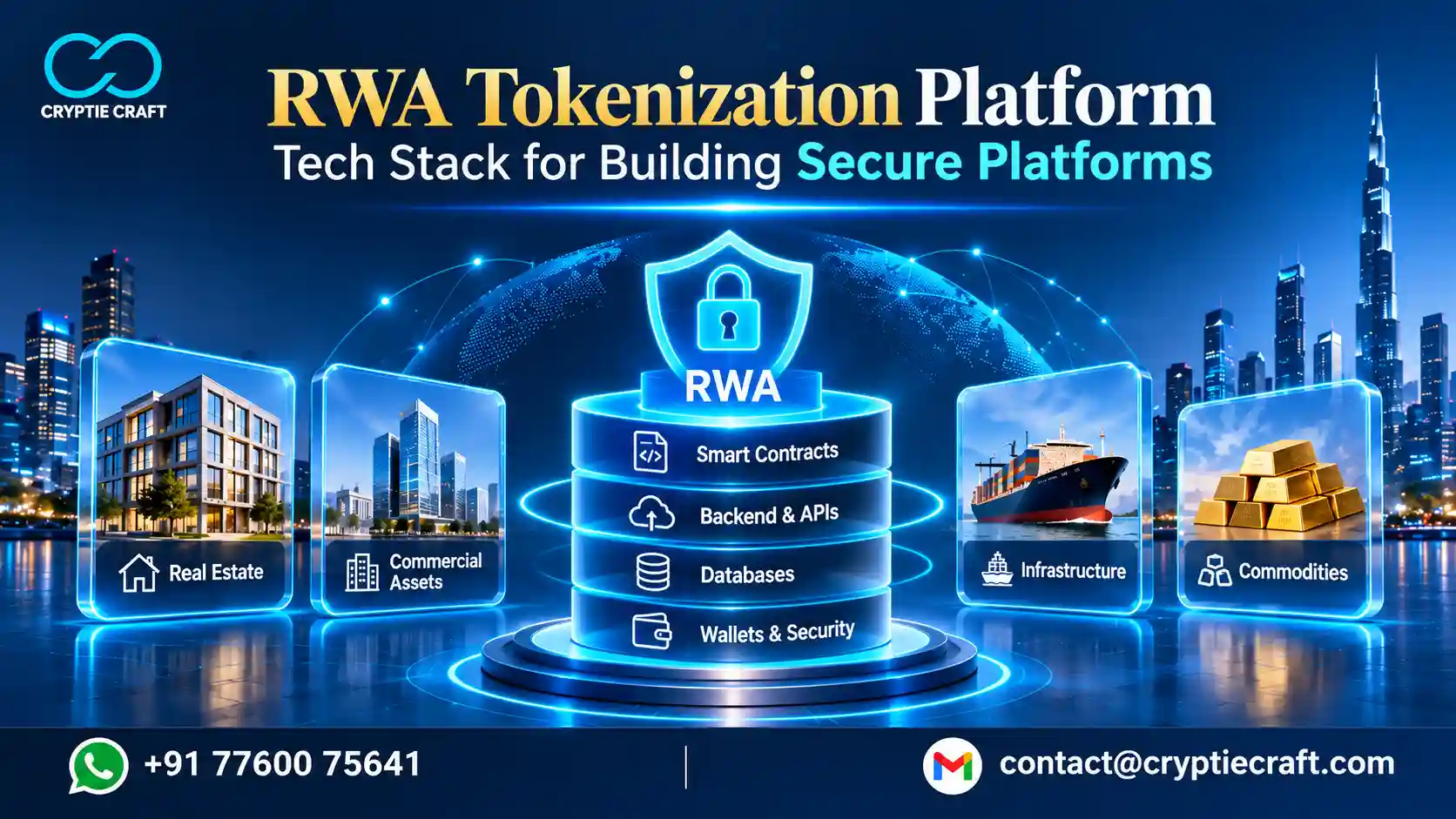
A digital token can represent an interest in commercial property, gold, or another real-world asset. However, creating the token is only one part of real-world asset tokenization. A functioning platform also needs technology to manage asset records, verify investors, process transactions, and maintain ownership information.
Choosing the right RWA Tokenization Platform Tech Stack involves more than selecting a blockchain. Smart contracts, backend frameworks, databases, wallets, APIs, and cloud infrastructure must work together to support the platform’s asset model and operational requirements.
This guide examines the essential technologies, blockchain networks, token standards, and development tools used in RWA tokenization platforms.
Understanding the Technology Behind RWA Tokenization
An RWA tokenization platform connects real-world assets with blockchain-based digital tokens. Smart contracts manage token operations, while application systems handle investor information, asset records, and external integrations.
The technology generally supports three connected functions.
- Asset information management stores property details, ownership documents, commodity records, and supporting information.
- Token management handles issuance, transfers, and transaction records through smart contracts.
- Platform integration connects investor verification, digital wallets, payment services, and external asset data.
One important distinction is that creating a token does not automatically establish legal ownership of an underlying asset. The rights represented by the token must be supported by appropriate legal agreements and asset management arrangements.
Core Technologies Used in RWA Tokenization Platform Development
An RWA tokenization platform combines application technologies with blockchain infrastructure. Each component has a specific responsibility within the platform architecture.
1. Smart Contract Development Technologies
Smart contracts control the processes involved in creating, transferring, and managing blockchain-based tokens. They can also enforce investor eligibility, transfer conditions, and other predefined rules.
Common development technologies include:
- Solidity supports smart contract development across Ethereum and EVM-compatible platforms.
- Rust for Solana program development.
- OpenZeppelin for reusable smart contract components.
- Hardhat and Foundry for contract development, testing, and deployment.
For example, a permissioned property token can use smart contract rules to restrict transfers to eligible wallet addresses. The contract may also support token issuance, burning, pausing, and other administrative functions, depending on the implementation.
Developers should test access controls, transfer restrictions, upgrade mechanisms, and failure conditions before deploying contracts that manage valuable assets.
Official development references are available in the Ethereum developer documentation and OpenZeppelin documentation.
2. Backend Development Frameworks
The backend connects the platform interface with smart contracts, databases, and external services. It manages investor accounts, asset listings, transaction requests, and verification records.
| Technology | Common application |
| Node.js | Server-side application development |
| NestJS | Structured backend services |
| Express.js | API development |
| Python | Data processing and application services |
| FastAPI | API development |
Node.js with NestJS or Express.js is suitable for JavaScript-based applications. Python frameworks are another option when the platform requires specific data processing capabilities.
3. Frontend Development Frameworks
The frontend is the interface used by investors and administrators. It displays tokenized assets, investment information, wallet balances, and transaction history.
- React.js supports interactive investor dashboards.
- Next.js provides routing and server rendering features.
- Angular offers a structured framework for larger applications.
- TypeScript helps maintain consistent code and identify development errors.
The selection depends on the interface requirements and the development team’s preferred framework.
4. Database Management Systems
Databases store application information that does not need to be recorded directly on a blockchain.
| Database | Common application |
| PostgreSQL | Investor profiles and structured records |
| MongoDB | Flexible asset information |
| Redis | Caching and temporary application data |
PostgreSQL is a practical choice for structured investor information, asset records, and transaction references. The application should also reconcile its records with confirmed blockchain transactions.
5. KYC/AML Integration Technologies
RWA platforms may need to verify investors before allowing them to participate in specific asset offerings. KYC and AML tools assist with verifying identities and handling compliance requirements.
Common requirements include identity verification, sanctions screening, business verification, investor eligibility checks, and wallet allowlisting.
Providers such as Sumsub, Veriff, and Persona offer services that can be integrated through APIs. The appropriate provider depends on the platform’s target markets and verification requirements.
6. Blockchain Oracle Integration
Smart contracts cannot directly access information stored outside their blockchain network. Blockchain oracles connect them with off-chain data such as asset prices, reserve information, valuation updates, and other relevant records.
Chainlink provides oracle services that can deliver supported external information to smart contracts, including asset prices, reserve information, and other financial data.
For example, a gold-backed token platform may use a suitable Proof of Reserve feed to compare reported reserves with token supply. However, an oracle does not independently prove that a physical asset exists or that a custodian legally controls it. The reliability of the result depends on the underlying custodian records, data providers, verification methodology, and feed configuration.
Before integrating an oracle, developers should evaluate its data sources, update frequency, network availability, and suitability for the specific asset.
Chainlink’s Proof of Reserve documentation explains how reserve data can be delivered on-chain. Its data feed quality guidance also highlights the importance of assessing data sources and feed-specific risks.
7. Crypto Wallet Integration
Wallets allow investors to connect their blockchain accounts, receive tokens, and approve transactions.
| Wallet technology | Purpose |
| MetaMask | EVM-compatible wallet connection |
| WalletConnect | Connection to supported mobile and desktop wallets |
| MPC wallets | Distributed management of digital asset keys |
| Multisignature wallets | Multiple approvals for selected transactions |
Institutional platforms may also require custody services and additional transaction approval controls.
8. Cloud Infrastructure Tools
Cloud infrastructure hosts the application, databases, APIs, and supporting services.
Cloud platforms such as AWS, Microsoft Azure, and Google Cloud support computing and storage requirements. Docker creates containers for applications, Kubernetes manages those containers, and CI/CD tools streamline software testing and deployment.
The infrastructure should support application availability, backups, monitoring, and future growth.
Best Blockchain Networks for RWA Tokenization
Blockchain selection affects smart contract compatibility, transaction processing, network access, and infrastructure requirements. Four options worth evaluating are Ethereum, Polygon, Solana, and Hyperledger Besu.
An important distinction is the difference between public and private permissioned networks. Public networks allow broad participation in reading and submitting transactions, while private networks restrict participation to approved nodes or organizations.
A permissioned token does not necessarily require a private blockchain. An RWA platform can use a public network while applying smart contract rules that restrict which investors can receive or transfer tokens. Network access and token transfer permissions are two separate technical decisions.
Ethereum
Ethereum has an established smart contract ecosystem and supports Solidity development. Its token standards, including ERC-20 and ERC-3643, make it relevant to applications requiring programmable token rules and permissioned transfers.
Polygon
Polygon supports EVM-compatible development and familiar Ethereum tools. It can be considered when an application needs compatibility with the Ethereum development ecosystem and alternative transaction options.
Solana
Solana uses Rust-based development tools and supports high transaction throughput. Its Token-2022 extensions include features such as transfer hooks, which allow custom program logic to execute during token transfers. These can support selected transfer controls and other application-specific rules.
Hyperledger Besu
Hyperledger Besu is an Ethereum client that supports public and private network configurations. Its private network capabilities can suit enterprise applications that require controlled network participation and governance.
| Blockchain | Key consideration |
| Ethereum | Established smart contract ecosystem |
| Polygon | EVM compatibility |
| Solana | High transaction throughput |
| Hyperledger Besu | Private network support |
The best blockchain for RWA tokenization depends on token functionality, network access, transaction requirements, and the development environment.
Smart Contract Standards for Real-World Asset Tokenization
Token standards define how digital assets behave on a blockchain. The right choice depends on whether the asset requires interchangeable units, investor restrictions, or unique token identification.
ERC-20
ERC-20 supports interchangeable tokens. It can represent equal units of an asset related interest when the offering follows a fungible token model.
ERC-3643
ERC-3643 is designed for permissioned tokens. It builds on ERC-20 functionality and introduces components such as an Identity Registry, Trusted Issuers Registry, Claim Topics Registry, and Compliance contract.
During a transfer, the system can check whether the recipient has the required verified identity claims and whether the transaction satisfies the token’s compliance rules. This makes ERC-3643 suitable for RWA offerings that require investor eligibility checks, jurisdiction restrictions, or holding limits.
Unlike a private blockchain, ERC-3643 controls who can hold or receive a token. The underlying network can still be public, depending on the platform architecture.
The ERC-3643 specification describes its interfaces and transfer validation requirements.
ERC-1400
ERC-1400 is a security token standard framework that supports features such as partitions and transfer restrictions. It can be considered for digital securities with specific ownership and transfer conditions.
ERC-721 and ERC-1155
ERC-721 represents individually identifiable tokens, while ERC-1155 supports multiple token types within one contract. They may be useful when a platform needs distinct digital representations of assets.
| Standard | Main functionality | Potential application |
| ERC-20 | Interchangeable tokens | Fungible asset interests |
| ERC-3643 | Identity-based transfer controls | Permissioned RWA tokens |
| ERC-1400 | Security token functionality | Tokenized securities |
| ERC-721 | Unique token identification | Individual asset representation |
| ERC-1155 | Multiple token types | Mixed digital asset collections |
The standard should match the rights represented by the token, investor eligibility rules, and transfer conditions. A token standard alone does not establish legal ownership of an underlying asset.
Essential APIs and Development Tools for RWA Platforms
APIs connect an RWA application with blockchain networks and external services. Their roles differ according to the integration requirement.
- Blockchain connectivity: Alchemy, Infura, and QuickNode provide RPC infrastructure for communicating with supported blockchain networks.
- Wallet connectivity: WalletConnect and MetaMask SDK help applications connect with compatible investor wallets.
- Identity verification: Sumsub, Veriff, and Persona provide APIs for identity checks.
- Oracle integration: Chainlink connects smart contracts with supported external data sources.
- Contract development: Hardhat, Foundry, and OpenZeppelin support smart contract development, testing, and deployment.
These tools should be evaluated for blockchain compatibility, API capabilities, documentation, pricing, and support requirements.
How to Choose the Right Tech Stack for RWA Tokenization
The right RWA Tokenization Platform Tech Stack depends on the asset model and the platform’s operating requirements. Evaluate these five factors before finalizing the architecture.
- Asset representation: Determine how the platform will record asset information and represent ownership rights.
- Blockchain compatibility: Check support for the required token standards, smart contracts, and transaction model.
- Compliance requirements: Identify investor verification, permissioned transfers, and jurisdiction-based restrictions.
- Integration needs: Evaluate wallet, payment, identity verification, and external data connections.
- Scalability and maintenance: Consider transaction activity, infrastructure costs, upgrades, and future asset support.
For example, a permissioned real estate platform may require ERC-3643, identity verification, and structured asset records. A platform with different transaction requirements may need another blockchain or infrastructure configuration.
For projects targeting regulated markets, also consider the applicable RWA tokenization regulations before finalizing investor permissions and transfer rules.
Recommended Technology Stack for RWA Tokenization Platforms
The following is a practical reference stack for an Ethereum-compatible RWA tokenization platform.
| Platform layer | Suggested technology |
| Blockchain | Ethereum or Polygon |
| Smart contract language | Solidity |
| Token standards | ERC-3643, ERC-20 |
| Contract tools | Hardhat, OpenZeppelin |
| Backend | Node.js, NestJS |
| Frontend | React.js, Next.js |
| Database | PostgreSQL |
| Wallet integration | WalletConnect, MetaMask SDK |
| Identity verification | Sumsub, Veriff |
| Oracle integration | Chainlink |
| Cloud infrastructure | AWS, Docker |
This combination covers the main application, blockchain, and integration layers. It is a reference architecture rather than a universal solution. Final technology choices should reflect the asset rights, legal structure, target network, and platform requirements.
The architecture also determines which platform services can be offered and how they can be monetized. Depending on the services provided, the RWA tokenization platform revenue model may include transaction fees, subscription plans, asset management fees, or other service charges.
Why Choose Cryptiecraft for RWA Tokenization Platform Development?
Building a reliable RWA tokenization platform requires the right combination of blockchain architecture, smart contract development, asset data management, and investor integration.
At Cryptiecraft, we help businesses plan and develop RWA tokenization platforms around their specific asset models and technical requirements. Our team focuses on selecting suitable blockchain networks, implementing relevant token standards, and integrating the technologies needed to support asset representation and digital ownership management.
Whether you are planning a real estate tokenization platform, a commodity-backed token system, or a digital securities solution, we can help you identify the right technical approach.
Ready to plan your RWA platform? Connect with Cryptiecraft to discuss your project requirements and technology choices.
Frequently Asked Questions
Q1. What is the best technology stack for RWA tokenization platform development?
Ans: A suitable stack may include Ethereum, Solidity, ERC-3643, Node.js, React.js, PostgreSQL, wallet integrations, and identity verification APIs.
Q2. Which blockchain is best for real-world asset tokenization?
Ans: Ethereum is a strong option because of its established smart contract ecosystem, token standards, developer tools, and EVM-compatible infrastructure.
Q3. Is Ethereum or Solana better for RWA tokenization?
Ans: Ethereum offers an established token ecosystem, while Solana supports high transaction throughput. The better choice depends on compliance and platform requirements.
Q4. Which programming languages are used for RWA token development?
Ans: Solidity is used for EVM smart contracts, Rust for Solana programs, and JavaScript, TypeScript, or Python for application development.
Q5. What is the difference between ERC-20 and ERC-3643?
Ans: ERC-20 defines interchangeable tokens, while ERC-3643 adds identity-based eligibility checks and transfer restrictions for permissioned token transactions.
Q6. How do blockchain oracles connect real-world assets with smart contracts?
Ans: Blockchain oracles deliver external information, such as asset prices and reserve data, to smart contracts through supported data sources.